

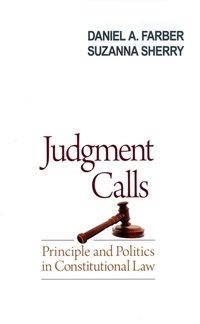
Judgment Calls
Principle and Politics in Constitutional Law
1st Edition
Published on 19. November 2008
218 pages
978-0-19-970781-2 (ISBN)
Description

Judgement Calls tackles one of the most important and controversial legal questions in contemporary America: How should judges interpret the Constitution? Our Constitution contains a great deal of language that is vague, broad, or ambiguous, making its meaning uncertain. Many people believe this uncertainty allows judges too much discretion. They suggest that constitutional adjudication is just politics in disguise, and that judges are legislators in robes who read the Constitution in accordance with their own political views. Some think that political decision making by judges is inevitable, and others think it can be restrained by "strict constructionist" theories like textualism or originalism. But at bottom, both sorts of thinkers believe that judging has to be either tightly constrained and inflexible or purely political and unfettered: There is, they argue, no middle ground.
Farber and Sherry disagree, and in this book they describe and defend that middle ground. They show how judging can be--and often is--both principled and flexible. In other words, they attempt to reconcile the democratic rule of law with the recognition that judges have discretion. They explain how judicial discretion can be exercised responsibly, describe the existing constraints that guide and cabin such discretion, and suggest improvements.
In exploring how constitutional adjudication works in practice (and how it can be made better), Farber and Sherry cover a wide range of topics that are relevant to their thesis and also independently important, including judicial opinion-writing, the use of precedent, the judicial selection process, the structure of the American judiciary, and the nature of legal education. They conclude with a careful look at how the Supreme Court has treated three of the most significant and sensitive constitutional issues: terrorism, abortion, and affirmative action. Timely, trenchant, and carefully argued, Judgment Calls is a welcome addition to the literature on the intersection of constitutional interpretation and American politics.
More details
Other editions
Additional editions
Book
01/2009
Oxford University Press Inc
€48.88
Shipment within 15-20 days
Persons
Daniel A. Farber is the Sho Sato Professor of Law and an adjunct faculty member of the Energy and Resources Group at the University of California, Berkeley. He is also the Faculty Director of the California Center for Environmental Law and Policy (CCELP) at Berkeley. Professor Farber also serves on the editorial board of Foundation Press, and is a member of the American Academy of Arts and Sciences and of the American Law Institute. He is a co-editor of Issues in Legal Scholarship.
Suzanna Sherry is Herman O. Loewenstein Professor of Law at Vanderbilt University Law School. Professor Sherry's work includes two books on constitutional theory, as well as more than 75 articles on such topics as constitutional theory and judicial decision-making, First Amendment law, constitutional history, electoral apportionment, cyberspace law, and state sovereign immunity. She is also a co-author of three legal textbooks.
Content
- Intro
- Contents
- 1 Introduction
- I: The "Problem" of Judicial Review
- 2 The Inevitability of American Judicial Review
- The origins of judicial review
- The unsatisfactory alternatives to judicial review
- The Supreme Court and the states
- 3 The Democracy Worry
- Worries about judicial review
- The countermajoritarian difficulty
- Misguided efforts to escape the countermajoritarian difficulty
- II: Discretion and Judgment
- 4 How to Think About Discretion
- Decision making without recipes
- Discretion, legislative and otherwise
- The administrative analogy
- 5 Reason and Relevance
- The importance of reasoned elaboration
- What arguments are relevant?
- How judges should make value judgments
- The risk of overreaching
- 6 The Anatomy of Judgment
- Judicial reasoning and the common law
- Improving judicial decision making
- III: Precedent as a Safeguard
- 7 Respect for Precedent
- Precedent and the rule of law
- The value of precedent
- Precedent and the modern constitutional order
- 8 Explaining Precedent
- What kinds of precedents?
- What does it mean to follow precedent?
- Does precedent really matter?
- IV: Process Safeguards
- 9 Deliberation and Multiple Decision Makers
- Tiered, multimember courts
- Judicial deliberation
- Other structural supports
- Public scrutiny of judicial opinions
- 10 Transparency
- Failures in transparency
- Arguments against transparency
- 11 Incrementalism
- Incrementalism and school desegregation
- Incrementalism and the First Amendment
- When process fails
- V: Internalized Safeguards
- 12 Professionalism and the Selection Process
- Professional norms
- Judicial selection and politicization
- Some institutional changes
- 13 The Role of the Legal Academy
- Scholarship and popular perception of the courts
- The traces of postmodernism
- The turn toward novelty
- Suggestions for improvement
- VI: Case Studies
- 14 Terrorism
- 15 Abortion
- 16 Affirmative Action
- Closing Words
- Notes
- Bibliographic Essay
- Index
- A
- B
- C
- D
- E
- F
- G
- H
- I
- J
- K
- L
- M
- N
- O
- P
- R
- S
- T
- U
- V
- W
- Y
