

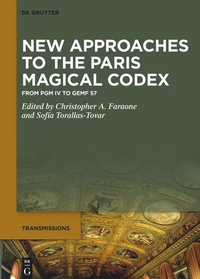
New Approaches to the Great Paris Magical Codex
Description

The Bibliothèque Nationale de France preserves an extraordinary document: a fourth-century CE papyrus codex from Upper Egypt. This handbook is over seventy inscribed pages long and is equivalent in length to four or five normal-sized papyrus rolls. But despite its great size, it contains only fifty-three recipes, many of unusual length and complexity. Our research team on the Transmission of Magical Knowledge project has been studying, re-editing and translating all the magical handbooks from Roman Egypt, and in the process, we have realized that the Paris Codex from Upper Egypt, long understood as the "typical" or "model" handbook of the age, is, in fact, a marvelous outlier in the group. The manuscript was probably never used for the preparation of quotidian magical spells, but rather as a book to be read and to fire the imagination of its readers. We propose in this volume a complete re-assessment of GEMF 57, not only of its materiality, scribal production, and its language, but also of its composition in different blocks coming from divergent exemplars.
The book is distributed into five sections: 1. Materiality of GEMF 57, including codicology, paleography and scribal practice; 2. Language and Rhetoric; 3. Poetry, on the metrical sections; 4. Special sections, including chapters on the Mithras Liturgy, the collapse of Solomon and the Epistolary section; 5. Special topics, on astrology and Egyptian influence.
More details
Other editions
Additional editions
Persons
Content
- Intro
- Preface
- Contents
- List of Contributors
- Introduction
- Appendix A: A Table of Contents for GEMF 57/PGM IV
- Appendix B: The Acquisition and Provenance of GEMF 57
- 1 Materiality
- Chapter 1 The Codicology of GEMF 57
- 1 Introduction
- 2 The Material Production of the Codex
- 3 The Writing and Binding of the Codex
- 4 Problems and Solutions
- 5 Conclusion
- Chapter 2 Hand Variation in GEMF 57
- 1 Introduction
- 2 Writing Styles in GEMF 57
- 2.1 The Formal Mixed Style
- 2.2 The Sloping Pointed Majuscule
- 2.3 Cursive Writing
- 3 Transitioning from Formal to Informal: Inorganic Variation
- 4 Organic Variation
- 4.1 The Coptic Text
- 4.2 Voces Magicae
- 4.3 Homeric Verse
- 5 Conclusion
- Appendix: The Ink of GEMF 57
- Chapter 3 Scribal Practice in GEMF 57
- 1 Introduction
- 2 The Subdivision of GEMF 57/PGM IV
- 3 Scribal Devices
- 4 Block 1 (ll. 1-153
- 1v-3r)
- 5 Block 2 (ll. 154-1389)
- 6 Block 3: 1390-1927 fol. 17r-22r
- 7 Block 4
- 8 Block 5 (ll. 2241-2942/25v-32r)
- 9 Block 6 and the end of the manuscript (ll. 2891-3274/32r-35v)
- 10 Scribal devices in GEMF 57
- 2 Language and Rhetoric
- Chapter 4 Egyptian Linguistic Influence in GEMF 57, Part 1: The Greek Text
- 1 Introduction
- 2 Coptic Dialects
- 3 The Egyptian Language in the Greek Sections of GEMF 57
- 4 Egyptian Vocabulary
- 4.1 Divine and Personal Names
- 4.2 Adjectives, Common Nouns and Pronouns
- 4.3 Egyptian Phrases
- 5 Orthography and Phonemics in GEMF 57
- 6 Conclusions
- Chapter 5 Egyptian Linguistic Influence in GEMF 57, Part 2: The Old Coptic Texts
- 1 Introduction
- 2 Old Coptic
- 3 Overview
- 3.1 Textual Divisions in the Old Coptic of GEMF 57
- 3.2 General Features
- 4 System 1: GEMF 57. 5-93
- 4.1 Text 1: Voces Magicae (ll. 5-8)
- 4.2 Text 2: Acclamation of Osiris for Divination (ll. 11-25)
- 4.3 Text 3: Invocation of the Wooden-Necked One (ll. 76-77 and 81-82)
- 4.4 Text 4: Phylactery against Demons (ll. 86-87):
- 4.5 Text 5: Solar Divination (ll. 91-93)
- 4.6 Summary of System 1
- 5 System 2: GEMF 57.94-153: Isis-Thoth Narrative Love Charm
- 5.1 The Dialect of the Isis-Thoth Narrative Love Charm
- 5.2 The Treatment of the 'H-Sounds'
- 5.3 The treatment of historic ?a
- 5.4 Summary of System 2
- 5.5 Intertextual Relations
- 6 System 3: GEMF 57.1231-1239: Exorcism
- 6.1 The Dialect of the Exorcism
- 6.2 The Religious Background of the Exorcism
- 7 Conclusions
- Chapter 6 Metrical Sections in GEMF 57: Form and Context in Greek Poetics
- 1 Introduction
- 2 Inventory of Metrical Compositions
- 3 General Comments
- 4 Meter and Composition of GEMF 57
- 5 Selection of Meter: Function and Audience
- 6 The Place of GEMF 57 in the History of Meter and Magic
- Chapter 7 Addressing the Gods with Verse and Incense: Hymns and Offerings in GEMF 57
- 1 Introduction
- 2 Hymns in the GEMF
- 3 Material Offerings in the GEMF
- 4 Comparisons with Dionysian Mystery Cult and Traditional Greek Cult
- 5 Cletic Hymns, Cletic Offerings
- 6 Conclusions
- Appendix: Details of Offerings Associated with GEMF Metrical Logoi
- 3 Special Sections and Features
- Chapter 8 Medea, the Magi, and the Memorandum of Aeëtes: Notes on the Mithras Liturgy
- 1 Introduction
- 2 The Structure and Extent of the Mithras Liturgy
- 3 The History of the Mithras Liturgy
- 4 Reading Aeëtes
- 5 Locating Aeëtes
- 6 Medea and Greek Magic
- 7 Aeëtes as Eastern King
- 8 Medea and Aeëtes as Parent-Author and Child-Addressee
- 9 The Chariot of Aeëtes and the Apotheosis of Medea
- 10 Medea the Persian
- 11 On Reading Magical Texts
- Chapter 9 Hybrid Invocations in GEMF 57 and a Lead Curse-Tablet from Hermopolis
- 1 Introduction
- 2 The Hybrid Insomnia-and-Attraction Curse in GEMF 57
- 3 The Hybrid Burning-and-Attraction Curse from on a Lead Tablet from Egypt (SM I 42)
- 4 Conclusion
- Appendix A: The Identity of the "Spirit Driver"
- Chapter 10 The Rhetoric of Secrecy
- 1 Introduction
- 2 Exclusive Group of Secret Sharers
- 3 The family model
- 4 Extraordinary Source of the Secret
- 4.1 Revelation from the Divine
- 4.2 Revelations from the Ancients
- 5 Conclusions
- Chapter 11 Epistolary Magic in GEMF 31 and 57
- 1 Introduction
- 2 Greeting and Farewell Formulae
- 3 The Letter of Pnouthis to Keryx (GEMF 31.43-194)
- 4 The Letter of Nephotes to King Psammetichos (GEMF 57.154-285)
- 5 The Letter of Pitys to King Ostanes (GEMF 57.2006-2125)
- 6 Kings in the Epistolary Texts of GEMF 57
- 7 Secrecy and Epistolary Reading in the Epistolary GEMF Texts
- 8 The Transmission of Epistolary Features
- 8.1 Paragraphoi
- 8.2 The Distinction between Epistolary Frames and Rubrics
- 8.3 Closing Epistolary Frames
- 9 Metanarrative, Materiality, and the Transmission of Magical Texts
- 10 Conclusion
- 4 Influences
- Chapter 12 Astrology and Magic in GEMF 57/PGM IV
- 1 Introduction
- 2 Definitions
- 3 Astrology in GEMF 57
- 4 The Astrological Excerpt GEMF 57.835-849
- 5 The Nature of the Astrological Excerpt
- 6 Context of the Astrological Excerpt in GEMF 57
- 7 Conclusion
- Chapter 13 Reconstructing Textual Tradition: Osirian Historiolae and Other Narrative Devices in GEMF 57
- 1 Introduction
- 2 Historiolae and Other Narrative Devices Tied to the Osirian Myth
- 2.1 Recipes in Block 1
- 2.2 The Burial Place of Osiris
- 2.3 Thoth as Father of Isis
- 2.4 Osiris' Infidelity with Nephthys
- 2.5 Recipes in Block 2
- 2.6 Block 2, Section A
- 2.7 Osiris Surrendered in Fetters to Typhon
- 2.8 Block 2, Section C
- 2.9 Osiris' Drowning in the Nile
- 3 Conclusions
- Bibliography
- Abbreviations
- Index
