

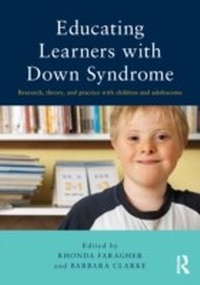
Educating Learners with Down Syndrome
Research, theory, and practice with children and adolescents
1st Edition
Published on 23. October 2013
280 pages
978-1-134-67342-1 (ISBN)
Description

For individuals with Down syndrome, the extent of the effect of intellectual disability depends largely on the degree of provision of appropriate support and intervention. In Educating Learners with Down Syndrome, editors Rhonda Faragher and Barbara Clarke have brought together a number of expert contributors, whose chapters review recent findings in the field of DS education, highlight promising practices, and identify areas for future research.
While the emphasis is primarily on the school years, links to early intervention and to life post-16 are made, with chapters organized into three parts: conceptual overview of issues in learning and teaching, learning mathematics, and literacy development. The book is also united by the cohesive themes of assessment, evidence-based practice, and inclusive practices.
Educating Learners with Down Syndrome importantly incorporates the voices of individuals with Down syndrome, whose personal narratives add significance to the research mission of the text and demonstrate the authors' inclusive philosophy. Aimed at researchers, teacher educators, higher degree students, and policy makers, this book is the first of its kind to provide a compendium of research on educating learners with Down syndrome.
While the emphasis is primarily on the school years, links to early intervention and to life post-16 are made, with chapters organized into three parts: conceptual overview of issues in learning and teaching, learning mathematics, and literacy development. The book is also united by the cohesive themes of assessment, evidence-based practice, and inclusive practices.
Educating Learners with Down Syndrome importantly incorporates the voices of individuals with Down syndrome, whose personal narratives add significance to the research mission of the text and demonstrate the authors' inclusive philosophy. Aimed at researchers, teacher educators, higher degree students, and policy makers, this book is the first of its kind to provide a compendium of research on educating learners with Down syndrome.
Reviews / Votes
"I was very much impressed by Educating Learners with Down Syndrome. In Russia, we have great demand from school teachers to provide them with innovative pedagogical tools for children with learning difficulties and I'm pleased to say this book has aroused a great interest." - Natalia Rigina, Downside Up"Educating Learners with Down Syndrome is a strong addition to the growing canon of books designed to assist teachers and school staff on how best to cater to students with Down syndrome. For parents, the book is an excellent primer on the educational needs of their children, as well as a tool to direct their child's teachers to." - James Wright, Voice
"Faragher and Clarke have brought together a diverse array of chapters that provide cutting edge information. [...] The emphasis on the core academic content areas of math and literacy in this volume is critically needed as educators, families, and other practitioners increasingly need strategies to teach core content in inclusive settings. [...] This volume sets the stage for ongoing research and practice." - Karrie A. Shogren, PsycCRITIQUES
More details
Language
English
Place of publication
London
United Kingdom
Publishing group
Taylor & Francis Ltd
Target group
College/higher education
Professional and scholarly
Product notice
Reflowable
Illustrations
16 s/w Abbildungen, 7 s/w Tabellen, 9 s/w Photographien bzw. Rasterbilder, 7 s/w Zeichnungen
7 Tables, black and white; 7 Line drawings, black and white; 9 Halftones, black and white; 16 Illustrations, black and white
File size
7,91 MB
ISBN-13
978-1-134-67342-1 (9781134673421)
Copyright in bibliographic data and cover images is held by Nielsen Book Services Limited or by the publishers or by their respective licensors: all rights reserved.
Schweitzer Classification
Other editions
Additional editions
Rhonda Faragher | Barbara Clarke
Educating Learners with Down Syndrome
Research, theory, and practice with children and adolescents
Book
10/2013
Routledge
€186.40
Shipment within 15-20 days
Rhonda Faragher | Barbara Clarke
Educating Learners with Down Syndrome
Research, theory, and practice with children and adolescents
Book
10/2013
Routledge
€71.90
Shipment within 15-20 days
Persons
Dr Rhonda Faragher is a Senior Lecturer in Mathematics Education at Australian Catholic University.
Dr Barbara Clarke is an Associate Professor at Monash University, Victoria, Australia.
Dr Barbara Clarke is an Associate Professor at Monash University, Victoria, Australia.
Content
Part 1: Issues in Learning and Teaching 1. A lifespan perspective on learning in the context of Quality of Life Emeritus Professor Roy Brown, University of Calgary 2. Cognitive strengths and weaknesses for informing educational practice Dr Donna Couzens, University of Queensland, Associate Professor Monica Cuskelly, University of Queensland 3. Mastery motivation in children with Down syndrome: Promoting and sustaining interest in learning Dr Linda Gilmore, University of Queensland, Associate Professor Monica Cuskelly, University of Queensland4 Enhancing learning for children with Down syndrome
Associate Professor Kathleen Feeley, Long Island University Part 2: Learning Mathematics 5. Mathematics profile of the learner with Down syndrome Dr Rhonda Faragher, Australian Catholic University, Associate Professor Barbara Clarke, Monash University 6. Developing early number concepts for children with Down syndrome Associate Professor Barbara Clarke, Monash University, Dr Rhonda Faragher, Australian Catholic University 7. Research on number knowledge of children with Down syndrome: Experiences from Indonesia Rumi Ati, PPPPTK Matematika 8. Learning mathematics in the secondary school: Possibilities for students with Down syndrome Dr Rhonda Faragher, Australian Catholic University Part 3: Literacy Development 9. Developing the reading skills of children with Down syndrome Dr Kelly Burgoyne, University of Portsmouth, Dr Becky Baxter, University of Portsmouth, Emeritus Professor Sue Buckley, OBE, University of Portsmouth 10. Challenging literate invisibility: Continuing literacy education for young aduls and adults with Down syndrome Associate Professor Karen Moni, University of Queensland, Dr Anne Jobling, University of Queensland 11. Down syndrome: A story from a developing county Rumi Ati, PPPPTK Matematika 12. Where we are, where we would like to be and (perhaps) how we get there Dr Rhonda Faragher, Associate Professor Barbara Clarke
Associate Professor Kathleen Feeley, Long Island University Part 2: Learning Mathematics 5. Mathematics profile of the learner with Down syndrome Dr Rhonda Faragher, Australian Catholic University, Associate Professor Barbara Clarke, Monash University 6. Developing early number concepts for children with Down syndrome Associate Professor Barbara Clarke, Monash University, Dr Rhonda Faragher, Australian Catholic University 7. Research on number knowledge of children with Down syndrome: Experiences from Indonesia Rumi Ati, PPPPTK Matematika 8. Learning mathematics in the secondary school: Possibilities for students with Down syndrome Dr Rhonda Faragher, Australian Catholic University Part 3: Literacy Development 9. Developing the reading skills of children with Down syndrome Dr Kelly Burgoyne, University of Portsmouth, Dr Becky Baxter, University of Portsmouth, Emeritus Professor Sue Buckley, OBE, University of Portsmouth 10. Challenging literate invisibility: Continuing literacy education for young aduls and adults with Down syndrome Associate Professor Karen Moni, University of Queensland, Dr Anne Jobling, University of Queensland 11. Down syndrome: A story from a developing county Rumi Ati, PPPPTK Matematika 12. Where we are, where we would like to be and (perhaps) how we get there Dr Rhonda Faragher, Associate Professor Barbara Clarke
