

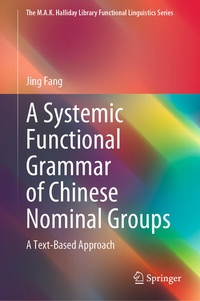
A Systemic Functional Grammar of Chinese Nominal Groups
Description

This book describes the grammar of Chinese nominal groups for the purpose of text analysis, drawing upon Halliday's systemic functional linguistics (SFL) model. Exploring the metafunctional grammatical resources in nominal groups, the book provides a new perspective on conducting text analysis by focusing on the metafunctions performed by various elements in the nominal group.
The observations on nominal groups presented here are based on both a working corpus of 180 texts of various types and a large referential corpus of over 16 billion tokens. With clear descriptions of the terminology used, the book presents a case study at the end of each major chapter, which demonstrates how the grammatical resources discussed can be applied to the delicate analysis of authentic texts. This monograph is more than a grammar book, for it offers a new way to engage with a text microscopically and enables readers to approach and analyse a text by focusing on grammatical units below the clause level. The book provides an accessible and valuable resource for readers who are interested in SFL-based typological description, text analysis, translation studies between English and Chinese, English-Chinese comparative linguistic studies, and Chinese language teaching and learning.
More details
Other editions
Additional editions
Person
Dr. Jing Fang is a Lecturer at the Department of Linguistics, Macquarie University, and holds a Ph.D. in systemic functional linguistics. Teaching in the university's postgraduate program for translation and interpreting, Jing is interested in using linguistic theories to interpret the choices made by translators and interpreters and in bridging theory and practice in the classroom. Her research interests include systemic functional linguistics, text analysis, language typology, and process- and product-based translation and interpreting studies. Jing is also a professional translator and interpreter between English and Chinese, certified by Australia's National Accreditation Authority of Translators and Interpreters (NAATI).
