

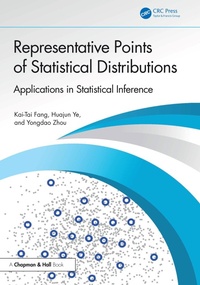
Representative Points of Statistical Distributions
Applications in Statistical Inference
Published on 12. June 2025
339 pages
978-1-040-36098-9 (ISBN)
Description

Statistical simulation has become a cornerstone in statistical research and applications. The aim of Representative Points of Statistical Distributions: Applications in Statistical Inference is to present a comprehensive exploration of various methods for statistical simulation and resampling, focusing on consistency and efficiency. It covers a range of representative points (RPs) - Monte Carlo (MC) RPs, quasi-Monte Carlo (QMC) RPs, and mean square error (MSE) RPs - and their applications, and includes a collection of recent developments in the field. It also explores other types of representative points and the corresponding approximate distributions, and delves into the realm of statistical simulation by exploring the limitations of traditional MC methods and the innovations brought about by the bootstrap method. In addition, the text introduces other kinds of representative points and the corresponding approximate distributions such as QMC and MSE methods.
Features
Comprehensive exploration of statistical simulation methods: provides a deep dive into MC methods and bootstrap methods, and introduces other kinds of RPs and the corresponding approximate distributions, such as QMC and MSE methods.
Emphasis on consistency and efficiency: highlights the advantages of these methods in terms of consistency and efficiency, addressing the slow convergence rate of classical statistical simulation.
Collection of recent developments: brings together the latest advancements in the field of statistical simulation, keeping readers up to date with the most current research.
Practical applications: includes numerous practical applications of various types of RPs (MC-RPs, QMC-RPs, and MSE-RPs) in statistical inference and simulation.
Educational resource: can serve as a textbook for postgraduate students, a reference book for undergraduate students, and a valuable resource for professionals in various fields.
The book serves as a valuable resource for postgraduate students, researchers, and practitioners in statistics, mathematics, and other quantitative fields.
Features
Comprehensive exploration of statistical simulation methods: provides a deep dive into MC methods and bootstrap methods, and introduces other kinds of RPs and the corresponding approximate distributions, such as QMC and MSE methods.
Emphasis on consistency and efficiency: highlights the advantages of these methods in terms of consistency and efficiency, addressing the slow convergence rate of classical statistical simulation.
Collection of recent developments: brings together the latest advancements in the field of statistical simulation, keeping readers up to date with the most current research.
Practical applications: includes numerous practical applications of various types of RPs (MC-RPs, QMC-RPs, and MSE-RPs) in statistical inference and simulation.
Educational resource: can serve as a textbook for postgraduate students, a reference book for undergraduate students, and a valuable resource for professionals in various fields.
The book serves as a valuable resource for postgraduate students, researchers, and practitioners in statistics, mathematics, and other quantitative fields.
More details
Language
English
Place of publication
London
United Kingdom
Publishing group
Taylor & Francis Ltd
Target group
College/higher education
Professional and scholarly
Illustrations
68 Tables, black and white; 37 Line drawings, black and white; 37 Illustrations, black and white
File size
14,14 MB
ISBN-13
978-1-040-36098-9 (9781040360989)
Copyright in bibliographic data and cover images is held by Nielsen Book Services Limited or by the publishers or by their respective licensors: all rights reserved.
Schweitzer Classification
Other editions
Additional editions
Kai-Tai Fang | Huajun Ye | Yongdao Zhou
Representative Points of Statistical Distributions
Applications in Statistical Inference
Book
06/2025
1st Edition
Chapman & Hall/CRC
€186.00
Shipment within 10-20 days

Book
05/2025
CRC Press
Unfortunately, price unknown
Article exhausted; check different version
Persons
Kai-Tai Fang is a reputable statistician. He was educated at Peking University and The Chinese Academy of Sciences for undergraduate and postgraduate studies. He was elected as a Fellow by the Institute of Mathematical Statistics (IMS) in 1992 and a Fellow by the American Statistical Association (ASA) in 2001 as well as an elective member of the International Statistical Institute (ISI) in 1985. Professor Fang visited Yale University and Stanford University for two years and was invited as a Guest Professor at the Swiss Federal Institute of Technology and a Visiting Professor at the University of North Carolina at Chapel Hill. He was Chair Professor of the Department of Mathematics at Hong Kong Baptist University from 1993 to January 2006. Now, he is a Chair Professor at BNUHKBU United International College. His research interests are in statistics and mathematics, specifically experimental design, multivariate analysis, and data mining. He published 24 books (including six monographs in English) and more than 300 referred papers.
Huajun Ye received a Bachelor and a Master's degrees in Probability and Mathematical Statistics from Peking University in 1999 and 2002, respectively. He received a PhD in Statistics from Manchester University, U.K. 2005, and his PhD research on covariance structures modeling of longitudinal data. In 2007, He joined BNU-HKBU United International College as an Assistant Professor. Now, he is a full Professor in the Department of Statistics and Data Science at BNU-HKBU United International College. His research interests include statistical modeling, inference, financial risk management, and statistical representative points. More than ten research papers have been published in international journals and conferences, including Biometrika, Mathematics, Journal of Complexity, Journal of Statistical Computation and Simulation, etc.
Yongdao Zhou received a B.S. degree in pure mathematics in 2002 and M.S. and Ph.D. in Statistics in 2005 and 2008, respectively, from Sichuan University, China. He was a postdoctoral fellow at HKBU-UIC Joint Institute of Research Studies. Then, he joined Sichuan University and was a full professor after 2015. In 2017, he joined Nankai University, where he is presently a full professor in statistics. He visited UCLA, the University of Manchester, the National University of Singapore, and Simon Fraser University as a visiting scholar. His research agenda focuses on experimental design and big data analysis. He published over 70 papers, such as in JRSSB, JASA, Biometrika, and IEEE TKDE, as well as eight monographs and textbooks. His research publications have won two best paper awards.
Huajun Ye received a Bachelor and a Master's degrees in Probability and Mathematical Statistics from Peking University in 1999 and 2002, respectively. He received a PhD in Statistics from Manchester University, U.K. 2005, and his PhD research on covariance structures modeling of longitudinal data. In 2007, He joined BNU-HKBU United International College as an Assistant Professor. Now, he is a full Professor in the Department of Statistics and Data Science at BNU-HKBU United International College. His research interests include statistical modeling, inference, financial risk management, and statistical representative points. More than ten research papers have been published in international journals and conferences, including Biometrika, Mathematics, Journal of Complexity, Journal of Statistical Computation and Simulation, etc.
Yongdao Zhou received a B.S. degree in pure mathematics in 2002 and M.S. and Ph.D. in Statistics in 2005 and 2008, respectively, from Sichuan University, China. He was a postdoctoral fellow at HKBU-UIC Joint Institute of Research Studies. Then, he joined Sichuan University and was a full professor after 2015. In 2017, he joined Nankai University, where he is presently a full professor in statistics. He visited UCLA, the University of Manchester, the National University of Singapore, and Simon Fraser University as a visiting scholar. His research agenda focuses on experimental design and big data analysis. He published over 70 papers, such as in JRSSB, JASA, Biometrika, and IEEE TKDE, as well as eight monographs and textbooks. His research publications have won two best paper awards.
Content
1. Statistical Distributions and Preliminary. 2. Approximated Discretization Methods to A Given Continuous Distribution. 3. Property and Generation of MSE-RPs of Univariate Distributions. 4. Statistical Simulation via Distributions formed by RPs. 5. Estimation of MSE-RPs and Resampling. 6. RPs of Multivariate Distributions. 7. Properties of MSE-RPs of Multivariate Distributions. 8. Applications of RPs in Various Fields. 9. Representative Points for Discrete Massive Data.
