

The Language and Iconography of Chinese Charms
Description

This book offers an in-depth description and analysis of Chinese coin-like charms, which date back to the second century CE and which continued to be used until mid 20th century. This work is unique in that it provides an archaeological and analytical interpretation of the content of these metallic objects: inscriptive, pictorial or both. As the component chapters show, these coin-like objects represent a wealth of Chinese traditional folk beliefs, including but not limited to family values, social obligations and religious desires. The book presents a collection of contributed chapters, gathering a diverse range of perspectives and expertise from some of the world's leading scholars in the fields of archaeology, religious studies, art history, language and museology.
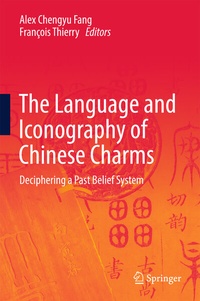
The background of the cover image is a page from Guang jin shi yun fu ?????, a rhyming dictionary first published in the ninth year of the Kangxi Reign (1652 CE). The metal charm dates back tothe Song Dynasty (960-1279 CE), depicting two deities traditionally believed to possess the majic power of suppressing evil spirits. The stich-bound book in the foreground is a collection of seal impressions from the beginning of the 20th century. Its wooden press board is inscribed da ji xiang ??? by Fang Zhi-bin ??? in the year of bing yin (1926 CE).
More details
Other editions
Additional editions
Persons
François Thierry was born in 1950 in Paris and, after secondary school in humanities, studied history and arts in university. He focused his research on the political history of the Late Ottoman Empire. Then he travelled extensively in the Middle East, Caucasus and Soviet Central Asia in the late 1960s and in the 1970s. After he passed the Agrégation in 1977, he became a teacher in Arts. At that time, he started to study Chinese language and history in Paris-7 University. In 1984, he was recruited by the Paris Mint Museum as research fellow for publishing the Far Eastern Coins collection and the famous Treasure of the Emperors of Vietnam kept in that institution. In 1986, he entered the Coins Department of the French National Library as research fellow for the publication of a catalogue of Vietnamese coins. In 1989 he was appointed as Curator of Oriental coins. Since mid 1980s, he started to establish close ties with Chinese colleagues and especially with the China Numismatic Society. François Thierry published many catalogues, studies and papers on Chinese, Vietnamese and pre-Islamic Turkish coins and currency. Past Chief Curator in the Coins Department of the French National Library, he is member of French Numismatic Society, the Royal Numismatic Society and the Hong Kong Numismatic Society. In 2006, he was awarded Medal of the Royal Numismatic Society for his scientific research.
