

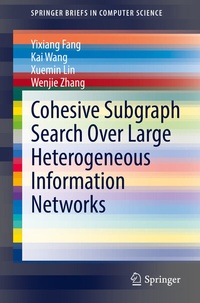
Cohesive Subgraph Search Over Large Heterogeneous Information Networks
Description

This SpringerBrief provides the first systematic review of the existing works of cohesive subgraph search (CSS) over large heterogeneous information networks (HINs). It also covers the research breakthroughs of this area, including models, algorithms and comparison studies in recent years. This SpringerBrief offers a list of promising future research directions of performing CSS over large HINs.
The authors first classify the existing works of CSS over HINs according to the classic cohesiveness metrics such as core, truss, clique, connectivity, density, etc., and then extensively review the specific models and their corresponding search solutions in each group. Note that since the bipartite network is a special case of HINs, all the models developed for general HINs can be directly applied to bipartite networks, but the models customized for bipartite networks may not be easily extended for other general HINs due to their restricted settings. The authors also analyze and compare these cohesive subgraph models (CSMs) and solutions systematically. Specifically, the authors compare different groups of CSMs and analyze both their similarities and differences, from multiple perspectives such as cohesiveness constraints, shared properties, and computational efficiency. Then, for the CSMs in each group, the authors further analyze and compare their model properties and high-level algorithm ideas.
This SpringerBrief targets researchers, professors, engineers and graduate students, who are working in the areas of graph data management and graph mining. Undergraduate students who are majoring in computer science, databases, data and knowledge engineering, and data science will also want to read this SpringerBrief.
More details
Other editions
Additional editions
Persons
Kai Wang is an Assistant Professor at Antai College of Economics & Management, Shanghai Jiao Tong University. He received his BSc degree from Zhejiang University in 2016 and his PhD degree from the University of New South Wales in 2020, both in computer science. His research interests lie in big data analytics, especially for the big graph and spatial data. Most of his research works have been publishedin top-tier database conferences (e.g., SIGMOD, PVLDB, and ICDE) and journals (e.g., VLDBJ and TKDE).
Xuemin Lin is a Chair Professor at Antai College of Economics & Management, Shanghai Jiao Tong University. He is a Fellow of IEEE. He received his BSc degree in applied math from Fudan University in 1984 and his PhD degree in computer science from the University of Queensland in 1992. Currently, he is the editorin-chief of IEEE Transactions on Knowledge and Data Engineering. His principal research areas are databases and graph visualization.
Wenjie Zhang is a professor and ARC Future Fellow in the School of Computer Science and Engineering at the University of New South Wales in Australia. She received her PhD from the University of New South Wales in 2010. She is an associate editor of IEEE Transactions on Knowledge and Data Engineering. Her research interests lie in large-scale data processing, especially in query processing over spatial and graph/network data.
