

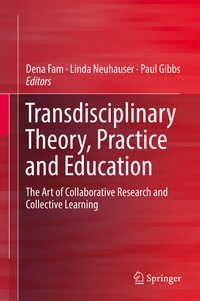
Transdisciplinary Theory, Practice and Education
Description

This exciting new state-of-the art book reviews, explores and advocates ways in which collaborative research endeavours can, through a transdisciplinary lens, enhance student, academic and social experiences. Drawing from a wide range of knowledges, contexts, geographical locations and internationally renowned expertise, the book provides a unique look into the world of transdisciplinary thinking, collaborative learning and action. In doing so, the book is action orientated, reflective, theoretical and intriguing and provides a place for all of these to meet and mingle in the spirit of curiosity and imagination.
More details
Other editions
Additional editions
Persons
Professor Linda Neuhauser is Clinical Professor of Community Health Sciences at the School of Public Health, University of California, Berkeley (California, USA) and is Visiting Professor at the Department of Social and Populations Sciences at Nanjing You-Dian University (Nanjing, China). She is also Co-Principal Investigator of the Health Research for Action center (HRA) at the UC Berkeley School of Public Health. Her teaching, research and practice is focused on using participatory methods across disciplines and societal sectors to engage diverse groups to identify and solve problems. She and her center colleagues have used participatory and transdisciplinary methods co-create and test many kinds of health and social interventions in many countries worldwide. She has authored over 100 publications about participatorydesign, transdisciplinary research and action, and health interventions.
Professor Paul Gibbs is Director of Education Research at the University of Middlesex. He is a professor of the University, founder of the Centre for Education Research and Scholarship and an Honorary Research Fellow at the Open University in Hong Kong and the University of Cyprus. He is currently completing three books: Transdisciplinary happiness and contentment and compassion all within the higher education context. He is also Series Editor of SpringerBriefs on Key Thinkers in Education and Debating Higher Education: Philosophical Perspectives for Springer Academic Press. He writes the marketing of higher education.
Content
PART I THEORISING TRANSDISCIPLINARITY AS A COLLABORATIVE PRACTICE.- Introduction, Paul Gibbs, Linda Neuhauser and Dena Fam.- Learning and transdisciplinary collaboration: A conceptual vocabulary, Julie Thompson Klein.- Practical and scientific foundations of transdisciplinary research and action, Linda Neuhauser.- Transforming Transdisciplinarity: An expansion of strong transdisciplinarity and its centrality in enabling effective collaboration, Katie Ross and Cynthia Mitchell.- The role of pliability and transversality within trans/disciplinarity: Opening university research and learning to planetary health, Jason Prior, Carole Cusack and Anthony Capon.- The transdisciplinary evolution of the university condition for sustainable development, Basarab Nicolescu.- PART II TRANSDISCIPLINARY LEARNING (EDUCATION).- Meta-considerations for planning, introducing and standardising collective learning in higher degree institutions, Dena Fam, Scott Kelly, Tania Leimbach, Lesley Hitchens and Michelle Callen.- Transdisciplinarity: towards an epistemology of what matters, Kate Maguire.- Trandisciplinarity and the 'Living Lab Model': Food waste management as a site for collaborative learning, Alexandra Crosby, Dena Fam and Abby Lopes.- Nurturing transdisciplinary graduate learning and skills through a community of practice approach, Chris Riedy, Cynthia Mitchell, Juliet Willetts and Ian Cunningham.- Making collective learning coherent: An adaptive approach to the practice of transdisciplinary pedagogy, Elizabeth Clarke and Craig Ashhurst.- Making the link between transdisciplinary learning and transdisciplinary design principles, BinBin Pearce, Carolina Adler, Lisette Senn, Pius Krütli, Michael Stauffacher and Christian Pohl.- The Connected Studio: Collective learning in an industry-education research test bed, Tanja Golja, Krista Jordan and Shilo McClean.-PART III TRANSDISCIPLINARY CASE STUDIES.- Shielding Indigenous worlds from extraction and the transformative potential of collaborative research, Jason De Santolo (Tribal affiliations: Garrwa and Barunggam).- Collaborative research and action: The Changzhou Worker Wellness Project, Linda Neuhauser, Xiaodong Wang, Hong Yun, Xiaoming Sun, Zhanhong Zong, Xingyu Shu, Jingshu Mao, Eve Wen-Jing Lee, and Sono Aibe.- Creative partnerships and cultural organizations: "Enabling" and "situating" arts-science collaboration and collective learning, Tania Leimbach and Keith Armstrong.- Climate adapted people shelters: A transdisciplinary reimagining of public infrastructure through open, design-led innovation, Brent Jacobs, Jochen Schweitzer, Lee Wallace, Suzanne Dunford and Sarah Barns.- Reflections on collective learning: open and closed, Valerie Brown.- Philosophical reflections: Coda, Paul Gibbs.
