

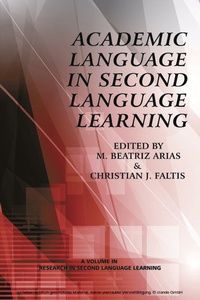
Academic Language In Second Language Learning
1st Edition
Published on 3. January 2013
253 pages
978-1-62396-116-9 (ISBN)
Description

Language in academic settings, also referred to academic language, has gained attention in the field of second language learning owing to new understandings of the complexities of language inherent in learning academic content, and new efforts to assess English learners' language proficiency in the context of school learning. The concept of academic language as distinct from social language has been in the academic literature since the mid-1950s, and surfaced as a major construct in the field of bilingual education in the 1980s. Many readers will be familiar with the ideas of BICS and CALP, first introduced by Jim Cummins in the 1980s. This book presents a critique of academic language as a separable construct from social language, and introduces current research efforts to understand how English learners interact, interpret, and show understanding of language in academic contexts in ways that re-think and go beyond the distinction between social and academic language.The book is organized into three main sections, each with a range of chapters that consider how academic language plays into how children and youth learn academic content as emergent bilingual students in school settings. A Foreward and Afterward offer commentary on the book and its contents. The intended audience for this book is graduate students, teacher educators, and researchers interested in issues of language and content learning for English learners, the new mainstream of schools across the nation. There is something for a wide range of readers and students of second language acquisition in this volume.
All prices
More details
Other editions
Additional editions
Christian J. Faltis | M. Beatriz Arias
Academic Language in Second Language Learning
Book
01/2013
Information Age Publishing
€70.40
Shipment within 3-4 weeks
Content
1 - Academic Language in Second Language Learning [Seite 2]
2 - A Volume in Research In Second Language Learning [Seite 2]
2.1 - Series Editors: JoAnn Hammadou Sullivan, University of Rhode Island [Seite 2]
3 - CONTENTS [Seite 6]
3.1 - Section I: Language in Academic Contents [Seite 6]
3.1.1 - 1. Demystifying and Questioning the Power of Academic Language [Seite 6]
3.1.2 - 2. Developing Academic English With English Language Learners: A Study of Mainstream Classroom Practices [Seite 6]
3.1.3 - 3. Pedagogical Language Knowledge and the Instruction of English Learners [Seite 6]
3.2 - Section II: Academic Language in Language Teaching [Seite 6]
3.2.1 - 4. Exploring Academic Language in Exemplary Beginning Teachers Through a Constructivist Inquiry Approach [Seite 6]
3.2.2 - 5. Developing Teachers' Critical Language Awareness in Digital Contexts [Seite 6]
3.2.3 - 6. Educators' Conceptions of Academic Literacy and Language [Seite 6]
3.3 - Section III: Academic Language in Subject-Area Content [Seite 7]
3.3.1 - 7. Academic Language in the Social Studies for English Learners [Seite 7]
3.3.2 - 8. Scaffolding Academic Language in Science for English Learners [Seite 7]
3.3.3 - 9. English Language Learning and Learning Academic Language in Mathematics [Seite 7]
3.4 - Research In Second Language Learning [Seite 3]
3.5 - Academic Language in Second Language Learning [Seite 4]
3.5.1 - edited by [Seite 4]
3.5.2 - M. Beatriz Arias [Seite 4]
3.5.3 - University of California [Seite 4]
3.5.4 - and [Seite 4]
3.5.5 - Christian J. Faltis [Seite 4]
3.5.6 - Arizona State University [Seite 4]
3.5.6.1 - Information Age Publishing, Inc. [Seite 4]
3.5.6.2 - Charlotte, North Carolina www.infoagepub.com [Seite 4]
3.5.6.3 - Foreword [Seite 8]
3.5.6.3.1 - M. Beatriz Arias [Seite 8]
3.6 - section 1 [Seite 14]
3.6.1 - Language in Academic Contents [Seite 14]
3.7 - CHAPTER 1 [Seite 16]
3.7.1 - Demystifying and Questioning the Power of Academic Language [Seite 16]
3.7.1.1 - Christian J. Faltis [Seite 16]
3.7.1.1.1 - Origins of the Distinctions Between Social and Academic Language [Seite 19]
3.7.1.1.2 - Bernstein's Restricted and Elaborated Codes [Seite 20]
3.7.1.1.3 - Cummins' BICS and CALP Distinction [Seite 23]
3.7.1.1.4 - A Current Example of Reification of Academic Language as Cognitively Superior [Seite 25]
3.7.1.1.5 - The Culture of the Standard and Academic Language [Seite 27]
3.7.1.1.6 - Focusing on Language in Academic Contexts [Seite 30]
3.7.1.1.7 - Refocusing on Broader Contexts [Seite 34]
3.7.2 - References [Seite 35]
3.7.2.1 - Figure 1. 1. Bernstein's analysis. [Seite 22]
3.8 - CHAPTER 2 [Seite 40]
3.8.1 - Developing Academic English With English Language Learners [Seite 40]
3.8.1.1 - A Study of Mainstream Classroom Practices [Seite 40]
3.8.1.1.1 - Shanan Fitts and Erica Bowers [Seite 40]
3.8.2 - Defining Academic English Language and Literacy [Seite 41]
3.8.2.1 - Teaching AEL in Elementary Classrooms [Seite 43]
3.8.3 - Methods of Data Collection and Analysis [Seite 46]
3.8.3.1 - Participants and Research Context [Seite 46]
3.8.3.2 - Professional Development [Seite 48]
3.8.3.3 - Classroom Observation Protocol and Exit Survey [Seite 49]
3.8.3.4 - Data Collection and Analysis [Seite 50]
3.8.4 - Findings: Teaching Practices for Developing AEL [Seite 51]
3.8.4.1 - Building Background Knowledge and Schema [Seite 52]
3.8.4.2 - Comprehensible Input [Seite 54]
3.8.4.3 - Explicit Teaching [Seite 55]
3.8.4.4 - Opportunities for Practice [Seite 57]
3.8.5 - Discussion and Conclusions [Seite 59]
3.8.6 - Appendix: Observation Protocol [Seite 64]
3.8.7 - Appendix: (Continued) [Seite 65]
3.8.7.1 - References [Seite 65]
3.8.8 - Table 2.1. Participating Teachers, Preparation, Experience and Numbers of ELLs [Seite 47]
3.8.9 - Table 2.1. Average Ratings for Each Instructional Area Observed [Seite 51]
3.9 - CHAPTER 3 [Seite 70]
3.9.1 - Pedagogical Language Knowledge and the Instruction of English Learners [Seite 70]
3.9.1.1 - Audrey Lucero [Seite 70]
3.9.2 - Academic Language and its Development [Seite 71]
3.9.3 - Instructional Moves that Facilitate Academic Language Development [Seite 73]
3.9.3.1 - Simultaneous Focus on Content and Language [Seite 74]
3.9.3.2 - Linguistic Scaffolding [Seite 74]
3.9.3.3 - Dialogic Interactions [Seite 75]
3.9.3.4 - Movement Along the Context Continuum [Seite 75]
3.9.3.5 - Explicit Instruction of Language [Seite 75]
3.9.4 - Methodology [Seite 76]
3.9.5 - Data Collection and Analysis [Seite 77]
3.9.6 - Findings [Seite 78]
3.9.6.1 - "Go-to" Moves [Seite 79]
3.9.6.2 - Señora Gregor [Seite 79]
3.9.6.3 - Mr. Riley [Seite 81]
3.9.6.4 - Ms. Cortez [Seite 83]
3.9.6.4.1 - Infrequently Used Moves [Seite 86]
3.9.6.5 - Dialogic Interactions [Seite 86]
3.9.6.6 - Explicit Instruction of Language [Seite 87]
3.9.7 - Implications for Pedagogical Language Knowledge [Seite 87]
3.9.8 - Areas for Future Research [Seite 89]
3.9.9 - Notes [Seite 89]
3.9.10 - References [Seite 90]
3.9.11 - Table 3.1. Coded Instructional Moves by Teacher [Seite 79]
3.9.12 - Table 3.2. Percentage of Different Types of Instructional Moves by Teacher [Seite 80]
3.10 - CHAPTER 4 [Seite 98]
3.10.1 - Exploring Academic Language in Exemplary Beginning Teachers Through a Constructivist Inquiry Approach [Seite 98]
3.10.1.1 - Barbara J. Merino, Al Mendle, Rick Pomeroy, and M. Cecilia Gómez [Seite 98]
3.10.2 - Theoretical Frameworks and Relevant Literature [Seite 99]
3.10.3 - Methods [Seite 102]
3.10.4 - Findings and Discussion [Seite 103]
3.10.5 - Conclusions [Seite 111]
3.10.6 - References [Seite 114]
3.10.7 - section ii [Seite 96]
3.10.7.1 - Academic Language in Language Teaching [Seite 96]
3.10.7.2 - Table 4.1. PACT Performance by Domain and Element With Rationale for Cases* [Seite 104]
3.10.7.3 - Table 5.1. Template for Second Language Learner Inquiry Project Website [Seite 126]
3.11 - CHAPTER 5 [Seite 116]
3.11.1 - Developing Teachers' Critical Language Awareness in Digital Contexts [Seite 116]
3.11.1.1 - Tomás Galguera [Seite 116]
3.11.2 - Teacher Language Awareness and Pedagogical Language Knowledge [Seite 118]
3.11.3 - Technology as New Literacies and Teachers as "Technology Natives" [Seite 120]
3.11.4 - Scaffolding in Electronic Contexts as Pedagogical Language Knowledge [Seite 122]
3.11.5 - Language Awareness Among Preservice Teachers: Two Illustrative Cases [Seite 124]
3.11.5.1 - Enduring Schemas and Conflicting Genres [Seite 125]
3.11.5.2 - Language Production as a Dilemma of Practice [Seite 130]
3.11.6 - Conclusion [Seite 133]
3.11.7 - Notes [Seite 134]
3.11.8 - References [Seite 134]
3.11.9 - Table 5.2. Analytic Rubric for Language Learner Inquiry Web Page [Seite 128]
3.11.10 - Table 5.2. (Continued) [Seite 129]
3.11.11 - Table 6.1. Important Features of Academic Literacy (and Themes) in Participants' Definitions [Seite 149]
3.12 - CHAPTER 6 [Seite 138]
3.12.1 - Educators' Conceptions of Academic Literacy and Language [Seite 138]
3.12.1.1 - Steven Z. Athanases and Juliet Michelsen Wahleithner [Seite 138]
3.12.2 - Framework [Seite 140]
3.12.2.1 - Competing Models of Academic Literacy [Seite 140]
3.12.2.2 - The Need for P-16 Educators' Perspectives and Knowledge in Educational Innovations [Seite 143]
3.12.3 - Method [Seite 143]
3.12.3.1 - Context for the Study: An Academic Literacy Summit [Seite 143]
3.12.3.2 - Participants [Seite 144]
3.12.3.3 - Data Collection [Seite 145]
3.12.3.4 - Data Analysis [Seite 145]
3.12.4 - Results [Seite 146]
3.12.4.1 - Educators' Wide-Ranging Conceptions of Academic Literacy Foci [Seite 146]
3.12.4.2 - Widely Varied Notions of the Functions and Dimensions of Academic Literacy [Seite 147]
3.12.4.3 - Increasing Specialization of Academic Literacy Features in Educators' Conceptions [Seite 148]
3.12.4.4 - Educators' Call for Professional Learning in Academic Literacy Development [Seite 153]
3.12.5 - Discussion and Implications for Teaching and Teacher Development [Seite 154]
3.12.6 - Acknowledgments [Seite 156]
3.12.7 - References [Seite 156]
3.12.7.1 - Figure 6. 1. Educators' conceptions of the features and functions of academic literacy [Seite 147]
3.12.7.2 - Figure 6. 2. The increasing specialization of academic literacy in educators' conceptions. [Seite 150]
3.12.7.3 - Figure 7. 3. Cohesive devices in text 1. [Seite 172]
3.13 - CHAPTER 7 [Seite 162]
3.13.1 - Academic Language in the Social Studies for English Learners [Seite 162]
3.13.1.1 - Luciana C. de Oliveira [Seite 162]
3.13.2 - Content-Specific Language in History and ELs [Seite 164]
3.13.2.1 - More Than Just Vocabulary [Seite 165]
3.13.3 - Potential Challenges of Academic Language in History for ELs [Seite 166]
3.13.3.1 - More Than Real Actors: Abstractions That Occur as Participants [Seite 167]
3.13.3.2 - More Than Single Words: Dense Definitions That Require Explanations [Seite 170]
3.13.3.3 - More Than Naming: Cohesive Devices That Create Links Within the Text [Seite 171]
3.13.3.4 - More Than Connectors: Series of Events and Actions That Construct Causality [Seite 174]
3.13.4 - Linguistically Responsive History Teaching: Developing Linguistic Knowledge about History [Seite 178]
3.13.5 - Conclusion [Seite 179]
3.13.6 - Note [Seite 181]
3.13.7 - References [Seite 181]
3.13.8 - section iii [Seite 160]
3.13.8.1 - Academic Language in Subject-Area Content [Seite 160]
3.13.8.1.1 - Figure 7. 1. Text 1: Passage from America: Pathways to the Present. [Seite 167]
3.13.8.1.2 - Figure 7. 4a. Cohesive devices in text 2. (Figure 7.4 continues on next page) [Seite 173]
3.13.8.1.3 - Figure 7. 2a. Text 2: Passage from Call to Freedom. (Figure 7.2 continues on next page) [Seite 169]
3.13.8.1.4 - Figure 7. 2b. Text 2: Passage from Call to Freedom. (Continued from previous page) [Seite 170]
3.13.8.1.5 - Figure 7. 4b. Cohesive devices in text 2. (Figure 7.4 continued from previous page) [Seite 174]
3.13.8.1.6 - Figure 7. 5a Series of events constructing implicit causal chains in text 2. (Figure 7.5 continues on next page) [Seite 176]
3.13.8.1.7 - Figure 7. 5b. Series of events constructing implicit causal chains in text 2. (Figure 7.5 continued from next page) [Seite 177]
3.14 - CHAPTER 8 [Seite 184]
3.14.1 - Scaffolding Academic Language in Science Education for English Language Learners [Seite 184]
3.14.1.1 - Frank Ramírez-Marín and Douglas B. Clark [Seite 184]
3.14.2 - Introduction [Seite 184]
3.14.3 - Science education and cultural and linguistic diversity in the United States [Seite 186]
3.14.4 - Integration of Science Teaching, Language, and Literacy [Seite 188]
3.14.4.1 - The Instructional Congruence Framework [Seite 188]
3.14.4.2 - The Effective Science Teaching for English Language Learners (ESTELL) Framework [Seite 190]
3.14.4.2.1 - 1. Facilitate learning through joint productive activity among teachers and students (Moll, 1990 [Seite 191]
3.14.4.2.2 - 2. Develop competence in the language and literacy of instruction throughout all instructional activities. [Seite 191]
3.14.4.2.3 - 3. Contextualize teaching and curriculum in the experiences and skills of home and community (pedagogical level, at the curriculum level, at the policy level). [Seite 191]
3.14.4.2.4 - 4. Challenge students toward cognitive complexity wherein teachers elicit and model complex reasoning of science concepts. [Seite 191]
3.14.4.2.5 - 5. Engage students through dialogue, especially instructional conversation, involving teacher initiation of conversation that requires student scientific reasoning and dialogue. [Seite 191]
3.14.4.2.6 - 1. LASERS (language acquisition through science education in rural schools) used inquiry science as a context for the implementation of pedagogy that integrated language and literacy development into cognitively demanding science learning using and i... [Seite 191]
3.14.4.2.7 - 2. The Seeds of Science, Roots of Reading project coordinated the efforts of science educators and literacy educators to create and test an integrated literacy-science curriculum for second and third grade elementary school classrooms (Cervetti, Pear... [Seite 192]
3.14.4.2.8 - 3. The science instruction for all (SIFA) looked into the impact of a multiyear instructional intervention designed and implemented to promote achievement of science and literacy among culturally and linguistically diverse students in the San Francis... [Seite 192]
3.14.4.2.9 - 4. The Imperial Valley Project in Science focused on the effects of instruction that allowed students to conduct science projects as investigations and develop their writing proficiency by keeping a journal to reflect on their science activities (Ama... [Seite 192]
3.14.4.2.10 - 5. The P-SELL project consisted on the implementation of an integrated science and literacy curriculum for third graders in urban elementary schools in Florida. According to Lee, Maerten-Rivera, Penfield, LeRoy, and Secada (2008) the study involved 1... [Seite 192]
3.14.4.2.11 - 1. The integration of science, language, and literacy development. [Seite 193]
3.14.4.2.12 - 2. The engagement of students in the use of scientific discourse. [Seite 193]
3.14.4.2.13 - 3. The development of scientific understanding through complex thinking. [Seite 193]
3.14.4.2.14 - 4. The implementation of collaborative inquiry in science learning. [Seite 193]
3.14.4.2.15 - 5. The contextualization of science learning. [Seite 193]
3.14.4.3 - Summary: General Agreement in Science Education Research on Core Issues for Supporting Diverse Students [Seite 194]
3.14.4.3.1 - 1. There is a need to provide language minority students, including ELLs, with pedagogical approaches that promote ELL's achievement in content areas while simultaneously developing literacy and language proficiency in English (e.g., Lee & Fradd, 1... [Seite 195]
3.14.4.3.2 - 2. Content-area instruction provides a meaningful context for English language and literacy development, while the language processes provide the medium for analysis and communication of subject matter knowledge (e.g., Casteel & Isom, 1994 [Seite 195]
3.14.4.3.3 - 3. Hands-on and inquiry-based science instruction can help students develop scientific understanding and engage in inquiry practices while also supporting academic language and literacy development (e.g., Lee, 2002 [Seite 195]
3.14.4.3.4 - 4. Integrating language and literacy research into contextualized science inquiry instruction has a positive effect for ELL students (e.g., Lee, 2005 [Seite 195]
3.14.5 - Supporting Academic Language: Challenges for Science Teachers [Seite 195]
3.14.6 - Possible Solution: The Systemic Functional Linguistics Approach to Language [Seite 198]
3.14.6.1 - 1. Identification of technical terms and definitions [Seite 200]
3.14.6.2 - 2. Conjunctions with specific roles (e.g., or) [Seite 200]
3.14.6.3 - 3. Everyday questions and words with specialized meanings [Seite 200]
3.14.6.4 - 4. Noun groups presented in a zigzag structure [Seite 200]
3.14.7 - Recommendations and Final Thoughts [Seite 201]
3.14.7.1 - Linguistic Supports for Students [Seite 202]
3.14.7.2 - Supports for Teachers Working With English language Learners [Seite 203]
3.14.7.3 - Final Thoughts [Seite 203]
3.14.8 - References [Seite 204]
3.15 - CHAPTER 9 [Seite 214]
3.15.1 - English Language Learning and Learning Academic Language in Mathematics [Seite 214]
3.15.1.1 - James A. Middleton, Silvia Llamas-Flores, and Paula Patricia Guerra-Lombardi [Seite 214]
3.15.2 - Introduction [Seite 214]
3.15.2.1 - On the Evolution and Purpose of Language [Seite 216]
3.15.2.2 - Mathematics as a Language [Seite 221]
3.15.2.3 - The Mathematics Register [Seite 222]
3.15.2.3.1 - The Relationship Between First Language, Second Language, and Academic Language [Seite 227]
3.15.3 - Conclusions [Seite 231]
3.15.3.1 - Recommendations for Practice [Seite 232]
3.15.4 - Notes [Seite 233]
3.15.5 - References [Seite 234]
3.15.6 - Table 9.1. Words Presenting Difficulties in the Register Of Mathematics [Seite 225]
3.15.7 - Table 9.2. Examples oF Difficult Syntax in Mathematical Language [Seite 227]
3.15.8 - Table 9.3. General Patterns of Development Across AL1 and AL2 and Prior Mathematics Understanding [Seite 230]
3.15.8.1 - Afterword [Seite 238]
3.15.8.1.1 - Karen E. Lillie [Seite 238]
3.15.8.1.1.1 - Defining and Understanding Academic Language [Seite 238]
3.15.8.1.1.2 - Seeing the Bigger Picture [Seite 239]
3.15.8.1.1.3 - Preparing Teachers: Doing, Knowing, and Using AL in the Classroom [Seite 241]
3.15.8.1.1.4 - The Common Core and AL [Seite 242]
3.15.8.1.1.5 - Implications for the Future of AL and Concluding Remarks [Seite 244]
3.15.8.2 - References [Seite 246]
3.15.8.3 - About the contributors [Seite 248]
2 - A Volume in Research In Second Language Learning [Seite 2]
2.1 - Series Editors: JoAnn Hammadou Sullivan, University of Rhode Island [Seite 2]
3 - CONTENTS [Seite 6]
3.1 - Section I: Language in Academic Contents [Seite 6]
3.1.1 - 1. Demystifying and Questioning the Power of Academic Language [Seite 6]
3.1.2 - 2. Developing Academic English With English Language Learners: A Study of Mainstream Classroom Practices [Seite 6]
3.1.3 - 3. Pedagogical Language Knowledge and the Instruction of English Learners [Seite 6]
3.2 - Section II: Academic Language in Language Teaching [Seite 6]
3.2.1 - 4. Exploring Academic Language in Exemplary Beginning Teachers Through a Constructivist Inquiry Approach [Seite 6]
3.2.2 - 5. Developing Teachers' Critical Language Awareness in Digital Contexts [Seite 6]
3.2.3 - 6. Educators' Conceptions of Academic Literacy and Language [Seite 6]
3.3 - Section III: Academic Language in Subject-Area Content [Seite 7]
3.3.1 - 7. Academic Language in the Social Studies for English Learners [Seite 7]
3.3.2 - 8. Scaffolding Academic Language in Science for English Learners [Seite 7]
3.3.3 - 9. English Language Learning and Learning Academic Language in Mathematics [Seite 7]
3.4 - Research In Second Language Learning [Seite 3]
3.5 - Academic Language in Second Language Learning [Seite 4]
3.5.1 - edited by [Seite 4]
3.5.2 - M. Beatriz Arias [Seite 4]
3.5.3 - University of California [Seite 4]
3.5.4 - and [Seite 4]
3.5.5 - Christian J. Faltis [Seite 4]
3.5.6 - Arizona State University [Seite 4]
3.5.6.1 - Information Age Publishing, Inc. [Seite 4]
3.5.6.2 - Charlotte, North Carolina www.infoagepub.com [Seite 4]
3.5.6.3 - Foreword [Seite 8]
3.5.6.3.1 - M. Beatriz Arias [Seite 8]
3.6 - section 1 [Seite 14]
3.6.1 - Language in Academic Contents [Seite 14]
3.7 - CHAPTER 1 [Seite 16]
3.7.1 - Demystifying and Questioning the Power of Academic Language [Seite 16]
3.7.1.1 - Christian J. Faltis [Seite 16]
3.7.1.1.1 - Origins of the Distinctions Between Social and Academic Language [Seite 19]
3.7.1.1.2 - Bernstein's Restricted and Elaborated Codes [Seite 20]
3.7.1.1.3 - Cummins' BICS and CALP Distinction [Seite 23]
3.7.1.1.4 - A Current Example of Reification of Academic Language as Cognitively Superior [Seite 25]
3.7.1.1.5 - The Culture of the Standard and Academic Language [Seite 27]
3.7.1.1.6 - Focusing on Language in Academic Contexts [Seite 30]
3.7.1.1.7 - Refocusing on Broader Contexts [Seite 34]
3.7.2 - References [Seite 35]
3.7.2.1 - Figure 1. 1. Bernstein's analysis. [Seite 22]
3.8 - CHAPTER 2 [Seite 40]
3.8.1 - Developing Academic English With English Language Learners [Seite 40]
3.8.1.1 - A Study of Mainstream Classroom Practices [Seite 40]
3.8.1.1.1 - Shanan Fitts and Erica Bowers [Seite 40]
3.8.2 - Defining Academic English Language and Literacy [Seite 41]
3.8.2.1 - Teaching AEL in Elementary Classrooms [Seite 43]
3.8.3 - Methods of Data Collection and Analysis [Seite 46]
3.8.3.1 - Participants and Research Context [Seite 46]
3.8.3.2 - Professional Development [Seite 48]
3.8.3.3 - Classroom Observation Protocol and Exit Survey [Seite 49]
3.8.3.4 - Data Collection and Analysis [Seite 50]
3.8.4 - Findings: Teaching Practices for Developing AEL [Seite 51]
3.8.4.1 - Building Background Knowledge and Schema [Seite 52]
3.8.4.2 - Comprehensible Input [Seite 54]
3.8.4.3 - Explicit Teaching [Seite 55]
3.8.4.4 - Opportunities for Practice [Seite 57]
3.8.5 - Discussion and Conclusions [Seite 59]
3.8.6 - Appendix: Observation Protocol [Seite 64]
3.8.7 - Appendix: (Continued) [Seite 65]
3.8.7.1 - References [Seite 65]
3.8.8 - Table 2.1. Participating Teachers, Preparation, Experience and Numbers of ELLs [Seite 47]
3.8.9 - Table 2.1. Average Ratings for Each Instructional Area Observed [Seite 51]
3.9 - CHAPTER 3 [Seite 70]
3.9.1 - Pedagogical Language Knowledge and the Instruction of English Learners [Seite 70]
3.9.1.1 - Audrey Lucero [Seite 70]
3.9.2 - Academic Language and its Development [Seite 71]
3.9.3 - Instructional Moves that Facilitate Academic Language Development [Seite 73]
3.9.3.1 - Simultaneous Focus on Content and Language [Seite 74]
3.9.3.2 - Linguistic Scaffolding [Seite 74]
3.9.3.3 - Dialogic Interactions [Seite 75]
3.9.3.4 - Movement Along the Context Continuum [Seite 75]
3.9.3.5 - Explicit Instruction of Language [Seite 75]
3.9.4 - Methodology [Seite 76]
3.9.5 - Data Collection and Analysis [Seite 77]
3.9.6 - Findings [Seite 78]
3.9.6.1 - "Go-to" Moves [Seite 79]
3.9.6.2 - Señora Gregor [Seite 79]
3.9.6.3 - Mr. Riley [Seite 81]
3.9.6.4 - Ms. Cortez [Seite 83]
3.9.6.4.1 - Infrequently Used Moves [Seite 86]
3.9.6.5 - Dialogic Interactions [Seite 86]
3.9.6.6 - Explicit Instruction of Language [Seite 87]
3.9.7 - Implications for Pedagogical Language Knowledge [Seite 87]
3.9.8 - Areas for Future Research [Seite 89]
3.9.9 - Notes [Seite 89]
3.9.10 - References [Seite 90]
3.9.11 - Table 3.1. Coded Instructional Moves by Teacher [Seite 79]
3.9.12 - Table 3.2. Percentage of Different Types of Instructional Moves by Teacher [Seite 80]
3.10 - CHAPTER 4 [Seite 98]
3.10.1 - Exploring Academic Language in Exemplary Beginning Teachers Through a Constructivist Inquiry Approach [Seite 98]
3.10.1.1 - Barbara J. Merino, Al Mendle, Rick Pomeroy, and M. Cecilia Gómez [Seite 98]
3.10.2 - Theoretical Frameworks and Relevant Literature [Seite 99]
3.10.3 - Methods [Seite 102]
3.10.4 - Findings and Discussion [Seite 103]
3.10.5 - Conclusions [Seite 111]
3.10.6 - References [Seite 114]
3.10.7 - section ii [Seite 96]
3.10.7.1 - Academic Language in Language Teaching [Seite 96]
3.10.7.2 - Table 4.1. PACT Performance by Domain and Element With Rationale for Cases* [Seite 104]
3.10.7.3 - Table 5.1. Template for Second Language Learner Inquiry Project Website [Seite 126]
3.11 - CHAPTER 5 [Seite 116]
3.11.1 - Developing Teachers' Critical Language Awareness in Digital Contexts [Seite 116]
3.11.1.1 - Tomás Galguera [Seite 116]
3.11.2 - Teacher Language Awareness and Pedagogical Language Knowledge [Seite 118]
3.11.3 - Technology as New Literacies and Teachers as "Technology Natives" [Seite 120]
3.11.4 - Scaffolding in Electronic Contexts as Pedagogical Language Knowledge [Seite 122]
3.11.5 - Language Awareness Among Preservice Teachers: Two Illustrative Cases [Seite 124]
3.11.5.1 - Enduring Schemas and Conflicting Genres [Seite 125]
3.11.5.2 - Language Production as a Dilemma of Practice [Seite 130]
3.11.6 - Conclusion [Seite 133]
3.11.7 - Notes [Seite 134]
3.11.8 - References [Seite 134]
3.11.9 - Table 5.2. Analytic Rubric for Language Learner Inquiry Web Page [Seite 128]
3.11.10 - Table 5.2. (Continued) [Seite 129]
3.11.11 - Table 6.1. Important Features of Academic Literacy (and Themes) in Participants' Definitions [Seite 149]
3.12 - CHAPTER 6 [Seite 138]
3.12.1 - Educators' Conceptions of Academic Literacy and Language [Seite 138]
3.12.1.1 - Steven Z. Athanases and Juliet Michelsen Wahleithner [Seite 138]
3.12.2 - Framework [Seite 140]
3.12.2.1 - Competing Models of Academic Literacy [Seite 140]
3.12.2.2 - The Need for P-16 Educators' Perspectives and Knowledge in Educational Innovations [Seite 143]
3.12.3 - Method [Seite 143]
3.12.3.1 - Context for the Study: An Academic Literacy Summit [Seite 143]
3.12.3.2 - Participants [Seite 144]
3.12.3.3 - Data Collection [Seite 145]
3.12.3.4 - Data Analysis [Seite 145]
3.12.4 - Results [Seite 146]
3.12.4.1 - Educators' Wide-Ranging Conceptions of Academic Literacy Foci [Seite 146]
3.12.4.2 - Widely Varied Notions of the Functions and Dimensions of Academic Literacy [Seite 147]
3.12.4.3 - Increasing Specialization of Academic Literacy Features in Educators' Conceptions [Seite 148]
3.12.4.4 - Educators' Call for Professional Learning in Academic Literacy Development [Seite 153]
3.12.5 - Discussion and Implications for Teaching and Teacher Development [Seite 154]
3.12.6 - Acknowledgments [Seite 156]
3.12.7 - References [Seite 156]
3.12.7.1 - Figure 6. 1. Educators' conceptions of the features and functions of academic literacy [Seite 147]
3.12.7.2 - Figure 6. 2. The increasing specialization of academic literacy in educators' conceptions. [Seite 150]
3.12.7.3 - Figure 7. 3. Cohesive devices in text 1. [Seite 172]
3.13 - CHAPTER 7 [Seite 162]
3.13.1 - Academic Language in the Social Studies for English Learners [Seite 162]
3.13.1.1 - Luciana C. de Oliveira [Seite 162]
3.13.2 - Content-Specific Language in History and ELs [Seite 164]
3.13.2.1 - More Than Just Vocabulary [Seite 165]
3.13.3 - Potential Challenges of Academic Language in History for ELs [Seite 166]
3.13.3.1 - More Than Real Actors: Abstractions That Occur as Participants [Seite 167]
3.13.3.2 - More Than Single Words: Dense Definitions That Require Explanations [Seite 170]
3.13.3.3 - More Than Naming: Cohesive Devices That Create Links Within the Text [Seite 171]
3.13.3.4 - More Than Connectors: Series of Events and Actions That Construct Causality [Seite 174]
3.13.4 - Linguistically Responsive History Teaching: Developing Linguistic Knowledge about History [Seite 178]
3.13.5 - Conclusion [Seite 179]
3.13.6 - Note [Seite 181]
3.13.7 - References [Seite 181]
3.13.8 - section iii [Seite 160]
3.13.8.1 - Academic Language in Subject-Area Content [Seite 160]
3.13.8.1.1 - Figure 7. 1. Text 1: Passage from America: Pathways to the Present. [Seite 167]
3.13.8.1.2 - Figure 7. 4a. Cohesive devices in text 2. (Figure 7.4 continues on next page) [Seite 173]
3.13.8.1.3 - Figure 7. 2a. Text 2: Passage from Call to Freedom. (Figure 7.2 continues on next page) [Seite 169]
3.13.8.1.4 - Figure 7. 2b. Text 2: Passage from Call to Freedom. (Continued from previous page) [Seite 170]
3.13.8.1.5 - Figure 7. 4b. Cohesive devices in text 2. (Figure 7.4 continued from previous page) [Seite 174]
3.13.8.1.6 - Figure 7. 5a Series of events constructing implicit causal chains in text 2. (Figure 7.5 continues on next page) [Seite 176]
3.13.8.1.7 - Figure 7. 5b. Series of events constructing implicit causal chains in text 2. (Figure 7.5 continued from next page) [Seite 177]
3.14 - CHAPTER 8 [Seite 184]
3.14.1 - Scaffolding Academic Language in Science Education for English Language Learners [Seite 184]
3.14.1.1 - Frank Ramírez-Marín and Douglas B. Clark [Seite 184]
3.14.2 - Introduction [Seite 184]
3.14.3 - Science education and cultural and linguistic diversity in the United States [Seite 186]
3.14.4 - Integration of Science Teaching, Language, and Literacy [Seite 188]
3.14.4.1 - The Instructional Congruence Framework [Seite 188]
3.14.4.2 - The Effective Science Teaching for English Language Learners (ESTELL) Framework [Seite 190]
3.14.4.2.1 - 1. Facilitate learning through joint productive activity among teachers and students (Moll, 1990 [Seite 191]
3.14.4.2.2 - 2. Develop competence in the language and literacy of instruction throughout all instructional activities. [Seite 191]
3.14.4.2.3 - 3. Contextualize teaching and curriculum in the experiences and skills of home and community (pedagogical level, at the curriculum level, at the policy level). [Seite 191]
3.14.4.2.4 - 4. Challenge students toward cognitive complexity wherein teachers elicit and model complex reasoning of science concepts. [Seite 191]
3.14.4.2.5 - 5. Engage students through dialogue, especially instructional conversation, involving teacher initiation of conversation that requires student scientific reasoning and dialogue. [Seite 191]
3.14.4.2.6 - 1. LASERS (language acquisition through science education in rural schools) used inquiry science as a context for the implementation of pedagogy that integrated language and literacy development into cognitively demanding science learning using and i... [Seite 191]
3.14.4.2.7 - 2. The Seeds of Science, Roots of Reading project coordinated the efforts of science educators and literacy educators to create and test an integrated literacy-science curriculum for second and third grade elementary school classrooms (Cervetti, Pear... [Seite 192]
3.14.4.2.8 - 3. The science instruction for all (SIFA) looked into the impact of a multiyear instructional intervention designed and implemented to promote achievement of science and literacy among culturally and linguistically diverse students in the San Francis... [Seite 192]
3.14.4.2.9 - 4. The Imperial Valley Project in Science focused on the effects of instruction that allowed students to conduct science projects as investigations and develop their writing proficiency by keeping a journal to reflect on their science activities (Ama... [Seite 192]
3.14.4.2.10 - 5. The P-SELL project consisted on the implementation of an integrated science and literacy curriculum for third graders in urban elementary schools in Florida. According to Lee, Maerten-Rivera, Penfield, LeRoy, and Secada (2008) the study involved 1... [Seite 192]
3.14.4.2.11 - 1. The integration of science, language, and literacy development. [Seite 193]
3.14.4.2.12 - 2. The engagement of students in the use of scientific discourse. [Seite 193]
3.14.4.2.13 - 3. The development of scientific understanding through complex thinking. [Seite 193]
3.14.4.2.14 - 4. The implementation of collaborative inquiry in science learning. [Seite 193]
3.14.4.2.15 - 5. The contextualization of science learning. [Seite 193]
3.14.4.3 - Summary: General Agreement in Science Education Research on Core Issues for Supporting Diverse Students [Seite 194]
3.14.4.3.1 - 1. There is a need to provide language minority students, including ELLs, with pedagogical approaches that promote ELL's achievement in content areas while simultaneously developing literacy and language proficiency in English (e.g., Lee & Fradd, 1... [Seite 195]
3.14.4.3.2 - 2. Content-area instruction provides a meaningful context for English language and literacy development, while the language processes provide the medium for analysis and communication of subject matter knowledge (e.g., Casteel & Isom, 1994 [Seite 195]
3.14.4.3.3 - 3. Hands-on and inquiry-based science instruction can help students develop scientific understanding and engage in inquiry practices while also supporting academic language and literacy development (e.g., Lee, 2002 [Seite 195]
3.14.4.3.4 - 4. Integrating language and literacy research into contextualized science inquiry instruction has a positive effect for ELL students (e.g., Lee, 2005 [Seite 195]
3.14.5 - Supporting Academic Language: Challenges for Science Teachers [Seite 195]
3.14.6 - Possible Solution: The Systemic Functional Linguistics Approach to Language [Seite 198]
3.14.6.1 - 1. Identification of technical terms and definitions [Seite 200]
3.14.6.2 - 2. Conjunctions with specific roles (e.g., or) [Seite 200]
3.14.6.3 - 3. Everyday questions and words with specialized meanings [Seite 200]
3.14.6.4 - 4. Noun groups presented in a zigzag structure [Seite 200]
3.14.7 - Recommendations and Final Thoughts [Seite 201]
3.14.7.1 - Linguistic Supports for Students [Seite 202]
3.14.7.2 - Supports for Teachers Working With English language Learners [Seite 203]
3.14.7.3 - Final Thoughts [Seite 203]
3.14.8 - References [Seite 204]
3.15 - CHAPTER 9 [Seite 214]
3.15.1 - English Language Learning and Learning Academic Language in Mathematics [Seite 214]
3.15.1.1 - James A. Middleton, Silvia Llamas-Flores, and Paula Patricia Guerra-Lombardi [Seite 214]
3.15.2 - Introduction [Seite 214]
3.15.2.1 - On the Evolution and Purpose of Language [Seite 216]
3.15.2.2 - Mathematics as a Language [Seite 221]
3.15.2.3 - The Mathematics Register [Seite 222]
3.15.2.3.1 - The Relationship Between First Language, Second Language, and Academic Language [Seite 227]
3.15.3 - Conclusions [Seite 231]
3.15.3.1 - Recommendations for Practice [Seite 232]
3.15.4 - Notes [Seite 233]
3.15.5 - References [Seite 234]
3.15.6 - Table 9.1. Words Presenting Difficulties in the Register Of Mathematics [Seite 225]
3.15.7 - Table 9.2. Examples oF Difficult Syntax in Mathematical Language [Seite 227]
3.15.8 - Table 9.3. General Patterns of Development Across AL1 and AL2 and Prior Mathematics Understanding [Seite 230]
3.15.8.1 - Afterword [Seite 238]
3.15.8.1.1 - Karen E. Lillie [Seite 238]
3.15.8.1.1.1 - Defining and Understanding Academic Language [Seite 238]
3.15.8.1.1.2 - Seeing the Bigger Picture [Seite 239]
3.15.8.1.1.3 - Preparing Teachers: Doing, Knowing, and Using AL in the Classroom [Seite 241]
3.15.8.1.1.4 - The Common Core and AL [Seite 242]
3.15.8.1.1.5 - Implications for the Future of AL and Concluding Remarks [Seite 244]
3.15.8.2 - References [Seite 246]
3.15.8.3 - About the contributors [Seite 248]

