

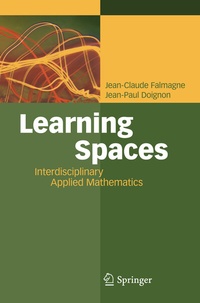
Learning Spaces
Description

Learning spaces offer a rigorous mathematical foundation for practical systems of educational technology. Learning spaces generalize partially ordered sets and are special cases of knowledge spaces. The various structures are investigated from the standpoints of combinatorial properties and stochastic processes.
Leaning spaces have become the essential structures to be used in assessing students' competence of various topics. A practical example is offered by ALEKS, a Web-based, artificially intelligent assessment and learning system in mathematics and other scholarly fields. At the heart of ALEKS is an artificial intelligence engine that assesses each student individually and continously.
The book is of interest to mathematically oriented readers in education, computer science, engineering, and combinatorics at research and graduate levels. Numerous examples and exercises are included, together with an extensive bibliography.
Reviews / Votes
From the reviews:
"The book deals with the construction of knowledge spaces and learning spaces . . Thus, the creative mathematician will find material capable of entertaining him or her for some time. The practitioner may be interested in applications. . there is no doubt that reading and working with this book will be rewarding for the mathematician and useful for scientists from very different areas. In many aspects it has the potential to serve as a guideline to a new and theoretically better founded form of psychometry." (Reinhard Suck, SIAM Review, Vol. 54 (2), 2012)
"This book is an enlarged second edition of the 1999 'Knowledge Spaces' by the same authors. . The authors cover both deterministic and probabilistic models, justify their findings and give good examples and applications, such as pattern recognition and medical diagnosis. . We recommend it to doctoral and postdoctoral studies." (George Stoica, Zentralblatt MATH, Vol. 1205, 2011)
More details
Other editions
Additional editions
Persons
Content
Overview and Mathematical Glossary.- Knowledge Structures and Learning Spaces.- Knowledge Spaces.- Well-Graded Families.- Surmise Systems.- Skill Maps, Labels and Filters.- Entailments and the Maximal Mesh.- Galois Connections.- Descriptive and Assessment Languages.- Greedoids, Learning Spaces, and Antimatroids.- Learning Spaces and Media.- Probabilistic Knowledge Structures.- Stochastic Learning Paths.- A Continuous Markov Procedure.- A Markov Chain Procedure.- Building a Knowledge Structure.- Building a Learning Space.- Applications.- Open Problems
