

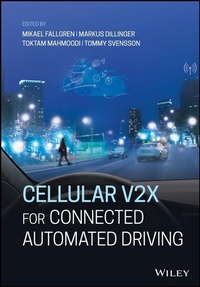
Cellular V2X for Connected Automated Driving
Description

A unique examination of cellular communication technologies for connected automated driving, combining expert insights from telecom and automotive industries as well as technical and scientific knowledge from industry and academia
Cellular vehicle-to-everything (C-V2X) technologies enable vehicles to communicate both with the network, with each other, and with other road users using reliable, responsive, secure, and high-capacity communication links. Cellular V2X for Connected Automated Driving provides an up-to-date view of the role of C-V2X technologies in connected automated driving (CAD) and connected road user (CRU) services, such as advanced driving support, improved road safety, infotainment, over-the-air software updates, remote driving, and traffic efficiency services enabling the future large-scale transition to self-driving vehicles. This timely book discusses where C-V2X technology is situated within the increasingly interconnected ecosystems of the mobile communications and automotive industries.
An expert contributor team from both industry and academia explore potential applications, business models, standardization, spectrum and channel modelling, network enhancements, security and privacy, and more. Broadly divided into two parts-introductory and advanced material-the text first introduces C-V2X technology and introduces a variety of use cases and opportunities, requiring no prerequisite technical knowledge. The second part of the book assumes a basic understanding of the field of telecommunications, presenting technical descriptions of the radio, system aspects, and network design for the previously discussed applications. This up-to-date resource:
- Provides technical details from the finding of the European Commission H2020 5G PPP 5GCAR project, a collaborative research initiative between the telecommunications and automotive industries and academic researchers
- Elaborates on use cases, business models, and a technology roadmap for those seeking to shape a start-up in the area of automated and autonomous driving
- Provides up to date descriptions of standard specifications, standardization and industry organizations and important regulatory aspects for connected vehicles
- Provides technical insights and solutions for the air interface, network architecture, positioning and security to support vehicles at different automation levels
- Includes detailed tables, plots, and equations to clarify concepts, accompanied by online tutorial slides for use in teaching and seminars
Thanks to its mix of introductory content and technical information, Cellular V2X for Connected Automated Driving is a must-have for industry and academic researchers, telecom and automotive industry practitioners, leaders, policymakers, and regulators, and university-level instructors and students. Additional resources available at the following site: Cellular V2X for Connected Automated Driving - 5GCAR
More details
Other editions
Additional editions
Persons
MIKAEL FALLGREN, PHD, is Senior Researcher at Ericsson Research, Stockholm, Sweden. He was project manager of the 5GCAR project, while also serving as chairman of the 5G PPP Automotive Working Group and vice-chair of the 5G PPP Steering Board. He joined Ericsson as Experienced Researcher in 2011 with focus on wireless access networks. He has been involved in several other European Projects, including EARTH, METIS, METIS-II and 5GCroCo.
MARKUS DILLINGER, Dipl.-Ing., is 5G R&D Head for vertical industry, Huawei Technologies, Munich, Germany. He was technical manager of the 5GCAR project. He joined Huawei as Head of Wireless Internet Technologies in 2010 where he led private and public R&D programs for car-to-car, ehealth and automation supporting 3GPP standardization and work for the vertical industry. He is currently member of 5G Health Association and member of 5GAA Executive Committee.
TOKTAM MAHMOODI, PHD, is Reader in Wireless Networks, and Director of the Centre for Telecommunications Research, King's College London, UK. She has worked in telecom industry and led number of research projects in the area of mobile and wireless networks, with applications in tele-health, mission-critical communication, industrial networking, and vehicular networks.
TOMMY SVENSSON, PHD, is full Professor, Chalmers University of Technology, Gothenburg, Sweden. He is leading research on air interface and wireless networking for access, backhaul/ fronthaul in mobile communications. He was deeply involved in European research towards 4G and 5G, and currently towards 6G. He has also experience from Ericsson AB on core-, radio access-, and microwave networks.
Content
List of Contributors xiii
Forewords xvii
Preface xxv
List of Abbreviations xxix
1 Introduction 1
1.1 Background and Motivation for C-V2X 2
1.1.1 Intelligent Transport Systems 2
1.1.2 Connected Automated Driving 3
1.1.3 Connected Road User Services 4
1.2 Toward a Joint Telecom and Automotive Roadmap for CAD 4
1.2.1 Telecom's Ambitions for Connected Driving 4
1.2.2 Automotive's Ambitions for Automated Driving 6
1.2.3 Joint Roadmap for CAD 7
1.3 Communication Technologies for CAD 8
1.3.1 Standardization of IEEE V2X 10
1.3.2 Standardization and Regulation Aspects of C-V2X 12
1.3.2.1 Available C-V2X Releases and Regulations 12
1.3.2.2 Future Requirements for C-V2X Releases and Regulations 13
1.4 Structure of this Book 14
References 18
2 Business Models 21
2.1 Current Market Analysis 22
2.2 Services Definition for CAD and CRU 23
2.2.1 Existing CAD and CRU Services 24
2.2.1.1 Emergency Call 24
2.2.1.2 Remote Diagnostics 24
2.2.1.3 Car Sharing 25
2.2.1.4 OTA Software Updates 25
2.2.1.5 Predictive Maintenance 25
2.2.1.6 Real-Time Road Traffic Management and Vehicle Guidance 25
2.2.2 Emerging CAD Services 25
2.2.2.1 Perception by Wireless Connectivity and Sensor Sharing 26
2.2.2.2 High-Definition Maps 26
2.2.3 Emerging CRU Services 26
2.2.3.1 Video Streaming and Gaming 26
2.2.3.2 Parking Reservations and Payment 26
2.3 Technical Components 27
2.4 Practicalities 28
2.4.1 Profile and SIM Card Provisioning 28
2.4.2 Routing Strategy 28
2.4.3 Roaming and Inter-operator Cooperation 29
2.4.4 Possible Business Model Evolution 29
2.4.4.1 OTA Software Updates 30
2.4.4.2 CAD Services and Related Automation Levels 31
2.5 Business Market Opportunities for V2X 34
2.5.1 CAD Business Model Enabled by 5G 34
2.5.1.1 Passive Infrastructure Sharing 37
2.5.1.2 Active Infrastructure Sharing, Excluding Spectrum Sharing 37
2.5.1.3 Active Infrastructure Sharing, Including Spectrum Sharing 37
2.5.2 Security Provision 38
2.5.2.1 The PKI Workflow 38
2.5.2.2 Enrollment of an ITS Station 39
2.5.2.3 Use of Authorizations Tokens 40
2.5.2.4 The Cost Hypothesis 40
2.5.3 OTA Software Updates 41
2.6 Business Model Analysis of 5G V2X Technical Components 44
2.6.1 Positioning 45
2.6.2 V2X Radio Design 46
2.6.2.1 Predictor Antenna 46
2.6.2.2 Beam-Forming 46
2.6.2.3 Efficiency 49
2.6.2.4 Reliability 49
2.6.2.5 Sidelink Out of Coverage 49
2.6.2.6 Sidelink in Coverage 49
2.6.3 Network Procedures 49
2.6.3.1 Local Standalone Network Procedures 51
2.6.3.2 Network Service Relationship Enhancement 51
2.6.3.3 Multi-Operator Solutions for V2X Communications 53
2.6.3.4 Network Orchestration and Management 53
2.6.4 End-to-End Security 54
2.6.5 Edge Computing Enhancements 55
2.6.6 Summary 58
2.7 Conclusions 58
References 60
3 Standardization and Regulation 63
3.1 Standardization Process Overview 64
3.1.1 General Aspects 64
3.1.2 Standardization and Regulation Bodies Relevant to ITS Specifications 64
3.1.2.1 International Telecommunication Union 65
3.1.2.2 Regional Standards Developing Organizations 66
3.1.2.3 3GPP, IEEE, and SAE 67
3.1.2.4 5G PPP and EATA 67
3.1.2.5 5GAA 68
3.1.3 3GPP Structure and Standardization Process 69
3.2 Regulatory Aspects and Spectrum Allocation 70
3.2.1 C-V2X Policy and Regulations in Europe 71
3.2.2 Radio Frequency Spectrum Allocation for V2X Communications 71
3.2.2.1 Spectrum Allocation for IMT Systems and 3GPP Technologies 71
3.2.2.2 Dedicated Spectrum for ITS Applications 72
3.2.2.3 Worldwide Spectrum Harmonization 73
3.3 Standardization of V2X Communication Technology Solutions 73
3.3.1 A Brief History of V2X Communication 74
3.3.2 Overview of DSRC/C-V2X Specifications Around the Globe 75
3.3.2.1 Europe 75
3.3.2.2 The Americas 76
3.3.2.3 Asia 77
3.3.3 C-V2X Standardization in 3GPP: Toward and Within 5G 79
3.3.3.1 C-V2X in 4G 80
3.3.3.2 C-V2X Supported by 5G 82
3.3.3.3 Future Plans 83
3.4 Application Aspects 84
3.4.1 EU Standardization 86
3.4.2 US Standardization 87
3.5 Summary 87
References 88
4 Spectrum and Channel Modeling 91
4.1 Spectrum and Regulations for V2X Communications 91
4.1.1 Spectrum Bands in Europe 92
4.1.1.1 ITS Spectrum at 5.9 GHz 92
4.1.1.2 5.8 GHz Frequency for Toll Collection 93
4.1.1.3 60 GHz ITS Band 93
4.1.1.4 IMT Bands in Europe 93
4.1.2 Spectrum Bands in Other Regions 94
4.1.2.1 United States 94
4.1.2.2 China 95
4.1.2.3 Other Regions of the World 96
4.1.3 Spectrum Auctions Worldwide 96
4.1.3.1 Europe 96
4.1.3.2 United States 104
4.1.3.3 Asia 105
4.1.3.4 Summary of Auctions and Cost Comparison Worldwide 108
4.1.4 Spectrum Harmonization Worldwide 111
4.1.4.1 Europe and Digital Single Market 111
4.1.4.2 World Radiocommunication Conference 2019 111
4.1.5 Summary 112
4.2 Channel Modeling 113
4.2.1 Propagation Environments 114
4.2.1.1 Link Types 114
4.2.1.2 Environments 114
4.2.2 Channel-Modeling Framework and Gap Analysis 116
4.2.3 Path-Loss Models 116
4.2.3.1 Path-Loss for V2V LOS Links 116
4.2.3.2 Shadow-Fading Models 121
4.2.3.3 Fast-Fading Parameters 122
4.2.3.4 Summary 123
4.2.4 Recent V2X Channel Measurements and Models 124
4.2.4.1 V2V Measurements in cmWave and mmWave 124
4.2.4.2 mmWave V2V (Sidelink) Channel Modeling 124
4.2.4.3 Multi-Link Shadowing Extensions 132
4.2.5 Summary 134
References 135
5 V2X Radio Interface 137
5.1 Beamforming Techniques for V2X Communication in the mm-Wave Spectrum 138
5.1.1 Beam Refinement for Mobile Multi-User Scenarios 139
5.1.1.1 Algorithm Description 140
5.1.1.2 Illustrative Performance Results 140
5.1.2 Beamformed Multicasting 143
5.1.3 Beam-Based Broadcasting 147
5.2 PHY and MAC Layer Extensions 152
5.2.1 Channel State Information Acquisition and MU-MIMO Receiver Design 152
5.2.1.1 The Importance and Challenges of Channel State Information Acquisition in MU-MIMO Systems 152
5.2.1.2 Interplay Between CSIR Acquisition and MU-MIMO Receiver Design 153
5.2.1.3 Novel Approaches to Near-Optimal MU-MIMO Linear Receiver Design and the Impact of CSIR Errors 156
5.2.1.4 Performance Modeling and Numerical Results in Multi-Antenna Cellular Vehicle Scenarios 157
5.2.2 Reference Signal Design 159
5.2.2.1 Challenges to CSI Acquisition in V2V Sidelink Communication 159
5.2.2.2 Reference Signal Design for V2V Sidelink 160
5.2.2.3 Performance Evaluation 163
5.2.3 Synchronization 164
5.2.4 Scheduling and Power Control 168
5.3 Technology Features Enabled by Vehicular Sidelink 172
5.3.1 UE Cooperation for Enhancing Reliability 173
5.3.1.1 Communication Scenario 173
5.3.1.2 Reliability Analysis - Channels with Equal Power 174
5.3.1.3 Evaluation 176
5.3.1.4 System Design Aspects 178
5.3.2 Full Duplex 181
5.3.2.1 Advantages of Full-Duplex Radio for C-V2X 182
5.4 Summary 184
References 185
6 Network Enhancements 191
6.1 Network Slicing 192
6.1.1 Network Slicing and 3GPP 192
6.1.2 Network Slicing and V2X 194
6.2 Role of SDN and NFV in V2X 196
6.3 Cloudified Architecture 199
6.4 Local End-to-End Path 200
6.5 Multi-Operator Support 202
6.6 Summary 205
References 205
7 Enhancements to Support V2X Application Adaptations 207
7.1 Background 208
7.2 Enhanced Application-Network Interaction for Handling V2X Use Cases 210
7.2.1 C-V2X Connectivity Negotiation 210
7.2.2 Use-Case-Aware Multi-RAT Multi-Link Connectivity 212
7.2.3 Location-Aware Scheduling 214
7.3 Redundant Scheduler for Sidelink and Uu 215
7.3.1 Application or Facilities Layer 216
7.3.2 Transport Level 219
7.3.3 RRC Level 220
7.4 Summary 221
References 221
8 Radio-Based Positioning and Video-Based Positioning 223
8.1 Radio-Based Positioning 225
8.1.1 Use Cases and Requirements 225
8.1.2 Radio-Based Positioning in New Radio Release 16 226
8.1.3 Radio-Based Positioning Beyond Release 16 228
8.1.3.1 The mmWave Channel 228
8.1.3.2 Signal Design 229
8.1.3.3 The Measurement Process 230
8.1.3.4 Localization, Mapping, and Tracking 231
8.1.4 Technology Component Complementation 233
8.1.5 Limitations of Radio-Based Positioning 235
8.1.6 Summary 236
8.2 Video-Based Positioning 237
8.2.1 Vehicle Positioning System Setup 237
8.2.2 Multi-Camera Calibration 239
8.2.3 Vehicle Detection 240
8.2.4 Vehicle Tracking 241
8.2.5 Vehicle Localization 241
8.2.6 Accuracy Evaluation 242
8.2.7 Summary 245
8.3 Conclusions 246
References 246
9 Security and Privacy 251
9.1 V2N Security 252
9.1.1 Security Challenges 253
9.1.2 Isolation Challenges 254
9.1.2.1 System Isolation (Between ECUs) 254
9.1.2.2 Network Isolation (Between Network Slices) 254
9.1.3 Software-Defined Vehicular Networking Security 255
9.1.3.1 Principles and Architecture 255
9.1.3.2 Security Benefits and Threats 255
9.2 V2V/V2I Security 256
9.2.1 Privacy 257
9.2.2 European Union Security Architecture 258
9.2.3 US Security Architecture 260
9.3 Alternative Approaches 261
9.4 Conclusion 262
References 262
10 Status, Recommendations, and Outlook 265
10.1 Future Prospects of C-V2X and the CAD Ecosystem 265
10.1.1 Future Needs for R&D and Standardization in C-V2X 266
10.1.2 Broader Aspects of CAD and CRU Services 268
10.2 Recommendations to Stakeholders 270
10.2.1 Mobile Network Operators 271
10.2.1.1 Network-Sharing Alternatives 271
10.2.1.2 New Business Models for Connected Vehicle Services 271
10.2.1.3 Roaming and Inter-Operator Cooperation 272
10.2.2 Original Equipment Manufacturers 272
10.2.2.1 Connecting Off-Board Sensors 272
10.2.2.2 Vehicle Processing Platforms Supported by Networks 273
10.2.2.3 Automotive Standardization 274
10.2.3 Regulators 274
10.2.3.1 Deployment, Coverage, and Road Infrastructure 274
10.2.3.2 Simplifying and Harmonizing Regulation 275
10.2.3.3 Data Sharing and Monetization 276
10.2.3.4 Spectrum Aspects 276
10.2.4 Suppliers and Certification 277
10.3 Outlook 278
References 279
Index 281
Preface
The mobile communications industry is on a path to using wireless connectivity to connect all kinds of vehicles and road users. The automotive industry and various transportation systems are part of this journey, with vehicles becoming increasingly aware of their immediate surrounding from various types of integrated onboard and external sensors. The knowledge acquired by vehicles can be shared locally by different types of short-range communication enablers, while long-range communication solutions can provide additional information with added value. With relevant information from both nearby and further away, a vehicle can adapt its behavior based on what lies ahead and thereby make more informed decisions.
Connected vehicles are among the primary enablers of safe, efficient automated driving both during the early stages of automation and in more advanced automation stages. There is, hence, a strong technology trend in which the mobile communications industry and the automotive industry are becoming interwoven to enable new functionalities and capabilities for future automated driving. In addition, there is strong, steady, increasing need for high-capacity mobile broadband to provide automotive cloud connectivity for onboard users. However, this transformation in the two industries needs to take place in tandem with other stakeholders and academic research to enable advanced solutions for traffic safety and increased driving comfort.
Globally, and for many years, stakeholders such as the telecom industry, vehicle manufacturers, traffic authorities, smart cities, and others related to transportation have recognized the value of cooperation through communication to increase safety and traffic efficiency and reduce energy consumption and pollution. In the coming decade, cellular vehicle-to-everything (C-V2X) is seen as an essential enabler of progress toward these societal and economic targets. In addition, various industry associations and standard-settings organizations are working jointly to facilitate fifth generation (5G) mobile network assisted driving and automation.
The 5G Communication Automotive Research and innovation (5GCAR) project, running from June 2017 to July 2019, played a pioneering role in bringing these two industry sectors together with substantial contributions to drive the joint vision forward. Discussions about working on a book mainly based on the 5GCAR project began at the launch of the project. We felt it was time to collect all the good work we were planning to do and disseminate it in a coherent and accessible way, while also reaching out to a broader audience than those who typically read our project deliverables and scientific publications. At that time, we also discussed the idea of potential publishers, but it wasn't until 2018 that we started more hands-on planning for the book. During IEEE Globecom 2018, we began to talk with Sandra Grayson at Wiley, and we felt that we had the same vision for a book on connected and automated driving.
You may also be interested to hear how the 5GCAR project got started, since there has been a lot of work behind it. It goes back to the early days of European-funded research toward 5G, initiated by European Commission Framework Program 7 (FP7) with the Mobile and Wireless Communications Enablers for the Twenty-Twenty Information Society (METIS) project, which started in November 2012. Six months later, METIS use cases like traffic efficiency and safety, traffic jams, blind spots, and real-time remote computing for mobile terminals were released. Back then, the telecom industry realized both the need for continued growth in the telecom sector and the potential for connecting various kind of machines for advanced information and communications technologies (ICT) solutions toward a smarter society. At this stage, several areas were identified as particularly promising, such as industrial production systems (Industry 4.0), smart grids, smart cities, safer and more efficient transportation systems, agriculture, and the use of ICT for health (eHealth). Thus, mobile communications were seen as having significant potential to act as key enablers for sustainability in the broad sense via digitalization. Some of these ideas and early requirements for 5G were summarized in four white papers by the 5G infrastructure Public Private Partnership (5G PPP) and one paper by the Next-Generation Mobile Network (NGMN) alliance in early 2015, and since then many 5G publications are now available.1 Back then, connected vehicles, smart grids, and smart manufacturing systems were identified as the most promising areas for early uptake. eHealth and smart grids have not yet taken off in a broad sense. Both intelligent transportation systems (ITS) to enable safe and efficient transport, and Industry 4.0 for more efficient and agile manufacturing, had good momentum. The strongest interest in 5G at this point turns out to come from the manufacturing and automotive industries. For these reasons, work planning within the 5G PPP took off to coordinate proposals to work closely with identified vertical key industries. In collaboration with the automotive sector, the identified key areas are cooperative ITS (C-ITS), connected automated driving (CAD), and connected road user (CRU) services. For instance, mobile networks and broadband-connected vehicles are already in many cars on the market. As a result, and in parallel, the 5G Automotive Association (5GAA) was launched in September 2016. The 5GAA has played an important role in the convergence of the telecom and automotive industries, and the establishment of the 5GCAR project was one of the early successful outcomes.
Through this engagement, the automotive industry came to realize that huge challenges lie ahead when it comes to digitalizing cars and relying on external industry partners for offloading of on-board processing. Connectivity and data storage and processing seem to be promising way forward. We believe the 5GCAR project has played an important role in the convergence of the telecom and automotive sectors to find common solutions, by creating a research environment in which telecom and automotive researchers and engineers have worked closely. We sincerely believe that such co-creation is the way for true transformation to happen by bringing people togther to solve problems. El Khamis Kadiri from the PSA Group concludes that "5GCAR has been a success story of how different sectors can work together to build new solutions and face the enormous challenges in the mobility domain to be faced in the coming years. Connectivity and 5G will be crucial tools"; and Magnus Eek at Volvo Cars adds that "The H2020 5GCAR final demonstration showed the benefit of sharing V2X sensor data between the 5G network system and connected vehicles to help to predict various dangerous scenarios and avoid them."
The material in this book originates primarily from such close collaborations in 5GCAR. The book's content is provided by researchers from partner institutions in the project. Hence, authors are from the telecom industry (Ericsson, Huawei, Nokia, and Orange), the automotive industry (PSA Group and Volvo Cars), an industrial equipment provider (Bosch), academia (King's College London and Chalmers University of Technology), research institutes (CTTC and CTAG), and small to medium-size enterprises (Sequans, Marben, and VISCODA). In June 2019, this team of researchers, in the form of the 5GCAR consortium, demonstrated cooperative maneuvers to enable and achieve a coordinated vehicle lane merge on a highway, cooperative perception in terms of see-through and long-range sensor sharing, as well as protection of vulnerable road users through cooperative safety. We have posted a few videos of these demos on the book's web page at Wiley. There you can also download background and supplementary material for this book, in the form of 5GCAR project deliverables, publications, tutorials, and presentations. Please have a look.
As a last note, we wish to thank all of the 5GCAR project partners who ensured the successful completion of the project. A special thanks to all of you who contributed as authors or editors to this book. We have enjoyed working with all of you in the 5GCAR project and toward this book!
1. Target Audience and Reader's Guide
The objective of this book is to promote recent joint telecom-automotive research on C-V2X communications solutions, to support their standardization, and to accelerate their commercial availability and global market penetration. The vision is to address society's connected mobility and road-safety needs with regard to applications such as assisted and autonomous driving, ubiquitous access to services, and integration into intelligent transportation. This book is designed to offer both introductory and in-depth knowledge of how mobile connectivity can pave the way to automated vehicles. Toward this end, it addresses - in addition to academia from the telecommunication and automotive sectors - experts and managers in industry, spectrum regulators, and road traffic authorities. We believe that mobile network operators, telecommunication...
