

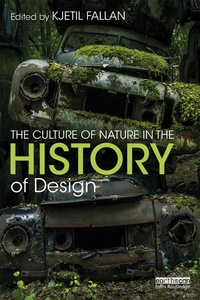
The Culture of Nature in the History of Design
1st Edition
Published on 26. March 2019
274 pages
978-0-429-89197-7 (ISBN)
Description

The Culture of Nature in the History of Design confronts the dilemma caused by design's pertinent yet precarious position in environmental discourse through interdisciplinary conversations about the design of nature and the nature of design. Demonstrating that the deep entanglements of design and nature have a deeper and broader history than contemporary discourse on sustainable design and ecological design might imply, this book presents case studies ranging from the eighteenth to the twenty-first century and from Singapore to Mexico. It gathers scholarship on a broad range of fields/practices, from urban planning, landscape architecture, and architecture, to engineering design, industrial design, furniture design and graphic design.
From adobe architecture to the atomic bomb, from the bonsai tree to Biosphere 2, from pesticides to photovoltaics, from rust to recycling - the culture of nature permeates the history of design. As an activity and a profession always operating in the borderlands between human and non-human environments, design has always been part of the environmental problem, whilst also being an indispensable part of the solution.
The book ventures into domains as diverse as design theory, research, pedagogy, politics, activism, organizations, exhibitions, and fiction and trade literature to explore how design is constantly making and unmaking the environment and, conversely, how the environment is both making and unmaking design. This book will be of great interest to a range of scholarly fields, from design education and design history to environmental policy and environmental history.
From adobe architecture to the atomic bomb, from the bonsai tree to Biosphere 2, from pesticides to photovoltaics, from rust to recycling - the culture of nature permeates the history of design. As an activity and a profession always operating in the borderlands between human and non-human environments, design has always been part of the environmental problem, whilst also being an indispensable part of the solution.
The book ventures into domains as diverse as design theory, research, pedagogy, politics, activism, organizations, exhibitions, and fiction and trade literature to explore how design is constantly making and unmaking the environment and, conversely, how the environment is both making and unmaking design. This book will be of great interest to a range of scholarly fields, from design education and design history to environmental policy and environmental history.
Reviews / Votes
'If, to Dieter Rams, good design is environmentally friendly, good design history is environmentally aware. Design history thrives when it interrogates the environmental complexities of human creations, and environmental historians can learn much of human behavior from design history. The essays in The Culture of Nature in the History of Design draw upon design histories of landscapes, communities, buildings, and materials around the world as different cultures, economic systems, and movements of resistance moved to create the new, create anew, to transform the discarded, and to reimagine the possible. The cumulative effect is a multifaceted conversation that systematically and profoundly examines the history of design's entanglements with nature, a conversation that promises to inspire important discussions in the future.'- Carl A. Zimring, author of Aluminum Upcycled: Sustainable Design in Historical Perspective
'The essays collected in The Culture of Nature in the History of Design offer fresh insights into environments and the objects that populate them. Its authors examine topics ranging from Victorian ecotopias to thermonuclear shelters, the totemic materiality of consumer goods to cybernetic mapping, desert and hydropower landscapes to "garbage housing" and cultures of D.I.Y. making, and experiments in postwar design pedagogy spanning continents and political systems. The volume's vivid mosaic of theoretically grounded essays challenges readers to reconsider humanity's making (and unmaking) of nature and the built environment.'
- Greg Castillo, College of Environmental Design, University of California, Berkeley
"The book is a significant offering, providing some valuable insights into where, why and how the history of design can contribute towards understanding humanity's evolving, and increasingly catastrophic, impacts on the global environment ... Its signal achievement is to create a licit space for historians of design to openly explore some of the most significant details of the recent past of 'sustainable design', whose history is still poorly understood and rather overshadowed by contemporary ideological preoccupations ... the book's linkage of this history to the more open theme of the 'culture of nature' ends up being a refreshing and rewarding one."
- Robert Crocker, Deputy Director, China Australia Centre for Sustainable Development, UniSA Creative, University of South Australia, Adelaide, Australia
More details
Edition
1. Auflage
Language
English
Place of publication
London
United Kingdom
Publishing group
Taylor & Francis Ltd
Target group
College/higher education
Product notice
Reflowable
Illustrations
7 Line drawings, black and white; 40 Halftones, black and white
File size
37,61 MB
ISBN-13
978-0-429-89197-7 (9780429891977)
Copyright in bibliographic data and cover images is held by Nielsen Book Services Limited or by the publishers or by their respective licensors: all rights reserved.
Schweitzer Classification
Other editions
Additional editions

Book
04/2019
1st Edition
Routledge
€206.60
Shipment within 10-20 days
Book
04/2019
1st Edition
Routledge
€71.40
Shipment within 10-20 days
Person
Kjetil Fallan is Professor of Design History at the University of Oslo and a founding member of the Oslo School of Environmental Humanities. He is the author of Designing Modern Norway: A History of Design Discourse (2017) and Design History: Understanding Theory and Method (2010), editor of Scandinavian Design: Alternative Histories (2012), and co-editor, with Grace Lees-Maffei, of the book series Cultural Histories of Design as well as the volumes Designing Worlds: National Design Histories in an Age of Globalization (2016) and Made in Italy: Rethinking a Century of Italian Design (2014).
Content
List of Illustrations
Notes on Contributors
Introduction: The Culture of Nature in the History of Design
Kjetil Fallan
Part 1: Conceptual Environments
Design's Ecological Operating Environments
Simon Sadler
Pattern Watchers I: Environmental Seeing, c. 1970
Larry Busbea
Computing Environmental Design
Peder Anker
Ludic Pedagogies at the College of Environmental Design, UC Berkeley, 1966 to 1972
Timothy Stott
Part 2: Ecotopian Landscapes
A Cityless and Countryless World: The Total Appropriation of Nature in Victorian Utopias
Nathaniel R. Walker
Clean and Disciplined: The Garden City in Singapore
Jesse O'Neill
Desertification, or Designing New Worlds in the Dust
Fattori Fraser
'There's a World Going on Underground': Ecotopian Realism in Subterranean Design
Even Smith Wergeland
Part 3: Design in the Garden
Contested Development: ICSID's Design Aid and Environmental Policy in the 1970s
Tania Messel
Power in the Landscape: Regenerating the Scottish Highlands after the Second World War
Frances Robertson
Design for the Garden: Questioning Gardening as Environmentalism
Jette Lykke Jensen
Permanence and Magic: Super-Natural Metaphors of Stainless Steel
Nicolas P. Maffei
Part 4: Design as Ecology
Forms of Human Environment (1970): Italian Design Responds to the Global Crisis
Elena Formia
Environmental Design Pedagogy in Leningrad in the 1980s
Yulia Karpova
Throwaway Houses: Garbage Housing and the Politics of Ownership
Curt Gambetta
The Unmaking of Autoprogettazione
Avinash Rajagopal and Vera Sacchetti
Index
Notes on Contributors
Introduction: The Culture of Nature in the History of Design
Kjetil Fallan
Part 1: Conceptual Environments
Design's Ecological Operating Environments
Simon Sadler
Pattern Watchers I: Environmental Seeing, c. 1970
Larry Busbea
Computing Environmental Design
Peder Anker
Ludic Pedagogies at the College of Environmental Design, UC Berkeley, 1966 to 1972
Timothy Stott
Part 2: Ecotopian Landscapes
A Cityless and Countryless World: The Total Appropriation of Nature in Victorian Utopias
Nathaniel R. Walker
Clean and Disciplined: The Garden City in Singapore
Jesse O'Neill
Desertification, or Designing New Worlds in the Dust
Fattori Fraser
'There's a World Going on Underground': Ecotopian Realism in Subterranean Design
Even Smith Wergeland
Part 3: Design in the Garden
Contested Development: ICSID's Design Aid and Environmental Policy in the 1970s
Tania Messel
Power in the Landscape: Regenerating the Scottish Highlands after the Second World War
Frances Robertson
Design for the Garden: Questioning Gardening as Environmentalism
Jette Lykke Jensen
Permanence and Magic: Super-Natural Metaphors of Stainless Steel
Nicolas P. Maffei
Part 4: Design as Ecology
Forms of Human Environment (1970): Italian Design Responds to the Global Crisis
Elena Formia
Environmental Design Pedagogy in Leningrad in the 1980s
Yulia Karpova
Throwaway Houses: Garbage Housing and the Politics of Ownership
Curt Gambetta
The Unmaking of Autoprogettazione
Avinash Rajagopal and Vera Sacchetti
Index
