

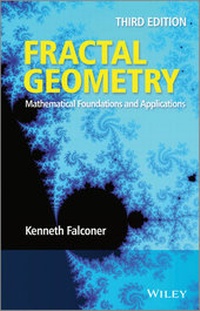
Fractal Geometry
Description

Reviews / Votes
"Falconer's book is excellent in many respects andthe reviewer strongly recommends it. May every university libraryown a copy, or three! And if you're a student reading this,go check it out today!." (Mathematical Associationof America, 11 June 2014)More details
Other editions
Additional editions

Person
Content
Preface to the first edition ix
Preface to the second edition xiii
Preface to the third edition xv
Course suggestions xvii
Introduction xix
Part I Foundations 1
1 Mathematical background 3
1.1 Basic set theory 3
1.2 Functions and limits 7
1.3 Measures and mass distributions 11
1.4 Notes on probability theory 17
1.5 Notes and references 24
Exercises 24
2 Box-counting dimension 27
2.1 Box-counting dimensions 27
2.2 Properties and problems of box-counting dimension 34
2.3 Modified box-counting dimensions 38
2.4 Some other definitions of dimension 40
2.5 Notes and references 41
Exercises 42
3 Hausdorff and packing measures and dimensions 44
3.1 Hausdorff measure 44
3.2 Hausdorff dimension 47
3.3 Calculation of Hausdorff dimension - simple examples 51
3.4 Equivalent definitions of Hausdorff dimension 53
3.5 Packing measure and dimensions 54
3.6 Finer definitions of dimension 57
3.7 Dimension prints 58
3.8 Porosity 60
3.9 Notes and references 63
Exercises 64
4 Techniques for calculating dimensions 66
4.1 Basic methods 66
4.2 Subsets of finite measure 75
4.3 Potential theoretic methods 77
4.4 Fourier transform methods 80
4.5 Notes and references 81
Exercises 81
5 Local structure of fractals 83
5.1 Densities 84
5.2 Structure of 1-sets 87
5.3 Tangents to s-sets 92
5.4 Notes and references 96
Exercises 96
6 Projections of fractals 98
6.1 Projections of arbitrary sets 98
6.2 Projections of s-sets of integral dimension 101
6.3 Projections of arbitrary sets of integral dimension 103
6.4 Notes and references 105
Exercises 106
7 Products of fractals 108
7.1 Product formulae 108
7.2 Notes and references 116
Exercises 116
8 Intersections of fractals 118
8.1 Intersection formulae for fractals 119
8.2 Sets with large intersection 122
8.3 Notes and references 128
Exercises 128
Part II Applications and Examples 131
9 Iterated function systems - self-similar and self-affine sets 133
9.1 Iterated function systems 133
9.2 Dimensions of self-similar sets 139
9.3 Some variations 143
9.4 Self-affine sets 149
9.5 Applications to encoding images 155
9.6 Zeta functions and complex dimensions 158
9.7 Notes and references 167
Exercises 167
10 Examples from number theory 169
10.1 Distribution of digits of numbers 169
10.2 Continued fractions 171
10.3 Diophantine approximation 172
10.4 Notes and references 176
Exercises 176
11 Graphs of functions 178
11.1 Dimensions of graphs 178
11.2 Autocorrelation of fractal functions 188
11.3 Notes and references 192
Exercises 192
12 Examples from pure mathematics 195
12.1 Duality and the Kakeya problem 195
12.2 Vitushkin's conjecture 198
12.3 Convex functions 200
12.4 Fractal groups and rings 201
12.5 Notes and references 204
Exercises 204
13 Dynamical systems 206
13.1 Repellers and iterated function systems 208
13.2 The logistic map 209
13.3 Stretching and folding transformations 213
13.4 The solenoid 217
13.5 Continuous dynamical systems 220
13.6 Small divisor theory 225
13.7 Lyapunov exponents and entropies 228
13.8 Notes and references 231
Exercises 232
14 Iteration of complex functions - Julia sets and the Mandelbrot set 235
14.1 General theory of Julia sets 235
14.2 Quadratic functions - the Mandelbrot set 243
14.3 Julia sets of quadratic functions 248
14.4 Characterisation of quasi-circles by dimension 256
14.5 Newton's method for solving polynomial equations 258
14.6 Notes and references 262
Exercises 262
15 Random fractals 265
15.1 A random Cantor set 266
15.2 Fractal percolation 272
15.3 Notes and references 277
Exercises 277
16 Brownian motion and Brownian surfaces 279
16.1 Brownian motion in R 279
16.2 Brownian motion in R n 285
16.3 Fractional Brownian motion 289
16.4 Fractional Brownian surfaces 294
16.5 Lévy stable processes 296
16.6 Notes and references 299
Exercises 299
17 Multifractal measures 301
17.1 Coarse multifractal analysis 302
17.2 Fine multifractal analysis 307
17.3 Self-similar multifractals 310
17.4 Notes and references 320
Exercises 320
18 Physical applications 323
18.1 Fractal fingering 325
18.2 Singularities of electrostatic and gravitational potentials 330
18.3 Fluid dynamics and turbulence 332
18.4 Fractal antennas 334
18.5 Fractals in finance 336
18.6 Notes and references 340
Exercises 341
References 342
Index 357
