

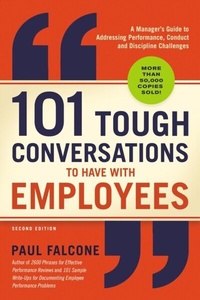
101 Tough Conversations to Have with Employees 3rd Edition
Description

101 Tough Conversations to Have with Employees provides guidance for managers on how to broach uncomfortable conversations across a wide range of issues.
Inappropriate workplace conduct, lateness, sexually offensive behavior, productivity and communication issues . . . these are just a few of the uncomfortable topics supervisors must sometimes discuss with their employees.
Top human resources author Paul Falcone offers realistic sample dialogues managers can use to facilitate clear, direct interactions with their employees that help sidestep potential awkwardness and meet issues head-on.
This practical, solution-oriented book walks you through some of the most common and most serious employee problems you are likely to encounter.
In 101 Tough Conversations to Have with Employees, Falcone covers topics including:
- substandard performance reviews,
- progressive disciplinary warnings and termination meetings,
- FMLA abuse and ADA accomodations,
- wage and hour challenges,
- team turnarounds,
- compensation conflicts, and more.
This handy guide helps you treat their people with dignity and respect, focusing not just on what to say but also on how to say it. It provides proven techniques you can use to protect yourself and your organizations-and get the very best from your people.
More details
Other editions
Additional editions

Person
Paul Falcone is principal of Paul Falcone Workplace Leadership Consulting, LLC, specializing in management and leadership training, executive coaching, international keynote speaking, and facilitating corporate offsite retreats. He is the former CHRO of Nickelodeon Animation Studios and has held senior-level HR positions with Paramount Pictures, Time Warner, and City of Hope. He has extensive experience in entertainment, healthcare/biotech, and financial services, including in international, nonprofit, and union environments.
Paul is the author of seventeen books, many of which have been ranked as #1 Amazon bestsellers in the categories of human resources management, business and organizational learning, labor and employment law, business mentoring and coaching, business conflict resolution and mediation, communication in management, and business decision-making and problem-solving. His books have been translated into Chinese, Hindi, Russian, Korean, Vietnamese, Indonesian, and Turkish and have sold in excess of 750,000 copies worldwide.
Paul is a certified executive coach through the Marshall Goldsmith Stakeholder Centered Coaching program, a long-term columnist for SHRM.org and HR Magazine, an adjunct faculty member in UCLA Extension's School of Business and Management, and a member of the board of directors of the American Management Association. He is an accomplished keynote presenter, in-house trainer, and webinar facilitator in the areas of hiring, talent and performance management, leadership development, workplace ethics, and effective leadership communication.
Content
- Cover
- Title Page
- Copyright
- Contents
- Preface
- Acknowledgments
- Introduction to the Second Edition
- Part I: Uncomfortable Workplace Situations
- 1. Common Managerial and Supervisory Discussions
- Scenario 1: Establishing Your Leadership Brand
- Scenario 2: Mediating Disputes Among Subordinates
- Scenario 3: Appropriate Responses to Requests to Speak "Off the Record"
- Scenario 4: Inheriting an Employee with Disciplinary Problems
- Scenario 5: Stopping Attitude Problems in Their Tracks
- Scenario 6: Advice Before a Holiday Party or an Offsite Event
- 2. Individual Appearance and Uncomfortable Workplace Dilemmas
- Scenario 7: Bad Hair Days
- Scenario 8: Inappropriate Dress
- Scenario 9: Body Piercing and Body Art
- Scenario 10: Inappropriate Tattoos
- Scenario 11: Halitosis (Bad Breath)
- Scenario 12: Body Odor from Lack of Cleanliness
- Scenario 13: Body Odor from a Suspected Medical Reason
- 3. Cultural and Social Differences
- Scenario 14: Euphemisms like "Honey," "Sweetie," and "Doll"
- Scenario 15: Speaking Foreign Languages in the Workplace
- Scenario 16: Inappropriate Displays of Sexually Explicit Material
- Scenario 17: Lack of Understanding of Multicultural Differences
- Part II: Job Performance Concerns
- 4. Performance Transgressions
- Scenario 18: Lack of Quality, Detail, or Efficiency
- Scenario 19: Lack of Quantity or Speed
- Scenario 20: Substandard Customer Satisfaction
- Scenario 21: Lack of Sales Production
- Scenario 22: Failure to Follow Through, or "Dropping the Ball"
- 5. Policy and Procedure Violations
- Scenario 23: Failure to Adhere to Safety Rules
- Scenario 24: Excessive Personal Telephone Calls
- Scenario 25: Excessive Time Spent on the Internet
- Scenario 26: Unauthorized Use of Company Equipment and Facilities
- Scenario 27: Wage and Hour Challenges-Failure to Adhere to Rest and Meal Periods
- Scenario 28: Working Unauthorized Overtime
- Scenario 29: Off-Duty Conduct and Moonlighting
- 6. Excessive Absenteeism or Tardiness and FMLA/ADA Issues
- Scenario 30: Excessive Unscheduled Absence: "No-Fault" System
- Scenario 31: Excessive Unscheduled Absence: "Excuse-Based" System
- Scenario 32: Patterning Excessive, Unscheduled Absence Around Weekends
- Scenario 33: Rolling Calendar Year Maneuvers
- Scenario 34: Excessive Tardiness
- Scenario 35: Exempt Employees Who Choose to Come and Go as They Please
- Scenario 36: FMLA Abuse: Failure to Provide Appropriate Medical Documentation
- Scenario 37: FMLA Abuse: Failure to Follow the Terms of the Medical Certification
- Scenario 38: FMLA Extension: Engaging in the ADA Interactive Process
- 7. Lack of Requisite Skills
- Scenario 39: Inferior Job Knowledge
- Scenario 40: Lack of Technical Skills
- Scenario 41: Inadequate Problem-Solving Skills
- Scenario 42: Substandard Written Expression
- Scenario 43: Poor Time Management
- Scenario 44: Lack of Organization and Neatness
- Part III: Inappropriate Workplace Behavior And Conduct
- 8. Sexually Offensive Behavior
- Scenario 45: Foul Language in the Workplace
- Scenario 46: Email Misuse
- Scenario 47: Finding Pornography on an Employee's Computer
- Scenario 48: Bullying
- Scenario 49: Discriminatory Comments or Racial Epithets
- Scenario 50: Leering
- Scenario 51: Sexual Harassment Findings (Reverse Harassment)
- Scenario 52: Sexual Harassment and "the Talk"-Stopping Problematic Behaviors Dead in Their Tracks
- Scenario 53: Sexual Harassment and Culture Change-Creating a Healthy and Respectful Work Environment (Beyond Training 101!)
- 9. Substandard Communication Skills
- Scenario 54: Gossips, Rumormongers, and Snitches
- Scenario 55: Whiners and Complainers
- Scenario 56: Requests for Confidential Conversations from Other Supervisors' Subordinates
- Scenario 57: Poor Listening Skills
- Scenario 58: Failure to Communicate Upward
- 10. Personal Style Issues
- Scenario 59: Suspected Alcoholism or Substance Abuse
- Scenario 60: Inability to Accept Constructive Criticism
- Scenario 61: Lack of Sensitivity and Protocol (Email Censuring)
- Scenario 62: Badgering and Challenging One's Supervisor
- Scenario 63: Lack of Teamwork and Relationship-Building Skills
- Scenario 64: On the Brink of Failure-Turning Around Teams That Are About to Implode
- Scenario 65: Laziness and Lack of Commitment
- Scenario 66: Blamers and Excuse Makers
- Scenario 67: Coworker Jealousy and Employees Who Can't Let Go of Their Anger
- Scenario 68: Supremacists-Arrogance and Superior Attitudes
- Scenario 69: Stubborn Employee Challenges-Entitlement, Resistance to Change, and Overt Defensiveness and Hostility
- 11. Leadership Style Challenges and Career Management Obstacles
- Scenario 70: Unwillingness to Confront Problems Head-On
- Scenario 71: Staff Motivation Conversations
- Scenario 72: Protecting Your Company from Legal Liabiliy (Documentation)
- Scenario 73: Inability to Provide Constructive Criticism
- Scenario 74: Handling Group Complaints Wisely
- Scenario 75: Lack of Diversity Awareness
- Scenario 76: Lack of Leadership-Risk Avoidance Gone Wild
- Scenario 77: Lack of Leadership-Resetting Expectations when Turnover Becomes a Problem
- Scenario 78: Lack of Leadership-Failure to Partner Appropriately with Human Resources
- Scenario 79: Unacceptable Skip-Level Findings for Directors and Above
- Part IV: Corporate Actions
- 12. Corporate (Intentional) Actions
- Scenario 80: Probationary Termination
- Scenario 81: Performance Review Bombshells: Surprising Employees with New Information at the Time of the Annual Appraisal
- Scenario 82: Performance Review Bombshells: When a "Meets Expectations" Score Is Issued in Error
- Scenario 83: Correcting for Grade Inflation Across Your Department, Division, or the Entire Company
- Scenario 84: Administering Disciplinary Warnings
- Scenario 85: A Final Written Warning as an Alternative to Outright Termination for Senior Managers
- Scenario 86: Administering Decisionmaking Leaves
- Scenario 87: Termination for Cause (in Conjunction with Progressive Discipline)
- Scenario 88: Convincing an Employee to Leave Voluntarily When There Are No Progressive Disciplinary Warnings on File
- Scenario 89: Negotiating a Separation Package When There Are No Progressive Disciplinary Warnings on File
- 13 Corporate ("No Fault") Actions
- Scenario 90: Layoff: Position Elimination-LIFO
- Scenario 91: Layoff: Position Elimination-Lack of Qualifications
- Scenario 92: Layoff: Position Elimination-Union Bumping Privileges
- Scenario 94: Layoff: Position Elimination-Plant Closure (WARN Act)
- Scenario 95: Follow-Up Discussions with Survivors After Layoffs Occur
- 14. Summary Offenses (Immediate Discharge)
- Scenario 96: Employee Theft
- Scenario 97: Time Card Fraud
- Scenario 98: Threats of Violence in the Workplace
- Scenario 99: Sexual Harassment
- Scenario 100: Insubordination
- 15. Special Circumstances
- Scenario 101: Compensation Conflicts-Dealing with Raise Requests Based on Internet Research
- Scenario 102: Compensation Conflicts-No Annual Increase Due to Low Performance Review Score
- Scenario 103: Compensation Conflicts-Denial of a Raise Due to Budget Considerations, Internal Equity Challenges, or Being "Red Circled" at the Top of the Salary Range
- Scenario 104: Compensation Conflicts-When Employees Inflate Their Worth While Drafting Self-Reviews
- Scenario 105: Terminating Employees Who Are on Investigatory Leave
- Scenario 106: Verbally Accepting an Employee's Resignation
- Closing Note
- Index

