

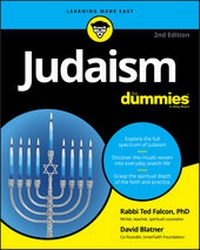
Judaism For Dummies
Description

Whether you're interested in the religion or the spirituality, the culture or the ethnic traditions, Judaism For Dummies explores the full spectrum of Judaism, dipping into the mystical, meditative, and spiritual depth of the faith and the practice.
In this warm and welcoming book, you'll find coverage of: Orthodox Jews and breakaway denominations; Judaism as a daily practice; the food and fabric of Judaism; Jewish wedding ceremonies; celebrations and holy days; 4,000 years of pain, sadness, triumph, and joy; great Jewish thinkers and historical celebrities; and much more.
* Updates to the "recent history" section with discussions of what has happened in the first decade of the twenty-first century including: the expansion of orthodox political power in Israel; expansion of interfaith work; unfortunate recent anti-Semitic events; and other news
* Expanded coverage of Jewish mysticism and meditation, which has become increasingly popular in recent years
* New coverage on Jewish views of morality, including birth control, homosexuality, and environmental concerns
* Revised recipes for traditional Jewish cooking, updated key vocabulary, and Yiddish phrases everyone should know
Jews have long spread out to the corners of the world, so there are significant Jewish communities on many continents. Judaism For Dummies offers a glimpse into the rituals, ideas, and terms that are woven into the history and everyday lives of Jewish people as near as our own neighborhoods and as far-reaching as across the world.
P.S. If you think this book seems familiar, you re probably right. The Dummies team updated the cover and design to give the book a fresh feel, but the content is the same as the previous release of Judaism For Dummies (9781118407516). The book you see here shouldn t be considered a new or updated product. But if you re in the mood to learn something new, check out some of our other books. We re always writing about new topics!
More details
Other editions
Additional editions
Content
Part 1: What Jews Generally Believe 9
Chapter 1: That's Funny, You Don't Look Jewish: Who's a Jew and Why 11
Chapter 2: It's All One: Judaism and God 25
Chapter 3: A Never-Ending Torah: The Unfolding of a Tradition 35
Chapter 4: A Path of Blessing: Judaism as a Daily Practice 47
Chapter 5: Jewish Mysticism 71
Chapter 6: Ethical Challenges 91
Part 2: From Womb to Tomb: The Life Cycle 107
Chapter 7: In the Beginning: Birth and Bris 109
Chapter 8: Coming of Age: The Bar/Bat Mitzvah 119
Chapter 9: Get Me to the Chuppa On Time: Weddings 127
Chapter 10: Stepping Through the Valley: The Shadow of Death 139
Part 3: An Overview of Jewish History 153
Chapter 11: Let My People Go: From Abraham to Exodus 155
Chapter 12: The Kings of Israel: The First Temple 167
Chapter 13: Bracketed by Exile: The Second Temple 177
Chapter 14: The Exiles Continue: The First Millennium 185
Chapter 15: The Greatest Horror, the Greatest Triumph 197
Chapter 16: Jewish Buddhists and Other Challenges of the New Age 215
Chapter 17: The Problem of Anti-Semitism 225
Part 4: Celebrations and Holy Days 237
Chapter 18: A Taste of Paradise: Shabbat 239
Chapter 19: In with the New: Rosh Hashanah 257
Chapter 20: Getting Serious: Yom Kippur 271
Chapter 21: The Great Outdoors: Sukkot 283
Chapter 22: Seeking Light in Dark Times: Chanukkah 293
Chapter 23: Celebrating Renewal: Tu B'Shvat 305
Chapter 24: A Jewish Carnival: Purim 309
Chapter 25: From Groan to Glee: Passover 319
Chapter 26: Spring Is Busting Out All Over: Shavuot 345
Chapter 27: A Day of Mourning: Tisha B'Av 357
Part 5: The Part of Tens 361
Chapter 28: Ten People Who Helped Shape Judaism 363
Chapter 29: Answers to Ten Common Questions about Judaism 371
Part 6: Appendixes 383
Appendix A: Oy Vey! and Other Words You Should Know 385
Appendix B: A Sampler of Jewish Prayers and Blessings 397
Appendix C: Go Now and Learn 405
Index 411
Introduction
We're amazed by how many people have become interested in Judaism in recent years. Some people interested in Judaism are in search of meaningful connections to the past. Some have a hunger for deeper understanding and ritual, a longing for something precious to pass on to their children, something nourishing and loving to live by. For many Jews (and non-Jews, too) this has meant exploring the rich tapestry of Judaism - some discovering the religion for the first time, others re-examining the lost or forgotten traditions from their youth.
For non-Jews, perhaps this interest follows an increasing awareness of the significance of Judaism as the source and inspiration for both Jesus and the "Old Testament." People seem to have a greater openness these days to appreciating the depth of Judaism without seeing it as a threat to other faiths.
For Jews, perhaps this resurgence of interest stems from a community recovering from Holocaust horrors and rediscovering that the faith and practice still exist. Certainly, much of the interest seems to come from the increasing realization that Judaism has much to offer in the mystical, meditative, and spiritual realms.
About This Book
The problem facing many people interested in Judaism is that the vast majority of Jewish books on the market today either tackle one particular subject in great depth (such as 300 pages just on the holiday of Sukkot), or they approach Judaism from an orthodox perspective ("These are the 613 things you should do if you know what's good for you"). We don't find anything wrong with either of these approaches, but we want to offer something different. We believe that even a subject as deep and important as Judaism can be fun to read about. And the more you find out about the subject, the more fun it is.
With that in mind, we offer you Judaism For Dummies. Wherever you're coming from - whether you're interested in the religion or the spirituality, the culture or the ethnic traditions - this book offers you a glimpse into Judaism that you've never seen before, one that helps you appreciate what all the excitement is about.
Even better, we've packaged all this great information in easy-to-read chapters that are organized in easy-to-access chunks.
Conventions Used in This Book
We use practices throughout this book that might take some getting used to. First, when we discuss dates, we don't use BC and AD, because they're based on Christian theology. Instead, we use BCE ("Before the Common Era") and CE ("in the Common Era").
We also do our best not to assign a gender to God. As we describe in Chapter 2, Judaism makes it very clear that God is neither male nor female. However, when we feel that something is being lost by not using masculine or feminine pronouns, we leave them in.
Additionally, to help you navigate this book as you begin to navigate the world of Judaism, we use the following conventions:
- Italic text highlights new words and defined terms. We italicize Hebrew words when we first define them and then use regular font for subsequent appearances of the term.
- Boldfaced text indicates keywords in bulleted lists and the action part of numbered steps.
Monofont
Pronouncing Jewish Words
You can't read about Judaism without bumping into the Hebrew language, and we include a lot of Hebrew throughout this book. However, there are a few things you need to know about reading Hebrew. For example, the Hebrew language is read right-to-left.
Cha, Kha, Ha!
Hebrew doesn't have a "ch" sound, like the English words "chew" or "lunch." The sound just doesn't exist!
On the other hand, English doesn't have that guttural, throat-clearing sound like the Scottish make when they say "Loch Ness" (like saying "ha" down in your throat instead of in your mouth), and Hebrew does. In most cases we transliterate ("spell out the way it sounds") this "kh" sound. However, for a few words that are better known, such as "Chanukkah" and "challah," we use "ch" because that's how they are usually spelled. Even though we spell them using "ch," you should use the guttural sound when you see words such as "Chanukkah" or "challah."
Yiddish - that Eastern European mixture of Hebrew, German, and Slavic languages - does have the English "ch" sound, and every now and again, we include words that use this sound (like "boychik" and "kvetch"). In these few instances, we let you know which pronunciation to use.
You say Tomato, I say Tomaso
There is one letter in the Hebrew alphabet that Ashkenazi Jews have traditionally pronounced "sav" and Sephardi Jews have pronounced "tav." The result is that many words can be pronounced correctly in two ways. For example, Shabbat and Shabbos are both correct. Modern Israeli Hebrew follows the Sephardic tradition (with the hard "t"), but many descendants of Eastern European Jews prefer the softer "s" sound.
In this book, we almost always use the Modern Israeli pronunciation. If you're more comfortable with "bris" (rather than "brit"), "Shavuos" (rather than "Shavuot"), or "B'reishees" (rather than "B'reisheet"), don't call our publisher and complain - just swap them in your head.
Also note that Israelis tend to place the emphasis of a word on the last syllable, where Westerners tend to place it on an earlier syllable. So, you hear "Shah-vu-oht" instead of "Sha-vu-ohs," or "mah-zahl tov" instead of "mah-zel tov."
Pronouncing vowels
Hebrew vowels are pronounced almost like Spanish or Japanese vowels: the a is said "ah," o is "oh," e is "eh," i is "ee," and u is "oo." For example, Magen David (the star of David) is pronounced "mah-gehn dah-veed," and Tikkun Olam ("the repair of the world") is pronounced "tee-koon oh-lahm." Whenever possible, we include pronunciation keys throughout the book.
About the translations
Translating one language into another always requires interpretation and compromise. The translations of Hebrew that you see in this book - which are either our own or came from traditional Jewish sources - may be significantly different than those in other books. If you find two different translations for the same text, there's a good chance that both are true, depending on your perspective, and that there are lessons to appreciate from both versions.
Foolish Assumptions
When writing this book, we assumed that our readers didn't know anything about Jews and Judaism. Toward that end, we explain all the rituals, ideas, and terms that you need to know in a way that you can understand, even if you're reading about these things for the first time.
In fact, when it comes to Judaism, being a "dummy" isn't just tolerated - it's actively encouraged, and has been for over 2,000 years. Each spring, during the holiday called Passover (see Chapter 25), Jews around the world reread a book called the Haggadah. The book tells the story of how the Hebrews escaped Egyptian slavery about 3,300 years ago, and it supplements the tale with a bunch of other poems, songs, and fables, including one about the following four children:
- The "Wise" child searches for depth and meaning in the Passover story, trying to find hidden connections and spiritual truths in the holiday.
- The "Wicked" child, whose rebellious nature requires detailed explanations for everything, demands that the holiday's rituals be relevant in his or her own life.
- The "Simple" child just smiles, saying, "Tell me what to do and I'll do it." This child wants to know how but not why, and finds deep comfort in the rituals themselves.
- The "dummy" that the title of this book refers to is the fourth child. This child hungers for knowledge but doesn't know where to begin. The Haggadah describes the fourth child only as the "One who doesn't know enough to ask a question."
Centuries of rabbis have taught that all these children live within each of us, and that you must celebrate them all - and especially the dummy inside.
This book is designed for all four of your inner children. Sometimes you may say, "Listen, I just want to know how this ritual is done." So we describe rituals and give you step-by-step instructions. Other times you may want to stomp your feet and say, "What is this tradition? How is it relevant to me?" That's good! Sometimes everyone needs to express some rebelliousness, so we discuss those things in the book, too.
If...
