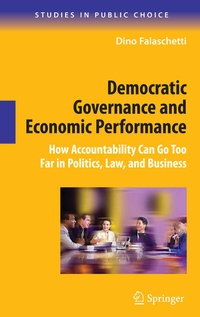
Democratic Governance and Economic Performance
Description

Conventional wisdom warns that unaccountable political and business agents can enrich a few at the expense of many. But logically extending this wisdom implies that associated principals - voters, consumers, shareholders - will favor themselves over the greater good when 'rules of the game' instead create too much accountability. Democratic Governance and Economic Performance rigorously develops this hypothesis, and finds statistical evidence and case study illustrations that democratic institutions at various governance levels (e.g., federal, state, corporation) have facilitated opportunistic gains for electoral, consumer, and shareholder principals. To be sure, this conclusion does not dismiss the potential for democratic governance to productively reduce agency costs. Rather, it suggests that policy makers, lawyers, and managers can improve governance by weighing the agency benefits of increased accountability against the distributional costs of favoring principal stakeholders over more general economic opportunities. Carefully considering the fundamentals that give rise to this tradeoff should interest students and scholars working at the intersection of social science and the law, and can help professionals improve their own performance in policy, legal, and business settings.
Reviews / Votes
"Falaschetti skillfully synthesizes key ideas from social choice theory, organizational economics, and interest group politics to challenge conventional wisdom about the benefits of democratic governance in organizations. This is an important book for reforming how financial institutions are regulated, and corporations are governed, in the wake of the great financial market collapse of 2008." (Margaret Blair, Vanderbilt Law)
"The scope of Democratic Governance and Economic Performance is truly commendable. While legal scholars, economists, and political scientists have raised parts of these issues before, by addressing the topic from both theoretical and empirical levels, this book provides useful perspective to anyone interested in the relationship between governance institutions and firm performance." (Jon Klick, Penn Law)
"This insightful book shares with Madison's "Federalist #10" a concern for potentially disruptive effects from "majority factions". Falaschetti reminds us that some of our most costly policies result from democratic responsiveness, while some of our most successful policies come from organizations (e.g. courts, the Fed) that insulate us from democratic pressures." (Gary Miller, Washington University, Political Science)
More details
Other editions
Additional editions