

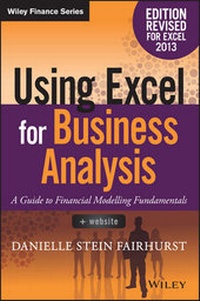
Using Excel for Business Analysis
Description

More details
Other editions
Additional editions
Previous edition
Person
Content
Preface ix
CHAPTER 1 What Is Financial Modelling? 1
What's the Difference between a
Spreadsheet and a Financial Model? 4
Types and Purposes of Financial Models 5
Tool Selection 6
What Skills Do You Need to Be a Good Financial Modeller? 17
The Ideal Financial Modeller 24
Summary 28
CHAPTER 2 Building a Model 31
Model Design 31
The Golden Rules for Model Design 33
Design Issues 35
The Workbook Anatomy of a Model 36
Project Planning Your Model 38
Model Layout Flow Charting 41
Steps to Building a Model 41
Information Requests 50
Version-Control Documentation 51
Summary 53
CHAPTER 3 Best Practice Principles of Modelling 55
Document Your Assumptions 55
Linking, Not Hard Coding 56
Enter Data Only Once 57
Avoid Bad Habits 57
Use Consistent Formulas 57
Format and Label Clearly 58
Methods and Tools of Assumptions Documentation 59
Linked Dynamic Text Assumptions Documentation 67
What Makes a Good Model? 70
Summary 72
CHAPTER 4 Financial Modelling Techniques 73
The Problem with Excel 73
Error Avoidance Strategies 75
How Long Should a Formula Be? 81
Linking to External Files 83
Building Error Checks 86
Summary 96
CHAPTER 5 Using Excel in Financial Modelling 97
Formulas and Functions in Excel 97
Excel Versions 101
Handy Excel Shortcuts 103
Basic Excel Functions 109
Logical Functions 112
Nesting: Combining Simple Functions to
Create Complex Formulas 115
Cell Referencing Best Practices 119
Named Ranges 122
Summary 126
CHAPTER 6 Functions for Financial Modelling 127
Aggregation Functions 127
LOOKUP Formulas 140
Nesting INDEX and MATCH 153
OFFSET Function 157
Regression Analysis 161
CHOOSE Function 164
Working with Dates 166
Financial Project Evaluation Functions 174
Loan Calculations 180
Summary 186
CHAPTER 7 Tools for Model Display 187
Basic Formatting 187
Custom Formatting 187
Conditional Formatting 193
Sparklines 200
Bulletproofing Your Model 204
Customising the Display Settings 208
Form Controls 216
Summary 232
CHAPTER 8 Tools for Financial Modelling 233
Hiding Sections of a Model 233
Grouping 238
Array Formulas 240
Goal Seeking 247
Structured Reference Tables 249
PivotTables 251
Macros 262
Summary 272
CHAPTER 9 Common Uses of Tools in Financial Modelling 273
Escalation Methods for Modelling 273
Understanding Nominal and Effective (Real) Rates 278
Calculating Cumulative Totals 283
How to Calculate a Payback Period 284
Weighted Average Cost of Capital (WACC) 288
Building a Tiering Table 293
Modelling Depreciation Methods 296
Break-Even Analysis 307
Summary 313
CHAPTER 10 Model Review 315
Rebuilding an Inherited Model 315
Improving Model Performance 323
Auditing a Financial Model 328
Summary 335
Appendix 10.1: QA Log 336
CHAPTER 11 Stress-Testing, Scenarios, and Sensitivity Analysis in Financial Modelling 337
What Are the Differences between Scenario, Sensitivity, and What-If Analyses? 338
Overview of Scenario Analysis Tools and Methods 340
Advanced Conditional Formatting 349
Comparing Scenario Methods 353
Summary 365
CHAPTER 12 Presenting Model Output 367
Preparing an Oral Presentation for Model Results 367
Preparing a Graphic or Written Presentation for Model Results 369
Chart Types 372
Working with Charts 380
Handy Charting Hints 386
Dynamic Named Ranges 388
Charting with Two Different Axes and Chart Types 394
Bubble Charts 400
Creating a Dynamic Chart 402
Waterfall Charts 407
Summary 420
About the Author 421
About the Website 423
Index 425
CHAPTER 1
What Is Financial Modelling?
There are all sorts of complicated definitions of financial modelling, and in my experience there is quite a bit of confusion around what a financial model is exactly. A few years ago, we put together a Plum Solutions survey about the attitudes, trends, and uses of financial modelling, asking respondents, "What do you think a financial model is?" Participants were asked to put down the first thing that came to mind, without any research or too much thinking about it. I found the responses interesting, amusing, and sometimes rather disturbing.
Some answers were overly complicated and highly technical:
- "Representation of behaviour/real-world observations through mathematical approach designed to anticipate range of outcomes."
- "A set of structured calculations, written in a spreadsheet, used to analyse the operational and financial characteristics of a business and/or its activities."
- "Tool(s) used to set and manage a suite of variable assumptions in order to predict the financial outcomes of an opportunity."
- "A construct that encodes business rules, assumptions, and calculations enabling information, analysis, and insight to be drawn out and supported by quantitative facts."
- "A system of spreadsheets and formulas to achieve the level of record keeping and reporting required to be informed, up-to-date, and able to track finances accurately and plan for the future."
Some philosophical:
- "A numerical story."
Some incorrect:
- "Forecasting wealth by putting money away now/investing."
- "It is all about putting data into a nice format."
- "It is just a mega-huge spreadsheet with fancy formulas that are streamlined to make your life easier."
Some ridiculous:
- "Something to do with money and fashion?"
Some honest:
- "I really have no idea."
And some downright profound:
- "A complex spreadsheet."
There are many (often very complicated and long-winded) definitions available from different sources, but I actually prefer the last, very broad, but accurate description: "a complex spreadsheet." Whilst it does need some definition, a financial model can pretty much be whatever you need it to be.
As long as a spreadsheet has inputs and outputs, and is dynamic and flexible-I'm happy to call it a financial model! Pretty much the whole point of financial modelling is that you change the inputs and the outputs. This is the major premise behind scenario and sensitivity analysis-this is what Excel, with its algebraic logic, was made for! Most of the time, a model will contain financial information and serve the purpose of making a financial decision, but not always. Quite often it will contain a full set of financial statements: profit and loss, cash flow, and balance sheet; but not always.
According to the more staid or traditional definitions of financial modelling, the following items would all most certainly be classified as financial models:
- A business case that determines whether or not to go ahead with a project.
- A five-year forecast showing profit and loss, cash flow, and balance sheet.
- Pricing calculations to determine how much to bid for a new tender.
- Investment analysis for a joint venture.
But what about other pieces of analysis that we perform as part of our roles? Can these also be called financial models? What if something does not contain financial information at all? Consider if you were to produce a spreadsheet for the following purposes:
- An actual-versus-budget monthly variance analysis that does not contain scenarios and for which there are no real assumptions listed.
- A risk assessment, where you enter the risk, assign a likelihood to that risk, and calculate the overall risk of the project using probability calculations. This does not contain any financial outputs at all.
- A dashboard report showing a balance scorecard type of metrics reporting like headcount, quality, customer numbers, call volume, and so on. Again, there are few or no financial outputs.
See the section, "Types and Purposes of Financial Models," later in this chapter for greater detail on financial models that don't actually contain financial information.
Don't get hung up on whether you're actually building something that meets the definition of a financial model or not. As long as you've got inputs and outputs that change flexibly and dynamically, you can call it a financial model. If you're using Excel to any extent whereby you are linking cells together, chances are you're already building a financial model-whether you realise it or not. The most important thing is that you are building the model (or whatever it's called!) in a robust way, following the principles of best practice, which this book will teach you.
Generally, a model consists of one or more input variables along with data and formulas that are used to perform calculations, make predictions, or perform any number of solutions to business (or nonbusiness) requirements. By changing the values of the input variables, you can do sensitivity testing and build scenarios to see what happens when the inputs change.
Sometimes managers treat models as though they are able to produce the answer to all business decisions and solve all business problems. Whilst a good model can aid significantly, it's important to remember that models are only as good as the data they contain, and the answers they produce should not necessarily be taken at face value.
"The reliability of a spreadsheet is essentially the accuracy of the data that it produces, and is compromised by the errors found in approximately 94 percent of spreadsheets."1 When presented with a model, the savvy manager will query all the assumptions, and the way it has been built. Someone who has had some experience in building models will realise that they must be treated with caution. Models should be used as one tool in the decision-making process, rather than the definitive solution.
WHAT'S THE DIFFERENCE BETWEEN A SPREADSHEET AND A FINANCIAL MODEL?
Let me make one thing very clear: I am not partial to the use of the word spreadsheet; in fact, you'll hardly find it used at all in this book.
I've often been asked the difference between the two, and there is a fine line of definition between them. In a nutshell, an Excel spreadsheet is simply the medium that we can use to create a financial model.
At the most basic level, a financial model that has been built in Excel is simply a complex spreadsheet. By definition, a financial model is a structure that contains input data and supplies outputs. By changing the input data, we can test the results of these changes on the output results, and this sort of sensitivity analysis is most easily done in an Excel spreadsheet.
One could argue then, that they are in fact the same thing; there is really no difference between a spreadsheet and a financial model. Others question if it really matters what we call them as long as they do the job. After all, both involve putting data into Excel, organising it, formatting, adding some formulas, and creating some usable output. There are, however, some subtle differences to note:
- "Spreadsheet" is a catch-all term for any type of information stored in Excel, including a financial model. Therefore, a spreadsheet could really be anything-a checklist, a raw data output from an accounting system, a beautifully laid out management report, or a financial model used to evaluate a new investment.
- A financial model is more structured. A model contains a set of variable assumptions, inputs, outputs, calculations, scenarios, and often includes a set of standard financial forecasts such as a profit and loss, balance sheet, and cash flow, which are based on those assumptions.
- A financial model is dynamic. A model contains variable inputs, which, when changed, impact the output results. A spreadsheet might be simply a report that aggregates information from other sources and assembles it into a useful presentation. It may contain a few formulas, such as a total at the bottom of a list of expenses or average cash spent over 12 months, but the results will depend on direct inputs into those columns and rows. A financial model will always have built-in flexibility to explore different outcomes in all financial reports based on changing a few key inputs.
- A spreadsheet is usually static. Once a spreadsheet is complete, it often becomes a stand-alone report, and no further changes are made. A financial model, on the other hand, will always allow a user to change input variables and see the impact of these assumptions on the output.
- A financial model will use relationships between several variables to create the financial report, and changing any or all of them will affect the output. For example, Revenue in Month 4 could be a result of Sales Price × Quantity Sold Prior Month × Monthly Growth in Quantities Sold. In this example, three factors come into play, and the end user can explore different mixes of all three to see the results and...
