

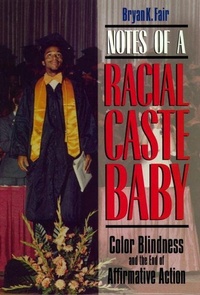
Notes of a Racial Caste Baby
Color Blindness and the End of Affirmative Action
Published on 1. January 1997
277 pages
978-0-8147-2798-0 (ISBN)
Description

The Constitution of the United States, writes Bryan Fair, was a series of compromises between white male propertyholders: Southern planters and Northern merchants. At the heart of their deals was a clear race-conscious intent to place the interests of whites above those of blacks.
In this provocative and important book, Fair, the eighth of ten children born to a single mother on public assistance in an Ohio ghetto, combines two histories--America's and his own- -to offer a compelling defense of affirmative action. How can it be, Fair asks, that, after hundreds of years of racial apartheid during which whites were granted 100% quotas to almost all professions, we have now convinced ourselves that, after a few decades of remedial affirmative action, the playing field is now level? Centuries of racial caste, he argues, cannot be swept aside in a few short years.
Fair ambitiously surveys the most common arguments for and against affirmative action. He argues that we must distinguish between America in the pre-Civil Rights Movement era--when the law of the land was explicitly anti-black--and today's affirmative action policies--which are decidedly not anti- white. He concludes that the only just and effective way in which to account for America's racial past and to negotiate current racial quagmires is to embrace a remedial affirmative action that relies neither on quotas nor fiery rhetoric, but one which takes race into account alongside other pertinent factors.
Championing the model of diversity on which the United States was purportedly founded, Fair serves up a personal and persuasive account of why race-conscious policies are the most effective way to end de facto segregation and eliminate racial caste.
Table of Contents
A Note to the Reader
Acknowledgments
Preface: Telling Stories
Recasting Remedies as Diseases
Color-Blind Justice
The Design of This Book
Pt. 1. A Personal Narrative
Not White Enough
Dee
Black Columbus
Racial Poverty
Man-Child
Colored Matters
Coded Schools
Busing
Going Home
Equal Opportunity
The Character of Color
Diversity as One Factor
The Deception of Color Blindness
Pt. 2. White Privilege and Black Despair: The Origins of Racial Caste in America
The Declaration of Inferiority
Marginal Americans
Inventing American Slavery
The Road to Constitutional Caste
Losing Second-Class Citizenship
Reconstruction and Sacrifice
Separate and Unequal
The Color Line
Critiquing Color Blindness
Pt. 3. The Constitutionality of Remedial Affirmative Action
The Origins of Remedial Affirmative Action
The Court of Last Resort
The Invention of Reverse Discrimination
The Politics of Affirmative Action: Myth or Reality?
Racial Realism
Eliminating Caste
Afterword
Notes
Index
In this provocative and important book, Fair, the eighth of ten children born to a single mother on public assistance in an Ohio ghetto, combines two histories--America's and his own- -to offer a compelling defense of affirmative action. How can it be, Fair asks, that, after hundreds of years of racial apartheid during which whites were granted 100% quotas to almost all professions, we have now convinced ourselves that, after a few decades of remedial affirmative action, the playing field is now level? Centuries of racial caste, he argues, cannot be swept aside in a few short years.
Fair ambitiously surveys the most common arguments for and against affirmative action. He argues that we must distinguish between America in the pre-Civil Rights Movement era--when the law of the land was explicitly anti-black--and today's affirmative action policies--which are decidedly not anti- white. He concludes that the only just and effective way in which to account for America's racial past and to negotiate current racial quagmires is to embrace a remedial affirmative action that relies neither on quotas nor fiery rhetoric, but one which takes race into account alongside other pertinent factors.
Championing the model of diversity on which the United States was purportedly founded, Fair serves up a personal and persuasive account of why race-conscious policies are the most effective way to end de facto segregation and eliminate racial caste.
Table of Contents
A Note to the Reader
Acknowledgments
Preface: Telling Stories
Recasting Remedies as Diseases
Color-Blind Justice
The Design of This Book
Pt. 1. A Personal Narrative
Not White Enough
Dee
Black Columbus
Racial Poverty
Man-Child
Colored Matters
Coded Schools
Busing
Going Home
Equal Opportunity
The Character of Color
Diversity as One Factor
The Deception of Color Blindness
Pt. 2. White Privilege and Black Despair: The Origins of Racial Caste in America
The Declaration of Inferiority
Marginal Americans
Inventing American Slavery
The Road to Constitutional Caste
Losing Second-Class Citizenship
Reconstruction and Sacrifice
Separate and Unequal
The Color Line
Critiquing Color Blindness
Pt. 3. The Constitutionality of Remedial Affirmative Action
The Origins of Remedial Affirmative Action
The Court of Last Resort
The Invention of Reverse Discrimination
The Politics of Affirmative Action: Myth or Reality?
Racial Realism
Eliminating Caste
Afterword
Notes
Index
More details
Series
Language
English
Place of publication
New York
United States
Target group
Professional and scholarly
File size
98,48 MB
ISBN-13
978-0-8147-2798-0 (9780814727980)
Copyright in bibliographic data and cover images is held by Nielsen Book Services Limited or by the publishers or by their respective licensors: all rights reserved.
Schweitzer Classification
Other editions
Additional editions
Book
01/1999
New York University Press
€36.50
Shipment within 15-20 days
Book
01/1997
New York University Press
€103.50
Shipment within 15-20 days
Person
Bryan K. Fair is Associate Professor of Law and Assistant Academic Vice President at the University of Alabama in Tuscaloosa.
Content
- Cover
- Title Page
- Copyright Page
- CONTENTS
- A NOTE TO THE READER
- ACKNOWLEDGMENTS
- PREFACE: TELLING STORIES
- RECASTING REMEDIES AS DISEASES
- COLOR-BLIND JUSTICE
- THE DESIGN OF THIS BOOK
- PART ONE A PERSONAL NARRATIVE
- NOT WHITE ENOUGH
- DEE
- BLACK COLUMBUS
- RACIAL POVERTY
- MAN-CHILD
- COLORED MATTERS
- CODED SCHOOLS
- BUSING
- GOING HOME
- EQUAL OPPORTUNITY
- THE CHARACTER OF COLOR
- DIVERSITY AS ONE FACTOR
- THE DECEPTION OF COLOR BLINDNESS
- PART TWO WHITE PRIVILEGE AND BLACK DESPAIR: THE ORIGINS OF RACIAL CASTE IN AMERICA
- THE DECLARATION OF INFERIORITY
- MARGINAL AMERICANS
- INVENTING AMERICAN SLAVERY
- THE ROAD TO CONSTITUTIONAL CASTE
- LOSING SECOND-CLASS CITIZENSHIP
- RECONSTRUCTION AND SACRIFICE
- SEPARATE AND UNEQUAL
- THE COLOR LINE
- CRITIQUING COLOR BLINDNESS
- PART THREE THE CONSTITUTIONALITY OF REMEDIAL AFFIRMATIVE ACTION
- THE ORIGINS OF REMEDIAL AFFIRMATIVE ACTION
- THE COURT OF LAST RESORT
- THE INVENTION OF REVERSE DISCRIMINATION
- THE POLITICS OF AFFIRMATIVE ACTION: MYTH OR REALITY?
- RACIAL REALISM
- ELIMINATING CASTE
- AFTERWORD
- NOTES
- INDEX
