

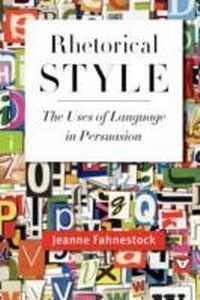
Rhetorical Style
The Uses of Language in Persuasion
1st Edition
Published on 29. September 2011
466 pages
978-0-19-987733-1 (ISBN)
Description

A comprehensive guide to the language of argument, Rhetorical Style offers a renewed appreciation of the persuasive power of the English language.
More details
Other editions
Additional editions
Book
01/2012
Oxford University Press Inc
€156.30
Shipment within 15-20 days
Book
01/2012
Oxford University Press Inc
€88.60
Shipment within 15-20 days
Content
- Cover
- Table of Contents
- Introduction
- Style in the Rhetorical Tradition
- Schools of Language Analysis
- Rhetorical Stylistics and Literary Stylistics
- Plan of the Book
- Source of Examples
- What This Book Is Not-and Is
- Notes
- PART ONE | WORD CHOICE
- 1. Language of Origin
- The Historical Layers of English
- The Old English Core
- The Norman French Contribution
- The Language of Learning from Latin and Greek
- Incorporations from World Contact
- An American Vocabulary
- Homonyms and Synonyms from Different Origins
- Clarity and Sincerity: When Core Words Dominate
- Elevation and Panache: Featuring French Borrowings
- Formality and Erudition: Words from Latin and Greek
- Analyses with Word Origins
- Summary
- Notes
- 2. New Words and Changing Uses
- From Nonce Constructions to Wider Use
- Loss and Migration
- Junk: A Case Study
- Accumulating Senses
- Summary
- Notes
- 3. Categories of Word Choice
- Lexical Field
- Level of Generality
- Abstract versus Concrete Diction
- Levels of Generality in Argument
- Ad Hoc Levels of Generality
- Functional Categories
- Taking a Census of Parts of Speech
- Modern Rhetoricians on Word Choice: Burke and Weaver
- Summary
- Notes
- 4. Language Varieties
- Low, Middle, and High
- Geographical and Social Varieties of English
- Regiolects and Sociolects
- Idiolects
- Registers: Occupation, Avocation, Discipline
- Genre and Register
- Shifting and Mixing Language Varieties
- Language Varieties and Humor
- Spoken versus Written Style
- Familiar Language
- Prepared Phrases, Clichés, and Idioms
- Maxims and Proverbs
- Allusions
- Summary
- Notes
- 5. Tropes
- Synecdoche
- Metonymy
- Antonomasia
- Metaphor
- Extended Metaphor and Allegory
- Simile
- Full Analogies
- Irony
- Irony in Written Texts
- Irony and Intention
- The Persuasive Effects of Irony
- Intolerable Irony
- Hyperbole and Litotes
- The Amphiboly and Paradox
- Paralepsis/Praeteritio: Denying while Saying
- Grice's Maxims and the Detection of Other Meanings
- Analysis: Women Drivers
- Summary
- Notes
- 6. Figures of Word Choice
- Schemes of Words
- Agnominatio
- Polyptoton
- Spreading Concepts through Polyptoton
- Etymological Arguments
- Ploce
- Antanaclasis (Puns)
- The Presence of the Word
- Figures of Sound
- Figures of Word Selection
- Synonyms (Synonymia)
- Correctio
- Emphasis (Significatio)
- Summary
- Notes
- PART II | SENTENCES
- 7. Sentence Basics: Predication
- Active versus Stative Predication
- Subject Choices
- Analyzing Subject Choices
- Verb Choices
- Analyzing Verb Choices
- Subject/Verb Analysis
- The North Pole
- A Trend at New Trier
- Nominal versus Verbal Style
- Nominalizations
- Personification (Personae Fictio)
- Personification in Science
- Multiplying Subjects and Verbs
- Summary
- Notes
- 8. Sentence Construction: Modification
- Adverb Clauses
- Adjective Clauses
- Noun Clauses
- The Consequences of Clause Types: Kennedy's Options
- Modifying with Phrases
- Phrases Built on Verbs
- Phrases Built on Nouns
- Prepositional Phrases
- Single-Word Modifiers
- An Epithetical Style
- Multiplying and Embedding Modifiers
- Amount of Modification
- Minimal Modification
- Heavily Modified Styles
- Analyzing Modification
- The Ubiquitous Saddam
- "To the People of Ireland"
- Summary
- Notes
- 9. Sentence Architecture
- Emphasis
- Emphasis by Position
- Emphasis by Sentence Role
- Emphasis from Inversions
- Combining Sources of Emphasis
- Placement of Modifiers: Branching Left, Right, and in the Middle
- Loose and Periodic Sentences
- Periodic Sentences
- Loose Sentences
- A Periodic Style
- A Loose Style
- Composition
- Iconic Form
- Absence in Words, Presence in Syntax
- The Default Form/Meaning Relationship
- Summary
- Notes
- 10. Figures of Argument
- Parallelism
- In Syllables (Isocolon)
- In Stress Patterns
- In Grammatical Structure (Parison)
- From Repetition
- Uses of Parallelism in Argument
- Induction
- Strategic Repetition
- Antithesis: Argument from Opposites
- Antimetabole: Argument from Inversion
- Definition as a Figure
- Summary
- Notes
- 11. Series
- Definition of a Series
- Series and Categorization
- Bracketing
- Series and Order
- Item Length and Order
- Gradatio
- Series and Conjunctions
- The Overall Length of Series
- Opening Up or Shutting Down
- Summary
- Notes
- 12. Prosody and Punctuation
- Speech and Writing
- Prosody
- Prosody into Punctuation
- Printing and Punctuation
- Punctuation and Meaning
- Figured Prosody
- Passage Prosody
- Variety in Sentence Length
- Summary
- Notes
- PART III | INTERACTIVE DIMENSION
- 13. Speaker and Audience Construction
- Pronouns
- Uses of I
- Uses of You
- Uses of We
- The Objective Voice
- Changing Footing: Managing the Interactive Dimension
- Pronoun Analysis: Lincoln's First Inaugural
- Disidentification
- Figures of Speaker/Audience Construction
- Calling on: Apostrophe
- Partitioning the Audience
- Purging the Audience
- Frankness of Speech: Licentia
- Figuring Speech Acts
- Asking and Answering Questions
- Rogatio and Formal Arguments
- Summary
- Notes
- 14. Incorporating Other Voices
- Direct Speech
- The Stylization of Direct Speech
- Indirect Speech
- Ambiguous Zones in Indirect Speech
- Reporting Speech Acts
- Representing Thoughts
- Texts as Speakers and "Text Acts"
- Invented Speakers
- Double Voicing and Heteroglossia
- Multivoicing: The Blogger's Specialty
- Summary
- Notes
- 15. Situation and Occasion
- Immediate Deixis
- Thematizing Deixis
- Immediate Deixis in Written Texts
- Occasion
- Constructing Situations and Occasions
- Exigence in Written Texts
- The Burkean Scene
- Imaginary Deixis
- Demonstratio and Descriptio
- Description and Emotion
- Ekphrasis: The Stand-Alone Description
- Summary
- Notes
- PART IV | PASSAGE CONSTRUCTION
- 16. Coherence
- Signs of Cohesion
- Given/New or Topic/Comment Patterns
- Interrupting the Topic String
- Schemas and Coherence
- Interclause Meaning Relations
- Inferred Relations
- Signaled Relations
- Combining Sources of Coherence
- Summary
- Appendix: Interclause Meaning Relations
- Notes
- 17. Passage Patterns
- Compositional Units in the Rhetorical Tradition
- Syllogism and Enthymeme
- Progymnasmatic Patterns
- Comparison in Different Grain Sizes
- Paragraphs
- Parataxis and Hypotaxis
- Metadiscourse: Figures of Discourse Management
- Summary
- Notes
- 18. Amplification
- Quintilian's Methods of Amplification
- Analysis with Quintilian's Methods
- Copia and Presence: Multa de Multis
- Erasmian Methods for Copia
- Epicheireme
- Diminishing
- Amplification and the Sublime
- The Last Paragraph of On the Origin of Species
- On Darwin's Word Choices
- On Darwin's Sentence Architecture
- On Darwin's Passage Construction
- On Darwin's Amplification and Interaction with Readers
- Summary
- Notes
- References
- Index
- A
- B
- C
- D
- E
- F
- G
- H
- I
- J
- K
- L
- M
- N
- O
- P
- Q
- R
- S
- T
- U
- V
- W
- Y
- Z
