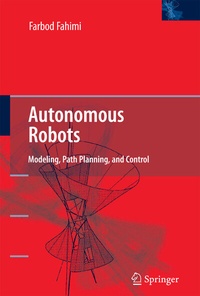
Autonomous Robots
Description

It is at least two decades since the conventional robotic manipulators have become a common manufacturing tool for different industries, from automotive to pharmaceutical. The proven benefits of utilizing robotic manipulators for manufacturing in different industries motivated scientists and researchers to try to extend the applications of robots to many other areas by inventing several new types of robots other than conventional manipulators. The new types of robots can be categorized in two groups; redundant (and hyper-redundant) manipulators, and mobile (ground, marine, and aerial) robots. These groups of robots, known as advanced robots, have more freedom for their mobility, which allows them to do tasks that the conventional manipulators cannot do.
Engineers have taken advantage of the extra mobility of the advanced robots to make them work in constrained environments, ranging from limited joint motions for redundant (or hyper-redundant) manipulators to obstacles in the way of mobile (ground, marine, and aerial) robots.
Since these constraints usually depend on the work environment, they are variable. Engineers have had to invent methods to allow the robots to deal with a variety of constraints automatically. A robot that is equipped with those methods is called an Autonomous Robot.
Autonomous Robots: Kinematics, Path Planning, and Control covers the kinematics and dynamic modeling/analysis of Autonomous Robots, as well as the methods suitable for their control. The text is suitable for mechanical and electrical engineers who want to familiarize themselves with methods of modeling/analysis/control that have been proven efficient through research.
More details
Other editions
Additional editions