

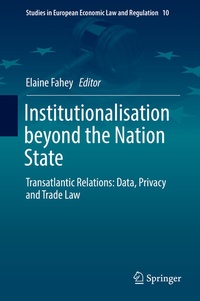
Institutionalisation beyond the Nation State
Description

This volume collects papers that explore institutionalisation in contemporary transatlantic relations. Policymakers, lawyers, and political scientists reflect on contemporary understandings of the process as an integration of regimes and orders from an EU perspective. The papers assess whether contemporary transatlantic relations call for a different approach to global governance with a heightened emphasis on institutionalisation. The book explores a diverse range of case studies of interest to a broad readership. In particular, it focuses upon two cutting-edge issues: transatlantic data privacy rules that are emerging after the post-Edward Snowdon / NSA / PRISM revelations; and trade aspects, especially the Transatlantic Trade and Investment Partnership (TTIP) Agreement. The contributors consider these case studies from a variety of perspectives, honing in on the dynamism, method, and high politics of transatlantic relations as they have recently evolved. They critically explore the commonly held assumption that transatlantic relations have historically been considered quasi-institutionalised at best or, at worst, lacking in terms of laws and institutions. Is institutionalisation a useful meeting point for all disciplines? Does it explain regional integration meaningfully across subjects? Can institutionalisation serve to promote accountability and good governance? Contributors across disciplines and subjects address these increasingly challenging and salient questions.
More details
Other editions
Additional editions
Person
Her research interests span the relationship between EU law and global governance, the EU's Area of Freedom, Security and Justice and the study of postnational rule-making, and are the subject of over 50 publications including books, articles, edited volumes and special issues, including a monograph, The Global Reach of EU Law (Routledge, 2016) and the multi-disciplinary edited volumes The Actors of Postnational Rule-Making: Conceptual Challenges of European and International Law (Routledge, 2015) and A Transatlantic Community of Law (Cambridge University Press, 2014).
In 2016, she was awarded a British Academy/ Leverhulme Research Grant for the project Between Internal Laws and Global Practices: UN Instruments in the EU's Area of Freedom, Security and Justice and an Emile. She is co-investigator in the Marie Curie ITN on TTIP led by the University of Birmingham (2017-2021).
