

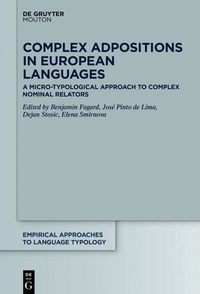
Complex Adpositions in European Languages
A Micro-Typological Approach to Complex Nominal Relators
1st Edition
Published on 26. October 2020
X, 400 pages
978-3-11-068664-7 (ISBN)
Description

While much attention has been devoted to simple nominal relators, especially prepositions and case markers, complex nominal relators have not yet been the focus of a systematic and cross-linguistic study.
The chapters of this volume provide not only a working definition of such constructions, but also a description of complex adpositions and other complex nominal relators in a variety of European languages, both Indo-European and non-Indo-European, including some languages for which this phenomenon had received little attention, such as Breton and Albanian. Building on synchronic and diachronic corpus-based investigations, the authors show commonalities and specificities of these linguistic items across languages, trying to explain why and how they emerged.
The research presented in this volume confirms the wide-spread use of complex adpositions in Europe, and the data reviewed in the final discussion suggests it might be the same in other parts of the world, as well. This book thus offers not only detailed descriptions of complex nominal relators in fifteen languages, but also indications of what to look for in other languages, and how to distinguish between a syntactically free sequence and a genuine complex nominal relator.
The chapters of this volume provide not only a working definition of such constructions, but also a description of complex adpositions and other complex nominal relators in a variety of European languages, both Indo-European and non-Indo-European, including some languages for which this phenomenon had received little attention, such as Breton and Albanian. Building on synchronic and diachronic corpus-based investigations, the authors show commonalities and specificities of these linguistic items across languages, trying to explain why and how they emerged.
The research presented in this volume confirms the wide-spread use of complex adpositions in Europe, and the data reviewed in the final discussion suggests it might be the same in other parts of the world, as well. This book thus offers not only detailed descriptions of complex nominal relators in fifteen languages, but also indications of what to look for in other languages, and how to distinguish between a syntactically free sequence and a genuine complex nominal relator.
More details
Series
Language
English
Place of publication
Berlin/Boston
Germany
Publishing group
de Gruyter Mouton
Target group
Professional and scholarly
US School Grade: College Graduate Student
Illustrations
17 b/w and 4 col. ill., 80 b/w tbl.
File size
2,02 MB
ISBN-13
978-3-11-068664-7 (9783110686647)
Schweitzer Classification
Other editions
Additional editions
Benjamin Fagard | José Pinto de Lima | Dejan Stosic
Complex Adpositions in European Languages
A Micro-Typological Approach to Complex Nominal Relators
Book
02/2024
1st Edition
De Gruyter Mouton
€184.95
Shipment within 7-9 days
Benjamin Fagard | José Pinto de Lima | Dejan Stosic
Complex Adpositions in European Languages
A Micro-Typological Approach to Complex Nominal Relators
E-Book
10/2020
1st Edition
De Gruyter Mouton
€184.95
Available for download
Persons
B. Fagard
, Lattice lab., Paris;
J. Pinto de Lima
, U. of Lisbon;
D. Stosic
, U. Toulouse Jean Jaurès, CNRS;
E. Smirnova
, U. of Neuchâtel.
Content
- Intro
- Contents
- Introduction: Complex adpositions and complex nominal relators
- Indo-European language families &
- isolates
- 1 Complex adpositions in Romance: Emergence and variation
- 2 Complex adpositions in three West Germanic Languages: German, Dutch, and English
- 3 Complex adpositions in Slavic languages: The case of Serbian
- 4 Complex prepositions in Breton
- 5 On complex adpositions in Modern Greek
- 6 Complex prepositions in Albanian: A first assessment
- Non Indo-European languages
- 7 What makes a complex postposition: The cyclic development of postpositions in Estonian
- 8 Complex and simple postpositions: The split in Permic
- 9 Case marking and complex adpositions in Basque
- 10 Structure and origin of Turkish adpositions
- 11 A chapter on compound prepositions in Maltese: prep-prep combinations and related issues
- Discussion
- 12 Complex adpositions in Europe and beyond: A synthesis
- Index
- Language Index
