

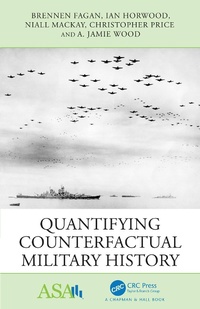
Quantifying Counterfactual Military History
1st Edition
Published on 27. September 2023
238 pages
978-0-429-94879-4 (ISBN)
Description

Forces shaping human history are complex, but the course of history is undeniably changed on many occasions by conscious acts. These may be premeditated or responsive, calmly calculated or performed under great pressure. They may also be successful or catastrophic, but how are historians to make such judgements and appeal to evidence in support of their conclusions? Further, and crucially, how exactly are we to distinguish probable unrealized alternatives from improbable ones? This book describes some of the modern statistical techniques that can begin to answer this question, as well as some of the difficulties in doing so. Using simple, well-quantified cases drawn from military history, we claim that statistics can now help us to navigate the near-truths, the envelope around the events with which any meaningful historical analysis must deal, and to quantify the basis of such analysis. Quantifying Counterfactual Military History is intended for a general audience who are interested in learning more about statistical methods both in military history and for wider applications.
Key Features:
This book demonstrates how modern statistical techniques can measure the impact of counterfactual decisions.
It examines the importance of counterfactual reasoning for both modern scholars and historical actors.
It combines historical narrative, mathematical precision and data to create a straightforward presentation of both factual and counterfactual military history.
It provides an original contribution to the debate over the validity and rigour of works of counterfactual history.
It is written in a manner accessible to readers who have no formal training in History or Statistics.
Key Features:
This book demonstrates how modern statistical techniques can measure the impact of counterfactual decisions.
It examines the importance of counterfactual reasoning for both modern scholars and historical actors.
It combines historical narrative, mathematical precision and data to create a straightforward presentation of both factual and counterfactual military history.
It provides an original contribution to the debate over the validity and rigour of works of counterfactual history.
It is written in a manner accessible to readers who have no formal training in History or Statistics.
Reviews / Votes
"A series of compelling demonstrations that counterfactual history need not be a 'parlour game.' If we carefully assemble the facts and honestly lay out our assumptions, we can apply sophisticated statistical tools that yield deep insights into key 20th century conflicts-and how they might have played out differently."- Phil Tetlock, University of Pennsylvania
"Well-written, concise prose, ground-breaking approach to using counterfactuals in historical analysis. Points out that counterfactual analysis is inherent in almost all investigations of causal relationships (laying out an explanation for why something happened almost always implies reasons why something else didn't happen - this is quite compelling). This sort of strong defense of counterfactuals could go a long way towards 'normalizing' the method, convincing others that this isn't just the realm of alternative history/Harry Turtledove novels. This book lays the groundwork for future work."
- Matthew Tattar, U.S. Naval War College
"The counterfactual terminology used in the book reminds but does not coincide with ideas and methodologies of the statistical causality analysis, potential outcomes, and counterfactual modeling. The presented analysis is rather similar to considerations often made after chess competitions by contemplating what could happen if one or another grandmaster would prefer each different movement. The book can be interesting for reading on history in a broader frame of comparison with other options which could occur in slightly diverse settings."
Stan Lipovetsky, Minneapolis, USA, Technometrics, May 2024.
"This book offers a compelling exploration of how statistical and mathematical techniques can be applied to analyze key events in military history. It successfully argues for the legitimacy of counterfactual analysis as a tool for historians, military leaders, and analysts interested in understanding the complexities of historical decision making." - Lt. Col. Amanda Gustave, USAF.
More details
Series
Edition
1. Auflage
Language
English
Place of publication
London
United Kingdom
Publishing group
Taylor & Francis Ltd
Target group
Professional and scholarly
Product notice
Reflowable
Illustrations
6 Tables, black and white; 15 Line drawings, color; 5 Line drawings, black and white; 6 Halftones, color; 16 Halftones, black and white; 21 Illustrations, color; 21 Illustrations, black and white
ISBN-13
978-0-429-94879-4 (9780429948794)
Copyright in bibliographic data and cover images is held by Nielsen Book Services Limited or by the publishers or by their respective licensors: all rights reserved.
Schweitzer Classification
Other editions
Additional editions
Brennen Fagan | Ian Horwood | Niall MacKay
Quantifying Counterfactual Military History
Book
09/2023
1st Edition
CRC Press
€104.90
Shipment within 10-20 days
Brennen Fagan | Ian Horwood | Niall MacKay
Quantifying Counterfactual Military History
Book
09/2023
1st Edition
CRC Press
€54.00
Shipment within 10-20 days
Persons
Dr Brennen Fagan is a postdoctoral research associate supported by the Leverhulme Centre for Anthropocene Biodiversity and the Department of Mathematics at the University of York. He received his PhD in Mathematics, working with the York Historical Warfare Analysis Group to better understand human conflict by examining and modelling historical war data, and now studies the mathematics of biodiversity change.
Dr Ian Horwood is a historian at York St John University, where he is Senior Lecturer. His principal interests are in US military history, airpower history and the wars in Indochina. Dr Horwood received his PhD in History from the University of Leeds.
Professor Niall MacKay is a mathematician and theoretical physicist at the University of York. He has interests in military history, operations research and combat modelling. He received his PhD in Theoretical and Mathematical Physics from Durham University.
Dr Christopher Price is Senior Lecturer in History at York St John University. His main areas of interest are political, economic and military history in the twentieth century, especially British and US history in the period surrounding the Great Depression, the two World Wars and the Cold War. He received his PhD in History from the University of York.
Professor Andrew James (Jamie) Wood is a mathematician and systems biologist at the University of York. He specializes in the simulation and analysis of complex systems, and has interests across a range of modern international history and the analysis of warfare. He received his PhD in Theoretical and Mathematical Physics from Imperial College London.
Dr Ian Horwood is a historian at York St John University, where he is Senior Lecturer. His principal interests are in US military history, airpower history and the wars in Indochina. Dr Horwood received his PhD in History from the University of Leeds.
Professor Niall MacKay is a mathematician and theoretical physicist at the University of York. He has interests in military history, operations research and combat modelling. He received his PhD in Theoretical and Mathematical Physics from Durham University.
Dr Christopher Price is Senior Lecturer in History at York St John University. His main areas of interest are political, economic and military history in the twentieth century, especially British and US history in the period surrounding the Great Depression, the two World Wars and the Cold War. He received his PhD in History from the University of York.
Professor Andrew James (Jamie) Wood is a mathematician and systems biologist at the University of York. He specializes in the simulation and analysis of complex systems, and has interests across a range of modern international history and the analysis of warfare. He received his PhD in Theoretical and Mathematical Physics from Imperial College London.
Content
1. Could History Have Been Otherwise? 2. Could the Germans Have Won the Battle of Jutland? 3. Could the Germans Have Won the Battle of Britain? 4. Could the United States Have Prevailed in Vietnam? 5. The Road to Able Archer: Counterfactual Reasoning and the Dangerous History of Nuclear Deterrence 1945-1983 6. Conclusions
