

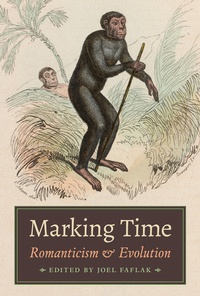
Marking Time
Romanticism and Evolution
1st Edition
Published on 29. November 2017
336 pages
978-1-4426-9959-5 (ISBN)
Description

Scholars have long studied the impact of Charles Darwin's writings on nineteenth-century culture. However, few have ventured to examine the precursors to the ideas of Darwin and others in the Romantic period.
Marking Time, edited by Joel Faflak, analyses prevailing notions of evolution by tracing its origins to the literary, scientific, and philosophical discourses of the long nineteenth century. The volume's contributors revisit key developments in the history of evolution prior to The Origin of Species and explore British and European Romanticism's negotiation between the classic idea of a great immutable chain of being and modern notions of historical change. Marking Time reveals how Romantic and post-Romantic configurations of historical, socio-cultural, scientific, and philosophical transformation continue to exert a profound influence on critical and cultural thought.
Marking Time, edited by Joel Faflak, analyses prevailing notions of evolution by tracing its origins to the literary, scientific, and philosophical discourses of the long nineteenth century. The volume's contributors revisit key developments in the history of evolution prior to The Origin of Species and explore British and European Romanticism's negotiation between the classic idea of a great immutable chain of being and modern notions of historical change. Marking Time reveals how Romantic and post-Romantic configurations of historical, socio-cultural, scientific, and philosophical transformation continue to exert a profound influence on critical and cultural thought.
Reviews / Votes
"...the essays in this volume offer interesting contributions to our understanding of the Romantic conception of natural history and its relation to Darwinian evolution - pointing toward the possibility of expanding the contours of the 'Romantic Darwin' narrative."- Andrea Gambarotto, Universite Catholique de Louvain (HPLS) "Marking Time: Romanticism and Evolution, thoughtfully edited by Joel Faflak, presents a multiplicity of thinkers delving deeply into the possibility and potential for entanglement among temporality, Romanticism, and evolution."
- Dewey W. Hall, California State Polytechnic University (European Romantic Review) "There is much to learn from Marking Time, both in terms of how evolution served as a pervasive concept and metaphor across multiple discourses and disciplines in the Romantic era, and in the specific writings and authors analyzed in individual chapters, in which familiar texts are made unfamiliar and unfamiliar texts are brought to the forefront. Marking Time will surely have a major effect on future studies of Romantic science and the history of evolution."
- Seth T. Reno Auburn, University at Montgomery (Clio) "Marking Time: Romanticism and Evolution offers excellent contributions to these diverse fields of study, and Faflak's timely collection leaves readers with a portrait of Romantic evolution's own entangled bank of topics and concepts far knottier-and more interesting-than the one familiar from more traditional histories of Darwinian evolutionary science."
- Andrew Bukett (Isis)
More details
Language
English
Place of publication
Toronto
Canada
Target group
College/higher education
Professional and scholarly
Edition type
Digital original
File size
2,40 MB
ISBN-13
978-1-4426-9959-5 (9781442699595)
Copyright in bibliographic data and cover images is held by Nielsen Book Services Limited or by the publishers or by their respective licensors: all rights reserved.
Schweitzer Classification
Other editions
Additional editions
Book
12/2017
University of Toronto Press
€90.50
Shipment within 10-20 days
Person
Joel Faflak is professor of English and Theory at Western University, where he was also the Inaugural Director of the School for Advanced Studies in the Arts and Humanities.
Content
List of Illustrations
Marking Time: Romanticism and Evolution
Joel Faflak
Part 1 Romanticism's Darwin
1. Plants, Analogy, and Perfection: Loose and Strict Analogies
Gillian Beer
2. Darwin and the Mobility of Species
Alan Bewell
3. Darwin's Ideas
Matthew Rowlinson
Part 2 Romantic Temporalities
4. Deep Time in the South Pacific: Scientific Voyaging and the Ancient/Primitive
Analogy
Noah Heringman
5. Malthus Our Contemporary?: Toward a Political Economy of Sex
Maureen N. McLane
Part 3 Goethe and the Contingencies of Life
6. Goethe's Morphology
Gabor Aron Zemplen
7. Vertiginous Life: Goethe, Bones, and Italy
Andrew Piper
8. Taking Chances
Theresa M. Kelley
Part 4 Evolutionary Idealisms
9. Did Goethe and Schelling Endorse Species Evolution?
Robert J. Richards
10. The Vitality of Idealism: Life and Evolution in Schelling's and Hegel's Systems
Tilottama Rajan
11. Degeneration: Inversions of Teleology
Joan Steigerwald
Contributors
Index
Marking Time: Romanticism and Evolution
Joel Faflak
Part 1 Romanticism's Darwin
1. Plants, Analogy, and Perfection: Loose and Strict Analogies
Gillian Beer
2. Darwin and the Mobility of Species
Alan Bewell
3. Darwin's Ideas
Matthew Rowlinson
Part 2 Romantic Temporalities
4. Deep Time in the South Pacific: Scientific Voyaging and the Ancient/Primitive
Analogy
Noah Heringman
5. Malthus Our Contemporary?: Toward a Political Economy of Sex
Maureen N. McLane
Part 3 Goethe and the Contingencies of Life
6. Goethe's Morphology
Gabor Aron Zemplen
7. Vertiginous Life: Goethe, Bones, and Italy
Andrew Piper
8. Taking Chances
Theresa M. Kelley
Part 4 Evolutionary Idealisms
9. Did Goethe and Schelling Endorse Species Evolution?
Robert J. Richards
10. The Vitality of Idealism: Life and Evolution in Schelling's and Hegel's Systems
Tilottama Rajan
11. Degeneration: Inversions of Teleology
Joan Steigerwald
Contributors
Index
