

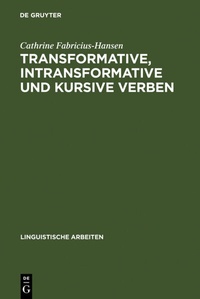
Transformative, intransformative und kursive Verben
1st Edition
Published on 2. January 2012
VIII, 220 pages
978-3-11-165787-5 (ISBN)
Description

Keine ausführliche Beschreibung für "Transformative, intransformative und kursive Verben" verfügbar.
More details
Other editions
Additional editions
Cathrine Fabricius-Hansen
Transformative, intransformative und kursive Verben
Book
01/1975
1st Edition
De Gruyter
€169.95
Article exhausted; check different version
Cathrine Fabricius-Hansen
Transformative, intransformative und kursive Verben
Book
01/1975
1st Edition
De Gruyter
€119.95
Shipment within 7-9 days
Content
- Intro
- 1. EINLEITUNG. SEMANTISCHE RELATIONEN
- 1.1. Semantische Relationen zwischen Sätzen
- 1.2. Semantische Relationen zwischen lexikalischen Einheiten
- 2. VORLÄUFIGE CHARAKTERISTIK TRANSFORMATIVER, INTRANSFORMATIVER UND KURSIVER VERBEN
- 3. PRÄSUPPOSITION UND FOLGERUNG VON TRANSFORMATIVEN UND INTRANSFORMATIVEN SÄTZEN
- 3.1. Transformative Sätze
- 3.2. Intransformative Sätze
- 3.3. Exkurs über die Repräsentation "nichttransformativer Zustandsbeziehungen" bei Heger
- 4. ZEITADVERBIALE BEI TRANSFORMATIVEN, INTRANSFORMATIVEN UND KURSIVEN VERBEN
- 4.1. Punktuelle, durative, terminale und initiale Adverbiale
- 4.2. (immer) noch und wieder
- 4.3. Zusammenfassung
- 5. DEFINIERENDE SEMANTISCHE RELATIONEN ZWISCHEN TRANSFORMATIVEN, INTRANSFORMATIVEN UND KURSIVEN VERBEN
- 5.1. Definition der drei Verbalkategorien
- 5.2. Die Begriffe (Relationen) "ingressiv", "egressiv" und "kontinuativ
- 5.3. Semantische Relationen zwischen transformativen und intransformativen Verben
- 5.4. Zusammenfassung
- 6. TRANSFORMATIVE UND INTRANSFORMATIVE VERBALKOMPLEXE
- 6.1. Ingressiv-, Egressiv- und Kontinuativperiphrasen von kursiven Verben
- 6.2. beginnen/anfangen, aufhören und fortfahren mit habituell-iterativ zu interpretierendem V
- 6.3. beginnen/anfangen, aufhören und fortfahren mit negiertem V". Ihre semantische Relation zueinander
- 6.4. Die Relation zwischen (Prädikativ- oder Funktionsverbfügungen mit) bleiben und werden bzw. kommen
- 6.5. Zusammenfassung
- 7. KAUSATIVITÄT UND (IN-)TRANSFORMATIVITÄT
- 7.1. Die direkte (einfache) Kausativrelation
- 7.2. Exkurs über lassen. "Aktive" und "passive" Kausation
- 7.3. Kausative Transformativa
- 7.4. Kausative Intransformativa
- 7.5. Zu den Beziehungen zwischen kausativ-transformativen und kausativ-intransformativen Verben und Verbalkomplexen
- 7.6. Addenda
- 8. ZUR KOMPONENTENANALYSE
- 8.1. Komponentielle Entsprechung der Ingressiv-, Egressiv- und Kontinuativrelation zwischen Verben
- 8.2. Synkretismen
- 8.3. Inhaltseinheiten als Prädikate interpretiert
- 8.4. Ausblick und Korrektion
- 9. ABSCHLIESSENDE BEMERKUNGEN
- Anmerkungen
- Literaturverzeichnis
