

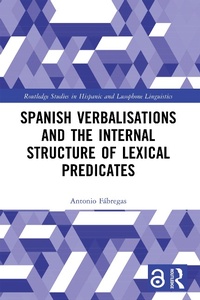
Spanish Verbalisations and the Internal Structure of Lexical Predicates
1st Edition
Published on 12. July 2022
274 pages
978-1-000-62523-3 (ISBN)
Description

Spanish Verbalisations and the Internal Structure of Lexical Predicates provides the first comprehensive and empirically detailed theoretical analysis of the different ways in which Spanish builds verbs from nouns and adjectives.
This book poses questions about the nature of theme vowels, parasynthesis and the structural relation between the three major lexical word classes from within a Neo-Constructionist framework that highlights the correlations between the syntactic and semantic behaviour of verbs and their morphological make up. Provided within are detailed empirical descriptions of each of the nine major ways of building lexical verbs in Spanish, as well as an integral analysis of those patterns that shows the significance of the contrast between them and their uses to address some foundational questions in morphological theory.
Spanish Verbalisations will be of particular interest to researchers in formal linguistics and Spanish.
The Open Access version of this book, available at www.taylorfrancis.com, has been made available under a Creative Commons Attribution 4.0 license.
This book poses questions about the nature of theme vowels, parasynthesis and the structural relation between the three major lexical word classes from within a Neo-Constructionist framework that highlights the correlations between the syntactic and semantic behaviour of verbs and their morphological make up. Provided within are detailed empirical descriptions of each of the nine major ways of building lexical verbs in Spanish, as well as an integral analysis of those patterns that shows the significance of the contrast between them and their uses to address some foundational questions in morphological theory.
Spanish Verbalisations will be of particular interest to researchers in formal linguistics and Spanish.
The Open Access version of this book, available at www.taylorfrancis.com, has been made available under a Creative Commons Attribution 4.0 license.
More details
Series
Edition
1. Auflage
Language
English
Place of publication
London
United Kingdom
Publishing group
Taylor & Francis Ltd
Target group
College/higher education
Illustrations
6 Tables, black and white; 127 Line drawings, black and white; 127 Illustrations, black and white
File size
3,20 MB
ISBN-13
978-1-000-62523-3 (9781000625233)
Copyright in bibliographic data and cover images is held by Nielsen Book Services Limited or by the publishers or by their respective licensors: all rights reserved.
Schweitzer Classification
Other editions
Additional editions
Book
01/2024
1st Edition
Routledge
€62.80
Shipment within 10-20 days
Book
07/2022
1st Edition
Routledge
€206.60
Shipment within 10-20 days
Person
Antonio Fabregas is Associate Professor of Spanish Linguistics at the Norwegian University of Science and Technology, Trondheim (NTNU), Norway.
Content
1. Introduction: what a verbalisation is and what we assume in this monograph
2. Theme vowels: a syntactic analysis for Spanish
3. The internal syntactic structure of parasynthesis
4. Deadjectival verbs in -a, parasynthetic or not
5. Denominal verbs in -a, parasynthetic or not
6. Formations in -ecer, parasynthetic or not
7. Verbalisations in -ificar
8. Verbalisations in -ear
9. Verbalisations in -izar
10. Conclusions of this monograph
Index
2. Theme vowels: a syntactic analysis for Spanish
3. The internal syntactic structure of parasynthesis
4. Deadjectival verbs in -a, parasynthetic or not
5. Denominal verbs in -a, parasynthetic or not
6. Formations in -ecer, parasynthetic or not
7. Verbalisations in -ificar
8. Verbalisations in -ear
9. Verbalisations in -izar
10. Conclusions of this monograph
Index
