

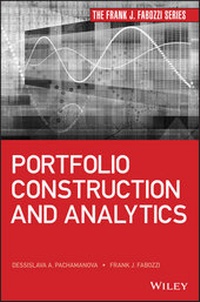
Portfolio Construction and Analytics
Description

More details
Other editions
Additional editions
Persons
Content
Preface xix
About the Authors xxv
Acknowledgments xvii
Chapter 1 Introduction to Portfolio Management and Analytics 1
1.1 Asset Classes and the Asset Allocation Decision 1
1.2 The Portfolio Management Process 4
1.2.1 Setting the Investment Objectives 4
1.2.2 Developing and Implementing a Portfolio Strategy 6
1.2.3 Monitoring the Portfolio 8
1.2.4 Adjusting the Portfolio 9
1.3 Traditional versus Quantitative Asset Management 9
1.4 Overview of Portfolio Analytics 10
1.4.1 Market Analytics 12
1.4.2 Financial Screening 15
1.4.3 Asset Allocation Models 16
1.4.4 Strategy Testing and Evaluating Portfolio Performance 17
1.4.5 Systems for Portfolio Analytics 20
1.5 Outline of Topics Covered in the Book 22
Part One Statistical Models of Risk and Uncertainty
Chapter 2 Random Variables, Probability Distributions, and Important Statistical Concepts 31
2.1 What Is a Probability Distribution? 31
2.2 The Bernoulli Probability Distribution and Probability Mass Functions 32
2.3 The Binomial Probability Distribution and Discrete Distributions 34
2.4 The Normal Distribution and Probability Density Functions 38
2.5 The Concept of Cumulative Probability 41
2.6 Describing Distributions 44
2.6.1 Measures of Central Tendency 44
2.6.2 Measures of Risk 47
2.6.3 Skew 54
2.6.4 Kurtosis 55
2.7 Dependence between Two Random Variables: Covariance and Correlation 55
2.8 Sums of Random Variables 57
2.9 Joint Probability Distributions and Conditional Probability 61
2.10 Copulas 64
2.11 From Probability Theory to Statistical Measurement: Probability Distributions and Sampling 66
2.11.1 Central Limit Theorem 70
2.11.2 Confidence Intervals 71
2.11.3 Bootstrapping 72
2.11.4 Hypothesis Testing 73
Chapter 3 Important Probability Distributions 77
3.1 Examples of Probability Distributions 79
3.1.1 Notation Used in Describing Continuous Probability Distributions 79
3.1.2 Discrete and Continuous Uniform Distributions 80
3.1.3 Student's t Distribution 82
3.1.4 Lognormal Distribution 83
3.1.5 Poisson Distribution 85
3.1.6 Exponential Distribution 87
3.1.7 Chi-Square Distribution 88
3.1.8 Gamma Distribution 90
3.1.9 Beta Distribution 90
3.2 Modeling Financial Return Distributions 91
3.2.1 Elliptical Distributions 92
3.2.2 Stable Paretian Distributions 94
3.2.3 Generalized Lambda Distribution 96
3.3 Modeling Tails of Financial Return Distributions 98
3.3.1 Generalized Extreme Value Distribution 98
3.3.2 Generalized Pareto Distribution 99
3.3.3 Extreme Value Models 101
Chapter 4 Statistical Estimation Models 106
4.1 Commonly Used Return Estimation Models 106
4.2 Regression Analysis 108
4.2.1 A Simple Regression Example 109
4.2.2 Regression Applications in the Investment Management Process 114
4.3 Factor Analysis 116
4.4 Principal Components Analysis 118
4.5 Autoregressive Conditional Heteroscedastic Models 125
Part Two Simulation and Optimization Modeling
Chapter 5 Simulation Modeling 133
5.1 Monte Carlo Simulation: A Simple Example 133
5.1.1 Selecting Probability Distributions for the Inputs 135
5.1.2 Interpreting Monte Carlo Simulation Output 137
5.2 Why Use Simulation? 140
5.2.1 Multiple Input Variables and Compounding Distributions 141
5.2.2 Incorporating Correlations 142
5.2.3 Evaluating Decisions 144
5.3 How Many Scenarios? 147
5.4 Random Number Generation 149
Chapter 6 Optimization Modeling 151
6.1 Optimization Formulations 152
6.1.1 Minimization versus Maximization 154
6.1.2 Local versus Global Optima 155
6.1.3 Multiple Objectives 156
6.2 Important Types of Optimization Problems 157
6.2.1 Convex Programming 157
6.2.2 Linear Programming 158
6.2.3 Quadratic Programming 159
6.2.4 Second-Order Cone Programming 160
6.2.5 Integer and Mixed Integer Programming 161
6.3 A Simple Optimization Problem Formulation Example: Portfolio Allocation 161
6.4 Optimization Algorithms 166
6.5 Optimization Software 168
6.6 A Software Implementation Example 170
6.6.1 Optimization with Excel Solver 171
6.6.2 Solution to the Portfolio Allocation Example 175
Chapter 7 Optimization under Uncertainty 180
7.1 Dynamic Programming 181
7.2 Stochastic Programming 183
7.2.1 Multistage Models 184
7.2.2 Mean-Risk Stochastic Models 189
7.2.3 Chance-Constrained Models 191
7.3 Robust Optimization 194
Part Three Portfolio Theory
Chapter 8 Asset Diversification 203
8.1 The Case for Diversification 204
8.2 The Classical Mean-Variance Optimization Framework 208
8.3 Efficient Frontiers 212
8.4 Alternative Formulations of the Classical Mean-Variance Optimization Problem 215
8.4.1 Expected Return Formulation 215
8.4.2 Risk Aversion Formulation 215
8.5 The Capital Market Line 216
8.6 Expected Utility Theory 220
8.6.1 Quadratic Utility Function 221
8.6.2 Linear Utility Function 223
8.6.3 Exponential Utility Function 224
8.6.4 Power Utility Function 224
8.6.5 Logarithmic Utility Function 224
8.7 Diversification Redefined 226
Chapter 9 Factor Models 232
9.1 Factor Models in the Financial Economics Literature 233
9.2 Mean-Variance Optimization with Factor Models 236
9.3 Factor Selection in Practice 239
9.4 Factor Models for Alpha Construction 243
9.5 Factor Models for Risk Estimation 245
9.5.1 Macroeconomic Factor Models 245
9.5.2 Fundamental Factor Models 246
9.5.3 Statistical Factor Models 248
9.5.4 Hybrid Factor Models 250
9.5.5 Selecting the "Right" Factor Model 250
9.6 Data Management and Quality Issues 251
9.6.1 Data Alignment 252
9.6.2 Survival Bias 253
9.6.3 Look-Ahead Bias 253
9.6.4 Data Snooping 254
9.7 Risk Decomposition, Risk Attribution, and Performance Attribution 254
9.8 Factor Investing 256
Chapter 10 Benchmarks and the Use of Tracking Error in Portfolio Construction 260
10.1 Tracking Error versus Alpha: Calculation and Interpretation 261
10.2 Forward-Looking versus Backward-Looking Tracking Error 264
10.3 Tracking Error and Information Ratio 265
10.4 Predicted Tracking Error Calculation 265
10.4.1 Variance-Covariance Method for Tracking Error Calculation 266
10.4.2 Tracking Error Calculation Based on a Multifactor Model 266
10.5 Benchmarks and Indexes 268
10.5.1 Market Indexes 268
10.5.2 Noncapitalization Weighted Indexes 270
10.6 Smart Beta Investing 272
Part Four Equity Portfolio Management
Chapter 11 Advances in Quantitative Equity Portfolio Management 281
11.1 Portfolio Constraints Commonly Used in Practice 282
11.1.1 Long-Only (No-Short-Selling) Constraints 283
11.1.2 Holding Constraints 283
11.1.3 Turnover Constraints 284
11.1.4 Factor Constraints 284
11.1.5 Cardinality Constraints 286
11.1.6 Minimum Holding and Transaction Size Constraints 287
11.1.7 Round Lot Constraints 288
11.1.8 Tracking Error Constraints 290
11.1.9 Soft Constraints 291
11.1.10 Misalignment Caused by Constraints 291
11.2 Portfolio Optimization with Tail Risk Measures 291
11.2.1 Portfolio Value-at-Risk Optimization 292
11.2.2 Portfolio Conditional Value-at-Risk Optimization 294
11.3 Incorporating Transaction Costs 297
11.3.1 Linear Transaction Costs 299
11.3.2 Piecewise-Linear Transaction Costs 300
11.3.3 Quadratic Transaction Costs 302
11.3.4 Fixed Transaction Costs 302
11.3.5 Market Impact Costs 303
11.4 Multiaccount Optimization 304
11.5 Incorporating Taxes 308
11.6 Robust Parameter Estimation 312
11.7 Portfolio Resampling 314
11.8 Robust Portfolio Optimization 317
Chapter 12 Factor-Based Equity Portfolio Construction and Performance Evaluation 325
12.1 Equity Factors Used in Practice 325
12.1.1 Fundamental Factors 326
12.1.2 Macroeconomic Factors 327
12.1.3 Technical Factors 327
12.1.4 Additional Factors 327
12.2 Stock Screens 328
12.3 Portfolio Selection 331
12.3.1 Ad-Hoc Portfolio Selection 331
12.3.2 Stratification 332
12.3.3 Factor Exposure Targeting 333
12.4 Risk Decomposition 334
12.5 Stress Testing 343
12.6 Portfolio Performance Evaluation 346
12.7 Risk Forecasts and Simulation 350
Part Five Fixed Income Portfolio Management
Chapter 13 Fundamentals of Fixed Income Portfolio Management 361
13.1 Fixed Income Instruments and Major Sectors of the Bond Market 361
13.1.1 Treasury Securities 362
13.1.2 Federal Agency Securities 363
13.1.3 Corporate Bonds 363
13.1.4 Municipal Bonds 364
13.1.5 Structured Products 364
13.2 Features of Fixed Income Securities 365
13.2.1 Term to Maturity and Maturity 365
13.2.2 Par Value 366
13.2.3 Coupon Rate 366
13.2.4 Bond Valuation and Yield 367
13.2.5 Provisions for Paying Off Bonds 368
13.2.6 Bondholder Option Provisions 370
13.3 Major Risks Associated with Investing in Bonds 371
13.3.1 Interest Rate Risk 371
13.3.2 Call and Prepayment Risk 372
13.3.3 Credit Risk 373
13.3.4 Liquidity Risk 374
13.4 Fixed Income Analytics 375
13.4.1 Measuring Interest Rate Risk 375
13.4.2 Measuring Spread Risk 383
13.4.3 Measuring Credit Risk 384
13.4.4 Estimating Fixed Income Portfolio Risk Using Simulation 384
13.5 The Spectrum of Fixed Income Portfolio Strategies 386
13.5.1 Pure Bond Indexing Strategy 387
13.5.2 Enhanced Indexing/Primary Factor Matching 388
13.5.3 Enhanced Indexing/Minor Factor Mismatches 389
13.5.4 Active Management/Larger Factor Mismatches 389
13.5.5 Active Management/Full-Blown Active 390
13.5.6 Smart Beta Strategies for Fixed Income Portfolios 390
13.6 Value-Added Fixed Income Strategies 391
13.6.1 Interest Rate Expectations Strategies 391
13.6.2 Yield Curve Strategies 392
13.6.3 Inter- and Intra-sector Allocation Strategies 393
13.6.4 Individual Security Selection Strategies 394
Chapter 14 Factor-Based Fixed Income Portfolio Construction and Evaluation 398
14.1 Fixed Income Factors Used in Practice 398
14.1.1 Term Structure Factors 399
14.1.2 Credit Spread Factors 400
14.1.3 Currency Factors 401
14.1.4 Emerging Market Factors 401
14.1.5 Volatility Factors 402
14.1.6 Prepayment Factors 402
14.2 Portfolio Selection 402
14.2.1 Stratification Approach 403
14.2.2 Optimization Approach 405
14.2.3 Portfolio Rebalancing 408
14.3 Risk Decomposition 410
Chapter 15 Constructing Liability-Driven Portfolios 420
15.1 Risks Associated with Liabilities 421
15.1.1 Interest Rate Risk 421
15.1.2 Inflation Risk 422
15.1.3 Longevity Risk 423
15.2 Liability-Driven Strategies of Life Insurance Companies 423
15.2.1 Immunization 424
15.2.2 Advanced Optimization Approaches 435
15.2.3 Constructing Replicating Portfolios 437
15.3 Liability-Driven Strategies of Defined Benefit Pension Funds 438
15.3.1 High-Grade Bond Portfolio Solution 439
15.3.2 Including Other Assets 442
15.3.3 Advanced Modeling Strategies 443
Part Six Derivatives and Their Application to Portfolio Management
Chapter 16 Basics of Financial Derivatives 449
16.1 Overview of the Use of Derivatives in Portfolio Management 449
16.2 Forward and Futures Contracts 451
16.2.1 Risk and Return of Forward/Futures Position 453
16.2.2 Leveraging Aspect of Futures 453
16.2.3 Pricing of Futures and Forward Contracts 454
16.3 Options 459
16.3.1 Risk and Return Characteristics of Options 460
16.3.2 Option Pricing Models 470
16.4 Swaps 485
16.4.1 Interest Rate Swaps 485
16.4.2 Equity Swaps 486
16.4.3 Credit Default Swaps 487
Chapter 17 Using Derivatives in Equity Portfolio Management 490
17.1 Stock Index Futures and Portfolio Management Applications 490
17.1.1 Basic Features of Stock Index Futures 490
17.1.2 Theoretical Price of a Stock Index Futures Contract 491
17.1.3 Portfolio Management Strategies with Stock Index Futures 494
17.2 Equity Options and Portfolio Management Applications 504
17.2.1 Types of Equity Options 504
17.2.2 Equity Portfolio Management Strategies with Options 506
17.3 Equity Swaps 511
Chapter 18 Using Derivatives in Fixed Income Portfolio Management 515
18.1 Controlling Interest Rate Risk Using Treasury Futures 515
18.1.1 Strategies for Controlling Interest Rate Risk with Treasury Futures 518
18.1.2 Pricing of Treasury Futures 520
18.2 Controlling Interest Rate Risk Using Treasury Futures Options 521
18.2.1 Strategies for Controlling Interest Rate Risk Using Treasury Futures Options 524
18.2.2 Pricing Models for Treasury Futures Options 526
18.3 Controlling Interest Rate Risk Using Interest Rate Swaps 527
18.3.1 Strategies for Controlling Interest Rate Risk Using Interest Rate Swaps 528
18.3.2 Pricing of Interest Rate Swaps 530
18.4 Controlling Credit Risk with Credit Default Swaps 532
18.4.1 Strategies for Controlling Credit Risk with Credit Default Swaps 534
18.4.2 General Principles for Valuing a Single-Name Credit Default Swap 535
Appendix: Basic Linear Algebra Concepts 541
References 549
Index 563
Preface
"Analytics" and "Big Data" have become buzzwords in many industries, and have dominated the news over the past few years. In finance, analytics and big data have been around for a long time, even if they were described with different terms. As J.R. Lowry, chief operating officer of State Street Global Exchange, stated in a 2014 interview published in the MIT Sloan Management Review, "In general, data and analytics have pervaded our business for many, many years, but it wasn't something that we were focused on in any kind of coherent way."
The need to focus on investment analytics in a coherent way has never been greater. In the aftermath of the 2007-2009 financial crisis, there has been a tremendous amount of regulatory change. Like most industries, the financial industry is trying to cope with the challenges of managing big data and the risks associated with using models. Many asset management firms face increasing pressure to address important questions such as
- How to measure, visualize, and manage risks better?
- How to find new sources of return?
- How to manage trading activity effectively?
- How to keep costs down?
The solution of banking giant State Street Corporation was to launch a new business, State Street Global Exchange (SSGX), which applies "a wrapper of information, insights and analytics around the investment process," and provides a "more purposeful approach to data and analytics across the company."1 SSGX is a center that has pulled in software capabilities and analytics groups focused on risk, as well as electronic trading platforms focused on foreign exchange, fixed income, and derivatives trading.
Portfolio and risk analytics platforms are offered by investment product providers such as Barclays (the POINT Advanced Analytics Platform)2 and BlackRock (the Aladdin Platform)3 with a similar goal of combining sophisticated risk analytics with comprehensive portfolio management, trading and operations tools. Longtime portfolio software vendors (Axioma, IBM Algorithmics, MSCI Barra, and Northfield Information Services) and data providers (Bloomberg, FactSet, Thomson Reuters) are adding both advanced analytics tools and the ability to link to various data sources. New partnerships are being formed-for example, financial data provider Thomson Reuters joined forces with Palantir Technologies, a leading Silicon Valley big data technology company, to create QA Studio, a solution for quantitative research that combines powerful analytics and intuitive visualizations to help with the generation of investment ideas.4 The development of free open source software such as the statistical modeling environment R5 and the open source programming environment Python6 with libraries for financial applications has greatly improved accessibility to analytical tools and has reduced the costs of implementing portfolio analytics solutions.
In this book, we often refer to the traditional asset management company model, in which the focus is on the selection of star portfolio managers in charge of different portions of a firm's funds under management. However, new technologies have been disrupting the investment industry as a whole. The bundling of asset management practice and software platform offerings is a recent phenomenon, as is the democratization of access to financial data7 and trading opportunities.8 The popularity of automated investment services companies, also called robo advisors,9 has been increasing. New-generation asset management companies include Quantopian,10 which provides an analytics and trading platform and crowdsources investment ideas from contributors from all over the world, with the goal of rewarding top performers and applying tested strategies to asset management instead of hiring and managing individual portfolio managers. The core of Quantopian's strategy involves providing useful market and stock fundamentals data, as well as a tool for backtesting, zipline, which has been made open source (free) to help create and support a community of contributors.
Nobody can tell what the future of the portfolio management industry will look like but it certainly seems inevitable that data and analytics will play a major role in it.
Central Themes
Portfolio Construction and Analytics attempts to look at the analytics process at investment firms from multiple perspectives: the data management side, the modeling side, and the software resources side. It reviews many widely used approaches to portfolio analytics and discusses new trends in metrics, modeling approaches, and portfolio analytics system design. The theoretical underpinnings of some of the modeling approaches are provided for context; however, our goal is to emphasize how such models are used in practice.
The book contains 18 chapters in six parts. Part One, Statistical Models of Risk and Uncertainty, contains the fundamental statistical modeling concepts necessary to understand the modeling and measurement of portfolio risk. Part Two, Simulation and Optimization Modeling, explains two important modeling techniques for constructing portfolios with desired characteristics and evaluating their risk and performance-simulation and optimization. Part Three, Portfolio Theory, introduces the classical quantitative portfolio risk optimization approach and new tools for optimizing portfolios, both in terms of total risk and in terms of risk relative to a selected benchmark. Parts Four and Five, Equity Portfolio Management and Fixed Income Portfolio Management, focus on specific factors and strategies used in equity and fixed income portfolio management, respectively. Part Six describes the basics of financial derivative instruments and how financial derivatives can be used for portfolio construction and risk management.
The material is presented at a high level but with practical real-world examples created with R and Microsoft Excel or provided by established portfolio software vendors, and should be accessible to a broad audience. We believe that practitioners and analysts who would like to get an overview of tools for portfolio analytics will find these themes-along with the examples of applications and instructions for implementation-useful. At the same time, we address the topics in this book in a rigorous way, and provide references to the original works, so the book should be of interest to academics, students, and researchers who need an updated and integrated view of portfolio construction and analytics.
Software
We were wary of using a specific software package and turning this book into a software tutorial because the popularity of different tools changes quickly. The examples in this book were created with Microsoft Excel and R, as well as portfolio risk management software by Barclays Capital and FactSet. We assume basic familiarity with spreadsheets and Microsoft Excel. Because of the wide variability of online resources and tutorials for Microsoft Excel and the open source software package R, we do not provide tutorials with the book;11 however, we try to provide hints for the implementation of the examples with R and point to the libraries that have the analytics capabilities needed to implement the examples.12
Teaching
Portfolio Construction and Analytics covers finance and applied analytical techniques topics. It can be used as a textbook for upper-level undergraduate or lower-level graduate (such as MBA or master's) courses with emphasis on modeling, such as applied investments, financial analytics, or the decision sciences. The book can be used also as a supplement in a special topics course in quantitative methods or finance, as a reference for student projects, or as a self-study aid by students.
The book assumes that the reader has only very basic background in finance or quantitative methods, such as understanding of the time value of money, knowledge of basic calculus, and comfort with numbers and metrics. Most analytical concepts necessary for understanding the notation or applications are introduced and explained in footnotes or in specified references. This makes the book suitable for readers with a wide range of backgrounds.
Every chapter follows the same outline. The concepts are introduced in the main body of the chapter, and illustrations are provided. Instructions for implementation of the examples are provided in footnotes. There is a summary that contains the most important discussion points at the end of each chapter.
A typical course may start with the material in Chapters 1 through 6. It can then cover Chapters 8 through 14, which discuss equity and fixed income portfolio construction strategies. Chapters 7 and 15 contain special topics that would be of interest in more quantitatively oriented courses and more advanced finance courses, respectively, or can be assigned for student projects. Depending on the amount of time an instructor has, Chapters 16 through 18 would be good to include in a course on investment management, as they discuss the fundamentals of portfolio risk management with financial derivative instruments.
Disclosure
Frank J. Fabozzi is a member of two board fund complexes where BlackRock Inc. is the manager of the funds. Mention of BlackRock's analytics or products in this book should not be construed as any form of endorsement.
1 Ferguson (2014). 2 See...