

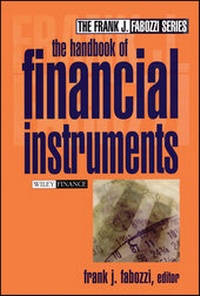
The Handbook of Financial Instruments
Description

instruments
The Handbook of Financial Instruments provides
comprehensive coverage of a broad range of financial instruments,
including equities, bonds (asset-backed and mortgage-backed
securities), derivatives (equity and fixed income), insurance
investment products, mutual funds, alternative investments (hedge
funds and private equity), and exchange traded funds. The
Handbook of Financial Instruments explores the basic
features of each instrument introduced, explains their risk
characteristics, and examines the markets in which they trade.
Written by experts in their respective fields, this book arms
individual investors and institutional investors alike with the
knowledge to choose and effectively use any financial instrument
available in the market today.
John Wiley & Sons, Inc. is proud to be the publisher of the
esteemed Frank J. Fabozzi Series. Comprising nearly 100
titles-which include numerous bestsellers--The Frank J.
Fabozzi Series is a key resource for finance professionals and
academics, strategists and students, and investors. The series is
overseen by its eponymous editor, whose expert instruction and
presentation of new ideas have been at the forefront of financial
publishing for over twenty years. His successful career has
provided him with the knowledge, insight, and advice that has led
to this comprehensive series.
Frank J. Fabozzi, PhD, CFA, CPA, is Editor of the
Journal of Portfolio Management, which is read by thousands
of institutional investors, as well as editor or author of over 100
books on finance for the professional and academic markets.
Currently, Dr. Fabozzi is an adjunct Professor of Finance at Yale
University's School of Management and on the board of directors of
the Guardian Life family of funds and the Black Rock complex of
funds.
More details
Other editions
Additional editions
Content
Contributing Authors.
Chapter 1. Overview of Financial Instruments (Frank J. Fabozzi).
Chapter 2. Fundamentals of Investing (Frank J. Fabozzi).
Chapter 3. Calculating Investment Returns (Bruce Feibel).
Chapter 4. Common Stock (Frank J. Fabozzi, et al.).
Chapter 5. Sources of Information for Investing in Common Stock (Pamela P. Peterson and Frank J. Fabozzi).
Chapter 6. Money Market Instruments (Frank J. Fabozzi, et al.).
Chapter 7. U.S. Treasury Securities (Frank J. Fabozzi and Michael J. Fleming).
Chapter 8. Inflation-Indexed Bonds (John B. Brynjolfsson).
Chapter 9. Federal Agency Securities (Frank J. Fabozzi and George P. Kegler).
Chapter 10. Municipal Securities (Frank J. Fabozzi).
Chapter 11. Corporate Bonds (Frank J. Fabozzi).
Chapter 12. Preferred Stock (Steven V. Mann and Frank J. Fabozzi).
Chapter 13. Emerging Markets Debt (Maria Mednikov Loucks, et al.).
Chapter 14. Agency Mortgage-Backed Securities (Frank J. Fabozzi and David Yuen).
Chapter 15. Nonagency MBS and Real Estate-Backed ABS (Frank J. Fabozzi and John Dunlevy).
Chapter 16. Commercial Mortgage-Backed Securities (Joseph F. DeMichele, et al.).
Chapter 17. Non-Real Estate Asset-Backed Securities (Frank J. Fabozzi and Thomas A. Zimmerman).
Chapter 18. Credit Card ABS (John N. McElravey).
Chapter 19. Leveraged Loans (Steven Miller).
Chapter 20. Collateralized Debt Obligations (Laurie S. Goodman and Frank J. Fabozzi).
Chapter 21. Investment Companies (Frank J. Jones and Frank J. Fabozzi).
Chapter 22. Exchange-Traded Funds and Their Competitors (Gary L. Gastineau).
Chapter 23. Stable-Value Pension Investments (John R. Caswell and Karl P. Tourville).
Chapter 24. Investment-Oriented Life Insurance (Frank J. Jones).
Chapter 25. Hedge Funds (Mark J. P. Anson).
Chapter 26. Private Equity (Mark J. P. Anson).
Chapter 27. Real Estate Investment (Susan Hudson-Wilson).
Chapter 28. Equity Derivatives (Bruce M. Collins and Frank J. Fabozzi).
Chapter 29. Interest Rate Derivatives (Frank J. Fabozzi and Steven V. Mann).
Chapter 30. Mortgage Swaps (David Yuen and Frank J. Fabozzi).
Chapter 31. Credit Derivatives (Moorad Choudhry).
Chapter 32. Managed Futures (Mark J. P. Anson).
Index.
Chapter 1
Overview of Financial Instruments
Frank J. Fabozzi, Ph.D., CFA
Adjunct Professor of Finance School of Management Yale University
Broadly speaking, an asset is any possession that has value in an exchange. Assets can be classified as tangible or intangible. A tangible asset is one whose value depends on particular physical properties-examples are buildings, land, or machinery. Intangible assets, by contrast, represent legal claims to some future benefit. Their value bears no relation to the form, physical or otherwise, in which these claims are recorded. Financial assets are intangible assets. For financial assets, the typical benefit or value is a claim to future cash. This book deals with the various types of financial assets or financial instruments.
The entity that has agreed to make future cash payments is called the issuer of the financial instrument; the owner of the financial instrument is referred to as the investor. Here are seven examples of financial instruments:
- A loan by Fleet Bank (investor/commercial bank) to an individual (issuer/borrower) to purchase a car
- A bond issued by the U.S. Department of the Treasury
- A bond issued by Ford Motor Company
- A bond issued by the city of Philadelphia
- A bond issued by the government of France
- A share of common stock issued by Microsoft Corporation, an American company
- A share of common stock issued by Toyota Motor Corporation, a Japanese company
In the case of the car loan by Fleet Bank, the terms of the loan establish that the borrower must make specified payments to the commercial bank over time. The payments include repayment of the amount borrowed plus interest. The cash flow for this asset is made up of the specified payments that the borrower must make.
In the case of a U.S. Treasury bond, the U.S. government (the issuer) agrees to pay the holder or the investor the interest payments every six months until the bond matures, then at the maturity date repay the amount borrowed. The same is true for the bonds issued by Ford Motor Company, the city of Philadelphia, and the government of France. In the case of Ford Motor Company, the issuer is a corporation, not a government entity. In the case of the city of Philadelphia, the issuer is a municipal government. The issuer of the French government bond is a central government entity.
The common stock of Microsoft entitles the investor to receive dividends distributed by the company. The investor in this case also has a claim to a pro rata share of the net asset value of the company in case of liquidation of the company. The same is true of the common stock of Toyota Motor Corporation.
DEBT VERSUS EQUITY INSTRUMENTS
Financial instruments can be classified by the type of claim that the holder has on the issuer. When the claim is for a fixed dollar amount, the financial instrument is said to be a debt instrument. The car loan, the U.S. Treasury bond, the Ford Motor Company bond, the city of Philadelphia bond, and the French government bond are examples of debt instruments requiring fixed payments.
In contrast to a debt obligation, an equity instrument obligates the issuer of the financial instrument to pay the holder an amount based on earnings, if any, after the holders of debt instruments have been paid. Common stock is an example of an equity claim. A partnership share in a business is another example.
Some securities fall into both categories in terms of their attributes. Preferred stock, for example, is an equity instrument that entitles the investor to receive a fixed amount. This payment is contingent, however, and due only after payments to debt instrument holders are made. Another "combination" instrument is a convertible bond, which allows the investor to convert debt into equity under certain circumstances. Both debt instruments and preferred stock that pay fixed dollar amounts are called fixed-income instruments.
CHARACTERISTICS OF DEBT INSTRUMENTS
As will become apparent, there are a good number of debt instruments available to investors. Debt instruments include loans, money market instruments, bonds, mortgage-backed securities, and asset-backed securities. In the chapters that follow, each will be described. There are features of debt instruments that are common to all debt instruments and they are described below. In later chapters, there will be a further discussion of these features as they pertain to debt instruments of particular issuers.
Maturity
The term to maturity of a debt obligation is the number of years over which the issuer has promised to meet the conditions of the obligation. At the maturity date, the issuer will pay off any amount of the debt obligation outstanding. The convention is to refer to the "term to maturity" as simply its "maturity" or "term." As we explain later, there may be provisions that allow either the issuer or holder of the debt instrument to alter the term to maturity.
The market for debt instruments is classified in terms of the time remaining to its maturity. A money market instrument is a debt instrument which has one year or less remaining to maturity. Debt instruments with a maturity greater than one year are referred to as a capital market debt instrument.
Par Value
The par value of a bond is the amount that the issuer agrees to repay the holder of the debt instrument by the maturity date. This amount is also referred to as the principal, face value, redemption value, or maturity value. Bonds can have any par value.
Because debt instruments can have a different par value, the practice is to quote the price of a debt instrument as a percentage of its par value. A value of 100 means 100% of par value. So, for example, if a debt instrument has a par value of $1,000 and is selling for $900, it would be said to be selling at 90. If a debt instrument with a par value of $5,000 is selling for $5,500, it is said to be selling for 110. The reason why a debt instrument sells above or below its par value is explained in Chapter 2.
Coupon Rate
The coupon rate, also called the nominal rate or the contract rate, is the interest rate that the issuer/borrower agrees to pay each year. The dollar amount of the payment, referred to as the coupon interest payment or simply interest payment, is determined by multiplying the coupon rate by the par value of the debt instrument. For example, the interest payment for a debt instrument with a 7% coupon rate and a par value of $1,000 is $70 (7% times $1,000).
The frequency of interest payments varies by the type of debt instrument. In the United States, the usual practice for bonds is for the issuer to pay the coupon in two semiannual installments. Mortgage-backed securities and asset-backed securities typically pay interest monthly. For bonds issued in some markets outside the United States, coupon payments are made only once per year. Loan interest payments can be customized in any manner.
Zero-Coupon Bonds
Not all debt obligations make periodic coupon interest payments. Debt instruments that are not contracted to make periodic coupon payments are called zero-coupon instruments. The holder of a zero-coupon instrument realizes interest income by buying it substantially below its par value. Interest then is paid at the maturity date, with the interest earned by the investor being the difference between the par value and the price paid for the debt instrument. So, for example, if an investor purchases a zero-coupon instrument for 70, the interest realized at the maturity date is 30. This is the difference between the par value (100) and the price paid (70).
There are bonds that are issued as zero-coupon instruments. Moreover, in the money market there are several types of debt instruments that are issued as discount instruments. These are discussed in Chapter 6.
There is another type of debt obligation that does not pay interest until the maturity date. This type has contractual coupon payments, but those payments are accrued and distributed along with the maturity value at the maturity date. These instruments are called accrued coupon instruments or accrual securities or compound interest securities.
Floating-Rate Securities
The coupon rate on a debt instrument need not be fixed over its lifetime. Floating-rate securities, sometimes called floaters or variable-rate securities, have coupon payments that reset periodically according to some reference rate. The typical formula for the coupon rate on the dates when the coupon rate is reset is:
Reference rate ± Quoted margin
The quoted margin is the additional amount that the issuer agrees to pay above the reference rate (if the quoted margin is positive) or the amount less than the reference rate (if the quoted margin is negative). The quoted margin is expressed in terms of basis points. A basis point is equal to 0.0001 or 0.01%. Thus, 100 basis points are equal to 1%.
To illustrate a coupon reset formula, suppose that the reference rate is the 1-month London interbank offered rate (LIBOR)-an interest rate described in Chapter 6. Suppose that the quoted margin is 150 basis points. Then the coupon reset formula is:
1-month LIBOR + 150 basis points
So, if 1-month LIBOR on the coupon reset date is 5.5%, the coupon rate is reset for that period at 7% (5% plus 200 basis...
