

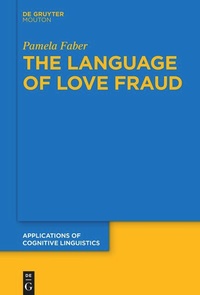
The Language of Love Fraud
Description

This study applies Fillmore's Frame Semantics and corpus linguistics to analyze love fraud. It demonstrates the stages of the event as well as the words and phrases used to activate each frame and cause the victim to love and trust the fraudster. The fraudster thus constructs a romantic relationship with the victim, solely through language. This relationship begins with friendship, progresses to 'soulmateship' and engagement, and finally ends in an online 'marriage'. Since one word can activate an entire frame, it is the fraudster's lexical choices that cause the victim to ignore the imperfectly written messages and blinds them to the syntactic, semantic, and pragmatic errors in the texts.
More details
Other editions
Additional editions
Person
Pamela Faber, University of Granada, Granada, Spain
Content
- Intro
- Preface
- Contents
- List of Figures
- List of Tables
- 1 Introduction to love fraud
- 1.1 History
- 1.2 Financial loss
- 1.3 Emotional loss
- 1.4 Love fraud in a nutshell
- 1.5 Research on love fraud
- 1.6 The love fraud study
- 1.6.1 Theoretical framework
- 1.6.2 Methodology
- 1.6.3 Subjects
- Outline placeholder
- Participant profiles and occupational narratives
- Generals
- Doctors
- Oil riggers
- Engineers
- Celebrities
- Miscellaneous
- 1.6.4 The men behind the mask
- Outline placeholder
- Hustler kingdoms (HKs)
- The fifteen golden rules of love fraud
- Love fraud terminology
- Feelings
- Guilt
- The magic word
- Life after scamming
- 1.7 Chapter summary
- 2 The love fraud relationship
- 2.1 Relationship construction
- 2.2 Relationship phases
- 2.2.1 Acquaintanceship
- Outline placeholder
- Personal information
- Name, occupation, and location
- Material possessions
- Marital status
- Age
- Cosmic force
- Photo
- Videocall
- All-purpose questions to foster intimacy
- Questions about habits
- The only child
- From acquaintanceship to friendship
- 2.2.2 Friendship
- Outline placeholder
- Trust and honesty
- 2.2.3 Soulmateship
- Outline placeholder
- Emotions, inspiration, hopes, and dreams
- Affective role
- Attributes
- Symbolic language
- Emotional maintenance
- Emotional integration
- Inner beauty and the burden of trust
- 2.2.4 Engagement
- 2.2.5 Marriage
- 2.3 The crisis
- 2.3.1 Enemy attack
- Outline placeholder
- The portfolio
- The diplomat
- 2.3.2 Retirement papers
- 2.3.3 Vacation leave
- Outline placeholder
- United Nations Vacation Office
- 2.3.4 Flight tickets
- 2.3.5 School or medical expenses
- Outline placeholder
- Credit card
- School assignments
- Medical expenses
- 2.3.6 Early contract termination
- 2.3.7 Project difficulties
- Outline placeholder
- Crises at sea: oil rigs
- Crises on dry land: lumberjacking
- Crises in the air: Travel certificate fees
- 2.3.8 Box of gold
- 2.3.9 Internet connection
- 2.3.10 Inheritance
- 2.3.11 Celebrity fan club card
- 2.3.12 Pirate attack
- 2.4 Payment
- 2.5 Revelation
- 2.5.1 Sadness
- 2.5.2 Denial
- 2.5.3 Sarcasm
- 2.5.4 Threats
- 2.5.6 Anger
- 2.5.7 Humor
- 2.6 Chapter summary
- 3 The syntax, semantics, and pragmatics of love fraud language
- 3.1 Introduction
- 3.2 Spelling
- 3.3 Punctuation
- 3.4 Capitalization
- Outline placeholder
- Days of the week
- Emphasis
- 3.5 Syntax
- 3.5.1 Ellipsis
- Outline placeholder
- Subject ellipsis
- Verb ellipsis
- 3.5.2 Verb forms
- Outline placeholder
- Auxiliary verbs
- Past participles
- Verb-noun confusion
- Verb contractions
- Informal contractions
- 3.5.3 Nouns
- Outline placeholder
- Singular/plural forms
- Noun-noun confusion
- Noun-verb confusion
- Noun-adjective confusion
- 3.5.4 Pronouns
- Outline placeholder
- Object pronouns
- Gender confusion
- 3.5.5 Adjectives
- Outline placeholder
- Comparisons
- Superlatives
- Adjective overuse
- Adjective-adverb confusion
- Adjective-noun confusion
- Misuse of et cetera
- 3.5.6 Interjections
- Outline placeholder
- Neologisms
- 3.5.7 Artificial intelligence, friend or foe?
- 3.6 Semantics
- 3.6.1 Frame activation: verbs of Liking and Loving
- Outline placeholder
- To feel attraction
- 3.7 Pragmatics
- 3.7.1 Conversational dynamics
- 3.7.2 Conversation topics
- Outline placeholder
- Food
- Weather
- Current activity
- Social events
- Requesting explanations
- 3.7.3 The pragmatics of word meaning
- Outline placeholder
- Synonyms and semantic substitution
- Use of endearments
- Semantic prosody
- Idioms
- 3.7.4 Speech acts
- Outline placeholder
- Profile stage
- Grooming stage
- Crisis stage
- 3.7.5 Cultural knowledge
- Outline placeholder
- Cultural misrecognition: cinematographic references
- Cultural misrecognition: music
- Educational system and level
- Historical implausibility
- Geographical misconceptions
- 3.8 Chapter summary
- 4 Scripts and love fraud formats
- 4.1 Scripts and the architecture of love fraud
- 4.2 Formats
- Outline placeholder
- Outline placeholder
- Sub-format 1: Introduction
- Sub-format 2: Personal information and shared interests
- Sub-format 3: Prelude to love
- Sub-format 4: Declaration of love
- Sub-format 5: Love confirmation and consolidation
- Sub-format 6: Trust building
- Sub-format 7: Crisis and request for money
- Sub-format 8: Billing
- 4.3 Chapter summary
- 5 Conclusion
- Appendix
- Format 1
- Format 2
- Format 3
- Format 4
- Format 5: Billing
- References
- Index
