

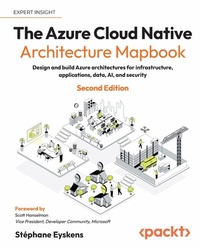
The Azure Cloud Native Architecture Mapbook
Description

- Translate enterprise requirements into secure and scalable reference architectures
- Gain practical design insights from a Microsoft cloud solution architect
- Get With Your Book: PDF Copy, AI Assistant, and Next-Gen Reader Free
Book DescriptionDesigning effective cloud-native architectures on Azure often feels overwhelming-especially when trying to translate complex requirements into reliable solutions. This book solves that problem by giving you a structured, visual guide to building modern systems that are scalable, secure, and production-ready. You'll discover how to plan, design, and communicate Azure-based architectures using practical reference diagrams mapped to real-world use cases. Organized by domains including infrastructure, applications, data, container orchestrators, AI, and security, each chapter walks you through the key services, patterns, and decisions that underpin successful solutions. Throughout the book, you'll find over 40 detailed architecture maps, created and curated by a seasoned Microsoft cloud solution architect. These maps illustrate how to align Azure services with business goals, manage hybrid and multi-cloud complexity, and incorporate best practices for governance, resilience, and cost optimization. This book gives you more than just diagrams; it offers the confidence to design cloud solutions that scale and perform. Whether you're modernizing a legacy stack or building greenfield applications, the Azure Cloud Native Architecture Mapbook is your trusted design companion from concept to delivery.What you will learn - Align architecture with business and technical requirements
- Choose the right compute, storage, and networking services
- Visualize key components using architectural map diagrams
- Apply design principles for identity, governance, and observability
- Architect hybrid and containerized solutions
- Translate real-world needs into actionable cloud designs
- Apply patterns from Microsoft's Cloud Adoption Framework
Who this book is forCloud architects, Solution Architects, developers, DevOps engineers, and IT professionals designing, deploying, or modernizing solutions on Microsoft Azure. Readers should understand core Azure services and have experience working in cloud-native or hybrid environments. Additionally, readers should be familiar with some generic architecture concepts.
All prices
More details
Content
Preface
Writing about Azure is a humbling experience. The platform evolves faster than any single book could ever hope to capture in full. New services appear, existing ones merge or fade, and best practices constantly shift. Yet beneath this flux lies something enduring-the architectural principles, mental models, and trade-offs that shape every successful Azure solution.
This book was written to uncover that enduring layer. It doesn't aim to document every feature or service in detail; Microsoft's documentation already does that brilliantly. Instead, it seeks to give you a map-a way to navigate Azure's vastness with purpose and clarity. Whether you are an architect defining a cloud strategy or an engineer implementing complex workloads, you'll find here the reasoning, patterns, and structure to make informed choices in the Azure ecosystem.
The journey begins with foundational thinking about what it means to architect in the cloud and how different roles contribute to that process. It then dives progressively into each vertical, such as infrastructure, containers, data, development, security, and artificial intelligence. Each chapter balances conceptual depth with practical insight, offering a cohesive narrative that connects the dots between technology, governance, and enterprise-grade practices.
Throughout, the emphasis is on why-why one architecture pattern fits better than another, why certain Azure services align naturally with specific goals, and why trade-offs must always be made. Real-world pragmatism anchors every discussion, because architecture ultimately lives in the tension between ideals and constraints.
Think of this book as a compass, not an encyclopedia. It won't give you all the answers-but it will help you ask the right questions. It will help you reason through design decisions, foresee implications, and approach Azure not as a collection of tools, but as a coherent ecosystem.
If you come away with a clearer sense of direction, a stronger architectural mindset, and renewed curiosity to explore further, then this book will have fulfilled its purpose.
Who this book is for
This book is for cloud architects, engineers, and technical decision-makers who design, build, or govern solutions on Azure. It assumes a solid grasp of cloud and architecture fundamentals but welcomes readers from all backgrounds-whether you specialize in infrastructure, development, data, or security. It's not only about Azure; it's about connecting the dots across architecture disciplines, showing how they come together to form cohesive, cloud-native solutions. If you're looking to strengthen your end-to-end architectural thinking and understand how every layer influences the others, this book is for you.
What this book covers
Chapter 1, Getting Started as an Azure Architect, details the different architecture roles and introduces the Azure ecosystem and cloud fundamentals.
Chapter 2, Solution Architecture, browses the vast Azure landscape and shows the most important building blocks and cross-cutting concerns every solution architect should be aware of.
Chapter 3, Infrastructure Design, dives deeper into the infrastructure vertical. It explains the various network topologies and addresses common infrastructure concerns, such as backup/restore, high availability, and disaster recovery.
Chapter 4, Working with Azure Kubernetes Service (AKS), is an in-depth exploration of AKS, with detailed architectures addressing single and multi-tenant clusters. The chapter highlights the key role played by logic isolation and service meshes.
Chapter 5, Working with Other Container Services, makes an extensive comparison between container services to help you choose the right one that best fits your unique requirements.
Chapter 6, Developing and Designing Applications with Azure, describes what each application factory should master to be efficient when developing cloud solutions, from local development tools and emulators to the most recurrent cloud-native design patterns.
Chapter 7, Data Architecture, covers the most recurrent data patterns, such as Lambda, Kappa, and Medallion architecture, as well as the traditional Online Transaction Processing (OLTP) and Online Analytical Processing (OLAP) services and the emerging Hybrid Transactional/Analytical Processing (HTAP) capabilities.
Chapter 8, Artificial Intelligence Architecture, explores both established and emerging AI patterns that have proven their relevance and are shaping the future of intelligent systems. Because the field evolves so rapidly, the chapter emphasizes architectural patterns and design principles rather than hands-on exercises.
Chapter 9, Security Architecture, provides a 360-degree view of Azure's security landscape and tackles typical concerns such as identity and access management, threat detection, security posture management, compliance, and governance.
Chapter 10, Closing Thoughts and Next Steps, provides a summary of the entire book as well as useful resources, which can help you deepen your skills further.
To get the most out of this book
Although the first chapter introduces some fundamental concepts, you should ideally already be familiar with the cloud, as well as having a sound understanding of software architecture.
Download the example code files
The code bundle for the book is hosted on GitHub at https://github.com/PacktPublishing/The-Azure-Cloud-Native-Architecture-Mapbook-Second-Edition. We also have other code bundles from our rich catalog of books and videos available at https://github.com/PacktPublishing. Check them out!
Conventions used
There are a number of text conventions used throughout this book.
CodeInText: Indicates code words in text, database table names, folder names, filenames, file extensions, pathnames, dummy URLs, user input, and Twitter handles. For example: "The main.tf file is where we parse the provided configuration file and call our Terraform modules accordingly to deploy the actual architecture."
A block of code is set as follows:
string blobUrl = blobClient.Uri.ToString(); _logger.LogInformation($"Pretend to handle blob \n Name:{name} \n"); var payload = new { BlobUrl = blobUrl }; Any command-line input or output is written as follows:
terraform init terraform apply --auto-approve Bold: Indicates a new term, an important word, or words that you see on the screen. For instance, words in menus or dialog boxes appear in the text like this. For example: "Next, click on Import Profile and select the download file. Accept all the default options."
Warnings or important notes appear like this.
Tips and tricks appear like this.
Get in touch
Feedback from our readers is always welcome.
General feedback: Email feedback@packtpub.com and mention the book's title in the subject of your message. If you have questions about any aspect of this book, please email us at questions@packtpub.com.
Errata: Although we have taken every care to ensure the accuracy of our content, mistakes do happen. If you have found a mistake in this book, we would be grateful if you reported this to us. Please visit http://www.packtpub.com/submit-errata, click Submit Errata, and fill in the form.
Piracy: If you come across any illegal copies of our works in any form on the internet, we would be grateful if you would provide us with the location address or website name. Please contact us at copyright@packtpub.com with a link to the material.
If you are interested in becoming an author: If there is a topic that you have expertise in and you are interested in either writing or contributing to a book, please visit http://authors.packtpub.com/.
Free Benefits with Your Book
This book comes with free benefits to support your learning. Activate them now for instant access (see the "How to Unlock" section for instructions).
Here's a quick overview of what you can instantly unlock with your purchase:
PDF and ePub Copies
Next-Gen Web-Based Reader
Access a DRM-free PDF copy of this book to read anywhere, on any device.
...