

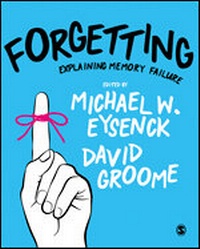
Forgetting
Explaining Memory Failure
1st Edition
Published on 6. July 2020
232 pages
978-1-5297-3018-0 (ISBN)
Description

Forgetting is the most obvious feature of human memory, whether this is everyday forgetfulness, like leaving your keys at home, or more serious medical conditions, such as amnesia. Forgetting: Explaining Memory Failure uses the most up-to-date evidence available to examine the psychological processes behind these extremes and everything in between. It explores why we have so little recollection of our childhood lives, as well as why we may create false memories of events that never happened.
In this book, Michael Eysenck & David Groome use cutting-edge research to examine one of the central issues in the study of memory: forgetting. It challenges assumptions about the processing of memory, offering insights into key debates, as well as providing readers with the critical skills to develop their own conclusions on the topic. With chapters from leading figures, this book also emphasises the positive aspects of forgetting, an important and often overlooked area in the field.
In this book, Michael Eysenck & David Groome use cutting-edge research to examine one of the central issues in the study of memory: forgetting. It challenges assumptions about the processing of memory, offering insights into key debates, as well as providing readers with the critical skills to develop their own conclusions on the topic. With chapters from leading figures, this book also emphasises the positive aspects of forgetting, an important and often overlooked area in the field.
Reviews / Votes
We are all subject to forgetting-sometimes quite dramatic forgetting. In this very readable book, Eysenck, Groome, and a team of experts in the science of memory describe many types and sources of forgetting. Written in a clear and engaging manner, these chapters will be of interest to anyone who has ever wondered how their memory works, and why it fails.Colin M MacLeod -- Colin M MacLeod
More details
Edition
First Edition
Language
English
Place of publication
London
United Kingdom
Publishing group
Sage Publications Ltd (Digital)
Target group
College/higher education
ISBN-13
978-1-5297-3018-0 (9781529730180)
Copyright in bibliographic data and cover images is held by Nielsen Book Services Limited or by the publishers or by their respective licensors: all rights reserved.
Schweitzer Classification
Other editions
Additional editions
Book
08/2020
1st Edition
SAGE Publications Ltd
€162.60
Shipment within 15-20 days
Persons
Michael W. Eysenck is Emeritus Professor at the University of Roehampton and Emeritus Professor and Honorary Fellow at Royal Holloway University of London. He has published 62 books and approximately 170 articles and book chapters. He has written numerous textbooks on cognitive psychology and his main research area is concerned with the relationship between anxiety and cognition.
David Groome was Senior Academic and Head of the Psychology Department at the University of Westminster, London. He retired in 2011, but he continues to write and he has authored or co-authored twelve psychology books. His research interests mainly involve cognition and memory, especially memory suppression and the effects of mood disorders on cognition. In 2009 he was awarded the BPS Award for Excellence in the Teaching of Psychology. His hobbies include tennis, travel, dogs, and music. In his spare time he is a keen guitarist, and is still waiting for his big break as a rock star.
David Groome was Senior Academic and Head of the Psychology Department at the University of Westminster, London. He retired in 2011, but he continues to write and he has authored or co-authored twelve psychology books. His research interests mainly involve cognition and memory, especially memory suppression and the effects of mood disorders on cognition. In 2009 he was awarded the BPS Award for Excellence in the Teaching of Psychology. His hobbies include tennis, travel, dogs, and music. In his spare time he is a keen guitarist, and is still waiting for his big break as a rock star.
Content
Chapter 1: Introduction - Michael Eysenck & David Groome
Chapter 2: Childhood forgetting - Harlene Hayne & Jane Herbert
Chapter 3: Autobiographical forgetting - Martin Conway
Chapter 4: Eyewitness forgetting - Coral Dando
Chapter 5: Prospective memory forgetting - Michael Scullin, Seth Koslov & Jarrod Lewis-Peacock
Chapter 6: Post-hypnotic amnesia - John F. Kihlstrom
Chapter 7: Organic Amnesia - Melissa C. Duff & Neal J. Cohen
Chapter 8: Retrieval Inhibition - Karl-Heinz Baeuml, Magdalena Abel & Oliver Kliegl
Chapter 9: Motivated Forgetting - David Groome, Michael Eysenck & Robin Law
Chapter 2: Childhood forgetting - Harlene Hayne & Jane Herbert
Chapter 3: Autobiographical forgetting - Martin Conway
Chapter 4: Eyewitness forgetting - Coral Dando
Chapter 5: Prospective memory forgetting - Michael Scullin, Seth Koslov & Jarrod Lewis-Peacock
Chapter 6: Post-hypnotic amnesia - John F. Kihlstrom
Chapter 7: Organic Amnesia - Melissa C. Duff & Neal J. Cohen
Chapter 8: Retrieval Inhibition - Karl-Heinz Baeuml, Magdalena Abel & Oliver Kliegl
Chapter 9: Motivated Forgetting - David Groome, Michael Eysenck & Robin Law
