

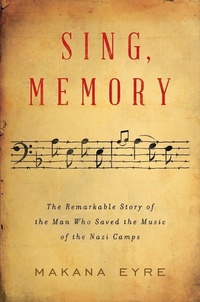
Sing, Memory
Description

A Polish musician, a Jewish conductor, a secret choir, and the rescue of a trove of music from the Sachsenhausen concentration camp.
On a cold October night in 1942, SS guards at the Sachsenhausen concentration camp violently disbanded a rehearsal of a secret Jewish choir led by conductor Rosebery d'Arguto. Many in the group did not live to see morning, and those who survived the guards' reprisal were deported to Auschwitz-Birkenau just a few weeks later. Only one of its members survived the Holocaust. Yet their story survives, thanks to Aleksander Kulisiewicz. An amateur musician, he was not Jewish, but struck up an unlikely friendship with d'Arguto in Sachsenhausen. D'Arguto tasked him with a mission: to save the musical heritage of the victims of the Nazi camps.
In Sing, Memory, Makana Eyre recounts Kulisiewicz's extraordinary transformation from a Polish nationalist into a guardian of music and culture from the Nazi camps. Aided by an eidetic memory, Kulisiewicz was able to preserve for posterity not only his own songs about life at the camp, but the music and poetry of prisoners from a range of national and cultural backgrounds. They composed symphonies, organized clandestine choirs, arranged great pieces of music by illustrious composers, and gathered regularly over the course of the war to perform for one another. For many, music enabled them to resist, bear witness, and maintain their humanity in some of the most brutal conditions imaginable.
After the war, Kulisiewicz returned to Poland and assembled an archive of camp music, which he went on to perform in more than a dozen countries. He dedicated the remainder of his life to the memory of the Nazi camps. Drawing on oral history and testimony, as well as extensive archival research, Eyre tells this rich and affecting human story of musical resistance to the Nazi regime in full for the first time.
More details
Other editions
Additional editions
Person
Content
- Intro
- Title
- Contents
- Author's Note
- Part I
- Chapter 1
- Chapter 2
- Chapter 3
- Chapter 4
- Chapter 5
- Chapter 6
- Chapter 7
- Part II
- Chapter 8
- Chapter 9
- Part III
- Chapter 10
- Chapter 11
- Part IV
- Chapter 12
- Chapter 13
- Chapter 14
- Illustrations
- Acknowledgments
- Notes
- Selected Bibliography
- Index
- Copyright
