

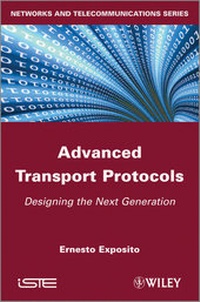
Advanced Transport Protocols
Description

More details
Other editions
Additional editions


Person
Ernesto Exposito has been Associated Professor at INSA, Toulouse, France since 2006, as well as a researcher at the LAAS laboratory of the CNRS, France. His research interests include autonomic communication services aimed at satisfying the requirements of new generation multimedia applications in heterogeneous network environments. His current research activities include designing, modeling and developing service-oriented, component-based and ontology-driven autonomic transport services.
Content
Preface xi
Chapter 1. Introduction 1
1.1. Evolution of application and network layers 1
1.2. Summary of contributions 3
1.3. Book structure 5
Chapter 2. Transport Protocols State of the Art 7
2.1. Introduction7
2.2. Transport layer reference models 9
2.2.1. OSI model 9
2.2.2. TCP/IP model 9
2.2.3. Transport layer 9
2.2.4. Transport services 10
2.3. Transport functions and mechanisms 11
2.3.1. Error control 11
2.3.2. Congestion control 14
2.3.3. Summary 19
2.4. IETF transport protocols 20
2.4.1. TCP 20
2.4.2. UDP21
2.4.3. SCTP 21
2.4.4. DCCP 22
2.4.5. MPTCP 23
2.5. Summary 23
Chapter 3. Semantic Modeling of Transport Protocols and Services 25
3.1. Introduction 25
3.2. Model and semantic-driven architecture 26
3.2.1. Model-driven architecture 26
3.2.2. Ontology-driven architecture 27
3.3. Design of a QoS ontology framework 28
3.3.1. Quality of Service definition 28
3.3.2. ITU-T X.641 framework 29
3.3.3. Service 29
3.3.4. Service user . 29
3.3.5. Service provider30
3.3.6. QoS characteristic 30
3.3.7. QoS requirement . 30
3.3.8. QoS parameter 30
3.3.9. QoS function. 31
3.3.10. QoS mechanism . 31
3.4. Design of a QoS transport ontology for the next generation
transport layer . 31
3.4.1. Ontology representation 31
3.4.2. X.641 QoS ontology . 32
3.4.3. QoS transport requirements 33
3.4.4. QoS transport mechanisms, functions and protocols . 33
3.5. QoS transport ontology specification. 34
3.5.1. TCP semantic description . 34
3.5.2. UDP semantic description. 36
3.5.3. SCTP semantic description 36
3.5.4. DCCP semantic description 38
3.5.5. MPTCP semantic description . 40
3.6. Usage of the QoS transport ontology specification 41
3.6.1. QoS transport services characterization 42
3.6.2. Transport components and transport composite
characterization 45
3.7. Summary 46
Chapter 4. Model-Driven Design Methodology of Transport
Mechanisms and Functions 49
4.1. Introduction49
4.2. Software engineering process 50
4.2.1. Unified Modeling Language 51
4.2.2. UML 2.4.1-based methodology 52
4.2.3. UML diagrams 55
4.2.4. Summary and additional resources 66
4.3. Applying the UML-based software engineering methodology
for transport services 68
4.3.1. Contextual model of transport functions and mechanisms 68
4.3.2. Analysis of requirements guiding transport functions 69
4.3.4. Design of transport functions and mechanisms 71
4.4. Summary 77
Chapter 5. Model-Driven Specification and Validation
of Error Control Transport Mechanisms and Functions 79
5.1. Introduction 79
5.2. Design of an error control function 80
5.2.1. Behavior specification of the sending side protocol entity 81
5.2.2. Behavior specification of the receiving side protocol entity 83
5.3. Functional validation of the error control function 84
5.3.1. Functional validation using a perfect medium 86
5.3.2. Functional validation using an imperfect medium 88
5.4. A new design of the error control function 93
5.4.1. Functional validation using an imperfect medium 96
5.4.2. More open questions 97
5.5. A model-driven simulation environment 98
5.5.1. Model-driven simulation framework 99
5.5.2. Model-driven network simulator package 100
5.5.3. Lossy medium simulator 101
5.5.4. Delayed medium simulator 102
5.5.5. Bandwidth-limited medium simulator 104
5.6. Chapter summary 106
5.7. Appendix 107
Chapter 6. Model-Driven Specification and Validation of Congestion
Control Transport Mechanisms and Functions 109
6.1. Introduction 109
6.2. Design of a congestion control function 110
6.2.1. Behavior specification of the sending and receiving side
protocol entities 111
6.2.2. The TCP-friendly rate control (TFRC) specification 114
6.2.3. Detailed TFRC design 117
6.3. Functional validation of the congestion control function 119
6.3.1. Case study 1: continuous stream of messages
(no time constraints) 121
6.3.2. Case study 2: GSM audio stream 123
6.3.3. Case study 3: MJPEG video stream 123
6.4. Summary 126
6.5. Appendix 127
Chapter 7. Specification and Validation of QoS-Oriented Transport
Mechanisms and Functions 129
7.1. Introduction 129
7.2. Contextual model of a QoS-oriented transport functions 130
7.3. Contextual model of a QoS-oriented error control functions 131
7.3.1. Partially ordered/partially reliable transport services 133
7.4. Contextual model of a QoS-oriented congestion control functions 138
7.4.1. QoS-aware TFRC congestion control 139
7.5. Design of the QoS-oriented error control functions 142
7.5.1. Basis of a fully reliable SACK-based function143
7.5.2. Design of a partially reliable SACK-based function 144
7.5.3. Design of a partially reliable function 146
7.5.4. Design of a differentiated and partially reliable function 147
7.5.5. Design of a time-constrained, differentiated and partially
reliable function 148
7.6. Design of the QoS-oriented congestion control function 148
7.6.1. Basis of a TCP-friendly rate control function 149
7.6.2. Design of a time-constrained and differentiated congestion
control function 151
7.7. Summary 153
Chapter 8. Architectural Frameworks for a QoS-Oriented
Transport Protocol 157
8.1. Introduction 157
8.2. Communication architecture requirements 159
8.3. Architectural frameworks for communication protocols 160
8.3.1. QoS-oriented architecture 160
8.3.2. Architectural frameworks for communication protocols 161
8.4. Design of a composite and QoS-oriented transport protocol 164
8.4.1. Design of the fully programmable transport protocol 164
8.5. Evaluation of the FPTP transport protocol 180
8.5.1. FPTP TD-TFRC mechanism 180
8.5.2. FPTP D-PR and TD-PR mechanisms 181
8.5.3. FPTP TD-TFRC mechanisms 182
8.5.4. Analysis of results 183
8.6. Summary 184
8.7. Appendix 184
Chapter 9. Service-Oriented and Component-Based
Transport Protocol 187
9.1. Introduction187
9.2. State-of-the-art on modern software architectural frameworks 188
9.2.1. Service-oriented architecture 188
9.2.2. Component-based design 190
9.2.3. Summary 192
9.3. Design guidelines of a component-based and service-oriented
architecture for the next generation transport layer 193
9.3.1. Service-oriented architecture transport layer (SOATL) 193
9.3.2. Service-component architecture for transport
protocols (SCATP) 193
9.3.3. Semantic model guiding the selection and composition
of transport services 194
9.4. FPTP semantic description 194
9.4.1. FPTP individual 195
9.4.2. Service characterization inferences based on components axioms 196
9.5. Summary 198
9.6. Appendix 199
Chapter 10. Adaptive Transport Protocol 201
10.1. Introduction 201
10.2. The enhanced transport protocol 202
10.2.1. Adaptive composite communication architecture 203
10.2.2. Behavioral adaptation 205
10.2.3. Structural adaptation 209
10.3. Summary 212
Chapter 11. Autonomic Transport Protocol 213
11.1. Introduction 213
11.2. Autonomic computing 214
11.3. Self-managing functions 215
11.4. Architecture 215
11.4.1. Autonomic elements 216
11.4.2. Autonomic orchestrators 218
11.4.3. Policies 219
11.4.4. Knowledge base 220
11.4.5. Summary 220
11.5. Design guidelines of an autonomic computing architecture
for the next-generation transport layer 221
11.5.1. Self-managing functionalities 221
11.5.2. Architecture 222
11.5.3. Autonomic orchestrators 224
11.5.4. Policy framework 228
11.5.5. Knowledge base 228
11.6. Summary 228
11.7. Appendix 229
Conclusions 231
Perspectives 235
Appendix 239
Bibliography 269
Index 279
