

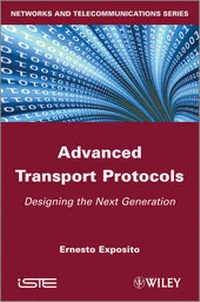
Advanced Transport Protocols
Designing the Next Generation
Published on 24. January 2013
320 pages
978-1-118-57832-2 (ISBN)
Description

The current diversity of transport services, as well as the complexity resulting from the deployment of specific transport protocols or mechanisms over the different services provided by heterogeneous networks, demand a novel design of the transport layer. Moreover, current and future applications will only be able to take advantage of the most adapted and available transport services if they are able to interact (i.e. discover, compose, deploy and adapt) efficiently with this advanced transport layer.
The work presented in this book proposes a model-driven methodology and a service-oriented approach aimed at designing the mechanisms, functions, protocols and services of the next generation transport layer.
The first part of this book presents the state of the art of transport protocols and introduces a model-driven methodology and an ontology semantic model implementation aimed at designing next generation transport protocols.
The second part presents the UML-based design of a component-based transport protocol. An extension to this protocol based on service-component and service-oriented architectures is also presented.
The third part presents various model-driven adaptive strategies aimed at managing the behavioral and structural adaptation of next generation autonomic transport protocols.
The fourth and final part presents the design of a transport layer based on component-oriented and service-oriented approaches and integrating the autonomic computing paradigm guided by the semantic dimension provided by ontologies.
More details
Other editions
Additional editions
Book
12/2012
1st Edition
Wiley-ISTE
€166.50
Article not available at the moment
Content
- Intro
- Title Page
- Contents
- Preface
- Chapter 1. Introduction
- 1.1. Evolution of application and network layers
- 1.2. Summary of contributions
- 1.3. Book structure
- Chapter 2. Transport Protocols State of the Art
- 2.1. Introduction
- 2.2. Transport layer reference models
- 2.2.1. OSI model
- 2.2.2. TCP/IP model
- 2.2.3. Transport layer
- 2.2.4. Transport services
- 2.3. Transport functions and mechanisms
- 2.3.1. Error control
- 2.3.2. Congestion control
- 2.3.3. Summary
- 2.4. IETF transport protocols
- 2.4.1. TCP
- 2.4.2. UDP
- 2.4.3. SCTP
- 2.4.4. DCCP
- 2.4.5. MPTCP
- 2.5. Summary
- Chapter 3. Semantic Modeling of Transport Protocols and Services
- 3.1. Introduction
- 3.2. Model and semantic-driven architecture
- 3.2.1. Model-driven architecture
- 3.2.2. Ontology-driven architecture
- 3.3. Design of a QoS ontology framework
- 3.3.1. Quality of Service definition
- 3.3.2. ITU-T X.641 framework
- 3.3.3. Service
- 3.3.4. Service user
- 3.3.5. Service provider
- 3.3.6. QoS characteristic
- 3.3.7. QoS requirement
- 3.3.8. QoS parameter
- 3.3.9. QoS function
- 3.3.10. QoS mechanism
- 3.4. Design of a QoS transport ontology for the next generation transport layer
- 3.4.1. Ontology representation
- 3.4.2. X.641 QoS ontology
- 3.4.3. QoS transport requirements
- 3.4.4. QoS transport mechanisms, functions and protocols
- 3.5. QoS transport ontology specification
- 3.5.1. TCP semantic description
- 3.5.2. UDP semantic description
- 3.5.3. SCTP semantic description
- 3.5.4. DCCP semantic description
- 3.5.5. MPTCP semantic description
- 3.6. Usage of the QoS transport ontology specification
- 3.6.1. QoS transport services characterization
- 3.6.2. Transport components and transport composite characterization
- 3.7. Summary
- Chapter 4. Model-Driven Design Methodology of Transport Mechanisms and Functions
- 4.1. Introduction
- 4.2. Software engineering process
- 4.2.1. Unified Modeling Language
- 4.2.2. UML 2.4.1-based methodology
- 4.2.3. UML diagrams
- 4.2.4. Summary and additional resources
- 4.3. Applying the UML-based software engineering methodology for transport services
- 4.3.1. Contextual model of transport functions and mechanisms
- 4.3.2. Analysis of requirements guiding transport functions
- 4.3.4. Design of transport functions and mechanisms
- 4.4. Summary
- Chapter 5. Model-Driven Specification and Validation of Error Control Transport Mechanisms and Functions
- 5.1. Introduction
- 5.2. Design of an error control function
- 5.2.1. Behavior specification of the sending side protocol entity
- 5.2.2. Behavior specification of the receiving side protocol entity
- 5.3. Functional validation of the error control function
- 5.3.1. Functional validation using a perfect medium
- 5.3.2. Functional validation using an imperfect medium
- 5.4. A new design of the error control function
- 5.4.1. Functional validation using an imperfect medium
- 5.4.2. More open questions
- 5.5. A model-driven simulation environment
- 5.5.1. Model-driven simulation framework
- 5.5.2. Model-driven network simulator package
- 5.5.3. Lossy medium simulator
- 5.5.4. Delayed medium simulator
- 5.5.5. Bandwidth-limited medium simulator
- 5.6. Chapter summary
- 5.7. Appendix
- Chapter 6.Model-Driven Specification and Validation of Congestion Control Transport Mechanisms and Functions
- 6.1. Introduction
- 6.2. Design of a congestion control function
- 6.2.1. Behavior specification of the sending and receiving side protocol entities
- 6.2.2. The TCP-friendly rate control (TFRC) specification
- 6.2.3. Detailed TFRC design
- 6.3. Functional validation of the congestion control function
- 6.3.1. Case study 1: continuous stream of messages (no time constraints)
- 6.3.2. Case study 2: GSM audio stream
- 6.3.3. Case study 3: MJPEG video stream
- 6.4. Summary
- 6.5. Appendix
- Chapter 7. Specification and Validation of QoS-Oriented Transport Mechanisms and Functions
- 7.1. Introduction
- 7.2. Contextual model of a QoS-oriented transport functions
- 7.3. Contextual model of a QoS-oriented error control functions
- 7.3.1. Partially ordered/partially reliable transport services
- 7.4. Contextual model of a QoS-oriented congestion control functions
- 7.4.1. QoS-aware TFRC congestion control
- 7.5. Design of the QoS-oriented error control functions
- 7.5.1. Basis of a fully reliable SACK-based function
- 7.5.2. Design of a partially reliable SACK-based function
- 7.5.3. Design of a partially reliable function
- 7.5.4. Design of a differentiated and partially reliable function
- 7.5.5. Design of a time-constrained, differentiated and partially reliable function
- 7.6. Design of the QoS-oriented congestion control function
- 7.6.1. Basis of a TCP-friendly rate control function
- 7.6.2. Design of a time-constrained and differentiated congestion control function
- 7.7. Summary
- Chapter 8. Architectural Frameworks for a QoS-Oriented Transport Protocol
- 8.1. Introduction
- 8.2. Communication architecture requirements
- 8.3. Architectural frameworks for communication protocols
- 8.3.1. QoS-oriented architecture
- 8.3.2. Architectural frameworks for communication protocols
- 8.4. Design of a composite and QoS-oriented transport protocol
- 8.4.1. Design of the fully programmable transport protocol
- 8.5. Evaluation of the FPTP transport protocol
- 8.5.1. FPTP TD-TFRC mechanism
- 8.5.2. FPTP D-PR and TD-PR mechanisms
- 8.5.3. FPTP TD-TFRC mechanisms
- 8.5.4. Analysis of results
- 8.6. Summary
- 8.7. Appendix
- Chapter 9. Service-Oriented and Component-Based Transport Protocol
- 9.1. Introduction
- 9.2. State of the art on modern software architectural frameworks
- 9.2.1. Service-oriented architecture
- 9.2.2. Component-based design
- 9.2.3. Summary
- 9.3. Design guidelines of a component-based and service-oriented architecture for the next generation transport layer
- 9.3.1. Service-oriented architecture transport layer (SOATL)
- 9.3.2. Service-component architecture for transport protocols (SCATP)
- 9.3.3. Semantic model guiding the selection and composition of transport services
- 9.4. FPTP semantic description
- 9.4.1. FPTP individual
- 9.4.2. Service characterization inferences based on components axioms
- 9.5. Summary
- 9.6. Appendix
- Chapter 10. Adaptive Transport Protocol
- 10.1. Introduction
- 10.2. The enhanced transport protocol
- 10.2.1. Adaptive composite communication architecture
- 10.2.2. Behavioral adaptation
- 10.2.3. Structural adaptation
- 10.3. Summary
- Chapter 11. Autonomic Transport Protocol
- 11.1. Introduction
- 11.2. Autonomic computing
- 11.3. Self-managing functions
- 11.4. Architecture
- 11.4.1. Autonomic elements
- 11.4.2. Autonomic orchestrators
- 11.4.3. Policies
- 11.4.4. Knowledge base
- 11.4.5. Summary
- 11.5. Design guidelines of an autonomic computing architecture for the nextgeneration transport layer
- 11.5.1. Self-managing functionalities
- 11.5.2. Architecture
- 11.5.3. Autonomic orchestrators
- 11.5.4. Policy framework
- 11.5.5. Knowledge base
- 11.6. Summary
- 11.7. Appendix
- Conclusions
- Perspectives
- Appendix
- Bibliography
- Index
