

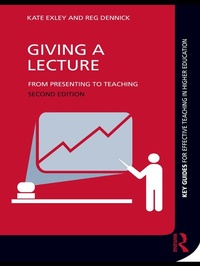
Giving a Lecture
From Presenting to Teaching
2nd Edition
Published on 7. May 2009
240 pages
978-1-134-02993-8 (ISBN)
Description

The second edition of Giving a Lecture builds upon the reputation and success of the Key Guides for Effective Teaching in Higher Education series. It is an excellent resource for those new to teaching at the University and College level and for those who just want to reflect upon and refresh their lecturing practice. The best selling first edition has been fully revised, and this edition continues to cover all the basics on how to go about lecturing while maintaining its jargon-free and accessible style. New lecturers will find the second edition equips them with the essential tools and guidance for delivering a successful lecture, and explains exciting new developments along with the fundamentals of lecturing.
Addressing a number of rapid developments that have occurred since its first publication in 2004, the second edition provides:
A new chapter on podcasting and e-lecturing
Much more on the effective use of PowerPoint
Guidance on using interactive handsets to promote active learning and engagement
Consideration of the role of Lectures in problem based learning (PBL) courses
An expanded chapter that addresses current diversity/inclusivity issues
A fresh look with new Illustrations
Updated 'Recommended Reading and Web-Resource' sections
This handy guide uses a multi-disciplinary approach based on sound educational theory to provide clear guidance and engaging ideas on giving a memorable and motivational lecture. Readers will find its straightforward approach is both readable and very practical, and new University and College Teachers, Graduate Teaching Assistants, Part-time Tutors, Teaching Clinicians and Practitioners, together with those interested in educational and staff development, will find this book provides them with all the guidance they need to lecture with confidence and skill.
Addressing a number of rapid developments that have occurred since its first publication in 2004, the second edition provides:
A new chapter on podcasting and e-lecturing
Much more on the effective use of PowerPoint
Guidance on using interactive handsets to promote active learning and engagement
Consideration of the role of Lectures in problem based learning (PBL) courses
An expanded chapter that addresses current diversity/inclusivity issues
A fresh look with new Illustrations
Updated 'Recommended Reading and Web-Resource' sections
This handy guide uses a multi-disciplinary approach based on sound educational theory to provide clear guidance and engaging ideas on giving a memorable and motivational lecture. Readers will find its straightforward approach is both readable and very practical, and new University and College Teachers, Graduate Teaching Assistants, Part-time Tutors, Teaching Clinicians and Practitioners, together with those interested in educational and staff development, will find this book provides them with all the guidance they need to lecture with confidence and skill.
Reviews / Votes
"...This book will be a great resource for new faculty, teaching assistants, and graduate students....Exley and Dennick have provided an excellent resource for educators to critically examine their lecture and teaching practices."-Teaching Theology & ReligionMore details
Series
Edition
2nd edition
Language
English
Place of publication
London
United Kingdom
Publishing group
Taylor & Francis Ltd
Target group
Professional and scholarly
Edition type
Revised edition
Illustrations
15 s/w Tabellen
15 Tables, black and white
File size
2,48 MB
ISBN-13
978-1-134-02993-8 (9781134029938)
Copyright in bibliographic data and cover images is held by Nielsen Book Services Limited or by the publishers or by their respective licensors: all rights reserved.
Schweitzer Classification
Other editions
Additional editions

Book
06/2009
2nd Edition
Routledge
€26.73
No shipping information available
Book
04/2009
2nd Edition
Routledge
€170.60
Shipment within 15-20 days
Book
04/2009
2nd Edition
Routledge
€69.00
Shipment within 15-20 days
Persons
Kate Exley is Senior Staff Development Officer at The University of Leeds and a consultant in Higher Education.
Reg Dennick is Assistant Director of Medical Education in the Medical School at the University of Nottingham.
Reg Dennick is Assistant Director of Medical Education in the Medical School at the University of Nottingham.
Content
Series Preface
Acknowledgements
List of figures
List of tables
1. Why lecture?
2. Preparing to lecture
3. Structuring and sequencing lectures
4. Using your voice effectively and projecting a confident self
5. Handling nerves, anxieties and discipline problems
6. Presenting material visually and using PowerPoint well
7. Preparing and using handouts and learning resources
8. Active learning in lectures and using interactive handsets
9. Podcasting and e-lectures
10. Responding to different needs and student diversity
11. Evaluating lecturing and developing your practice
Appendix I: Supporting students with a disability: the legal position
Appendix II: Further information on specific disabilities and support organizations
Bibliography
Index
Acknowledgements
List of figures
List of tables
1. Why lecture?
2. Preparing to lecture
3. Structuring and sequencing lectures
4. Using your voice effectively and projecting a confident self
5. Handling nerves, anxieties and discipline problems
6. Presenting material visually and using PowerPoint well
7. Preparing and using handouts and learning resources
8. Active learning in lectures and using interactive handsets
9. Podcasting and e-lectures
10. Responding to different needs and student diversity
11. Evaluating lecturing and developing your practice
Appendix I: Supporting students with a disability: the legal position
Appendix II: Further information on specific disabilities and support organizations
Bibliography
Index
