

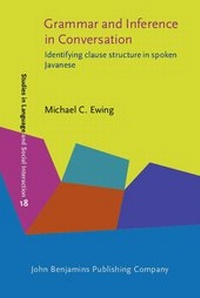
Grammar and Inference in Conversation
Identifying clause structure in spoken Javanese
1st Edition
Published on 21. December 2005
X, 276 pages
978-90-272-9390-9 (ISBN)
Description

This study analyzes how morphosyntactic structures and information flow characteristics are used by interlocutors in producing and understanding clauses in conversational Javanese, focusing on the Cirebon variety of the language. While some clauses display grammatical mechanisms used to code their structure explicitly and redundantly, many other clauses include few if any of these grammatical resources. These extremes mark a cline between the morphosyntactic and paratactic expression of clauses. The situation is thrown into relief by the frequency of unexpressed referents and conversationalists' heavy reliance on shared experience and cultural knowledge. In all cases, pragmatic inference grounded in the interactional context is essential for establishing not only the discourse functions, but indeed also the very structure of clauses in conversational Javanese. This study contributes to our understanding of transitivity, emergent constituency, prosodic organization and the co-construction of meaning and structure by conversational interlocutors.
More details
Other editions
Additional editions
Michael C. Ewing
Grammar and Inference in Conversation
Identifying clause structure in spoken Javanese
Book
12/2005
John Benjamins Publishing Co
€132.50
Shipment within 10-15 days
Person
Content
- Grammar and Inference in Conversation
- Editorial page
- Title page
- LCC data
- Table of contents
- Acknowledgements
- Introduction
- 1.1. Grammar and discourse
- 1.2. Cirebon Javanese
- 1.3. Data collection
- 1.4. Organization of this study
- The morphology of predicates
- 2.1. Predicates
- 2.2. Verbal predicates: Intransitive clauses
- 2.2.1. Monomorphemic intransitive verbs
- 2.2.2. Intransitive verbal morphology
- 2.2.3. Existential constructions
- 2.2.4. Summary: Intransitive verbal predicates
- 2.3. Verbal predicates: Transitive clauses
- 2.3.1. P-trigger constructions
- 2.3.2. A-trigger constructions
- 2.3.3. Transitive suffixes
- 2.3.4. Discussion: Transitive verb morphology
- 2.4. Non-verbal predicates
- 2.4.1. Nominal predicates
- 2.4.2. Prepositional phrase predicates
- 2.4.3. Other adverbial predicates
- 2.4.4. Expressives as predicates
- 2.4.5. Summary: Non-verbal predicates
- 2.5. Predicate morphology and clause structure
- The morphology of nominal expressions
- 3.1. Form and function of nominal expressions
- 3.2. Nominal expressions
- 3.2.1. Headless relative clauses
- 3.2.2. Lexical nouns
- 3.2.3. Names, kinship terms, titles, and vocatives
- 3.2.4. Pronouns
- 3.2.5. Unexpressed participants
- 3.2.6. Summary
- 3.3. Modification
- 3.3.1. Quantifiers
- 3.3.2. Modification by predicates
- 3.3.3. Demonstrative determiners
- 3.3.4. Association
- 3.4. Case marking
- 3.5. Summary
- Information flow
- 4.1. Introduction
- 4.2. Ideas in the mind
- 4.2.1. Activation
- 4.2.2. Identifiability
- 4.2.3. Identifiability pathway
- 4.3. Referentiality
- 4.3.1. Generality
- 4.3.2. Discourse referentiality
- 4.4. Configurations of information flow properties
- 4.5. Summary
- Constituents and constituent order
- 5.1. Constituency
- 5.2. The intonation unit
- 5.2.1. Identification of intonation units
- 5.2.2. IU-final particles
- 5.2.3. Summary: The intonation unit
- 5.3. Prosodic clusters
- 5.4. Constituent order
- 5.4.1. Constituency order in intransitive clauses
- 5.4.2. Constituency order in transitive clauses
- 5.5. P-trigger clauses
- 5.5.1. Single-IU P-trigger clauses
- 5.5.2. Multi-IU P-trigger clauses
- 5.5.3. Summary: P-trigger clauses
- 5.6. A-trigger clauses
- 5.6.1. Single-IU A-trigger clauses
- 5.6.2. Multi-IU A-trigger clauses
- 5.6.3. Summary: A-trigger clauses
- 5.7. Hierarchical constituency
- 5.8. Summary
- Clauses and interaction
- 6.1. Working together
- 6.2. Differing amounts of morphosyntax
- 6.2.1. Buildup
- 6.2.2. Breakdown
- 6.3. Tracking referents in extended discourse
- 6.4. Summary: Clauses and interaction
- Conclusion
- 7.1. The clause in Cirebon Javanese conversation
- 7.2. What are arguments?
- 7.3. What are clauses?
- Notes
- Chapter 1
- Chapter 2
- Chapter 3
- Chapter 4
- References
- Appendix
- Orthographic note
- Transcription conventions
- Abbreviations
- Author index
- Subject index
- The series Studies in Discourse and Grammar
