

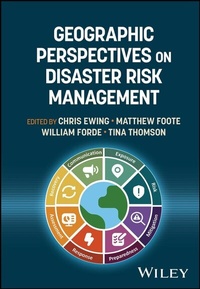
Geographic Perspectives on Disaster Risk Management
Description

A holistic view of geospatial data and analysis across the risk management lifecycle
Geospatial data and analytical tools are widely used for disaster management, insurance, humanitarian response, and defence-yet methodologies remain siloed. Geographic Perspectives on Disaster Risk Management, written by a team of experienced practitioners in catastrophe risk analytics and geospatial studies, connects these sectors by comparing approaches, identifying common challenges, and distilling cross-sector best practices for preparation, response, recovery, and mitigation.
Structured around the disaster risk cycle, the book addresses exposure and vulnerability mapping, risk preparedness and mitigation strategies, event monitoring, damage assessment, resilience building, and risk communication. It draws on data sources ranging from local traffic cameras to geostationary satellites and includes case studies illustrating real-world applications alongside outcome-based evaluations of current practices and future developments in disaster risk assessment.
Readers will also find:
- Cross-sector comparison of methodologies from international development, emergency response, insurance, defence, and commercial geospatial analytics
- Practical case studies demonstrating real-world challenges and solutions in disaster preparation, monitoring, damage assessment, and recovery operations
- Outcome-based evaluation of common approaches to emergency risk management, identifying strengths and limitations of current practice
- Coverage of future developments in data availability, analytical techniques, and climate risk assessment relevant to evolving environmental uncertainty
- Guidance on risk communication and decision-making frameworks that translate geospatial analysis into actionable operational and financial strategies
Designed for professionals in disaster management, emergency response, and the insurance industry, as well as researchers and advanced students in the geosciences, this book provides a structured, practice-oriented resource for applying geographic perspectives to quantify, communicate, and reduce disaster risk across sectors.
More details
Other editions
Additional editions
Persons
CHRIS EWING is Head of Business Development for Impact Forecasting, the catastrophe model development centre of Aon. He has 20 years' experience across risk management, (re)insurance, engineering, and humanitarian sectors. He holds a BSc in Physical Geography and an MSc in Geographical Information Science. Chris is a Chartered Geographer (GIS) from the Royal Geographical Society and a co-founder and Chair of the Disaster Risk Management Professional Practice Group.
MATTHEW FOOTE has over 30 years' experience in insurance, disaster risk financing, cartography, earth observation, and catastrophe risk analytics. He serves as UK Principal Representative to the GEO Programme Board and was the first chair of the GRMA Strategic Advisory Board. He is a fellow of the Royal Geographical Society and a co-founder of its Disaster Risk Management Professional Practice Group.
WILLIAM FORDE is a specialist in geospatial analytics and catastrophe risk. Drawing on senior leadership experience at global consulting firms and a leading GIS vendor, he helps insurers and regulators translate complex data into actionable insights for hazard management and resilience. He holds an MSc in Remote Sensing and a BA in Anthropology and Geogaphy from University College London and is a Fellow of the Royal Geographical Society, where he co-founded its Disaster Risk Management Professional Practice Group.
TINA THOMSON, PHD, has held senior leadership roles in analytics, research, and digital solutions spanning a career across Catastrophe Model Vendors, Property & Casualty Insurance, Reinsurance, and Reinsurance Brokers. Tina is passionate about the application of scientific concepts, emerging industry trends and new technologies. She holds a PhD in Geomatic Engineering from University College London. She is a Fellow of the Remote Sensing and Photogrammetry Society and a Chartered Geographer with the Royal Geographical Society, where she co-founded the Professional Practice Group for Disaster Risk Management.
Content
Editors xv
List of Contributors xvii
Contributors and Acknowledgements xxix
Foreword xxxi
Preface: Geography Underpins Disaster Risk Management xxxiii
1 Defining Characteristics of Assets for Risk Assessment - Exposure and Vulnerability 1
Anirudh Rao, Catalina Yepes- Estrada, and Vitor Silva
2 Common Approaches to Exposure and Vulnerability Data Across Risk Management Sectors 25
Charles Huyck, Marina Mendoza, and Melisa Huyck
3 Innovations in Spatial Exposure Modelling for Public Sector Disaster Risk Practitioners 49
Rashmin Gunasekera, Harriette Stone, Antonios Pomonis, James Daniell, Gonzalo Pita, and Bramka Jafino
4 Geographic Nature of Hazard and Risk 81
Michal Lörinc
5 Disaster Risk Reduction, Risk Mitigation 105
Stuart Fraser and Thaisa Comelli
6 Insurance and Risk Transfer Mechanisms 127
Chris Ewing and Alec Wild
7 Disaster Preparedness in Fragile, Conflict- and Violence-Affected Humanitarian Settings 161
Madeline Ewbank, Laura E.R. Peters, Juliane Schillinger, Liesa Sauerhammer, Cornelia Scholz, Catalina Jaime, Tesse de Boer, and Simphiwe Laura Stewart
8 Event Response: Mobilisation and Logistics 185
Claire Byrne, Samir Gandhi, Mark Gillick, Edith Lendak, Naomi Morris, Claudia Offner, Matt Pennells, and Matthew Sims
9 Real-Time Monitoring and Communication 225
Richard Teeuw
10 Damage Assessment 251
David Heathcote
11 Long-Term Resilience: Recovery Finance and Implementations of Lessons Learned 271
Alastair Norris and Claire Souch
12 Data Accuracy and Requirements: 'What Data Are Appropriate?' 297
Alec Wild, Heather Craig, James Knight, Charles Lan, Ryan Paulik, Liam Wotherspoon, and Conrad Zorn
13 Communicating Uncertainty 329
Giacomo Favaron
14 Reporting and Decision-Making 363
Kelvin Wong
15 Wrapping Up and Looking Ahead 385
Chris Ewing, Matthew Foote, William Forde, and Tina Thomson
Glossary 397
Index 409
