

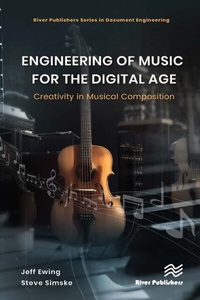
Engineering of Music for the Digital Age
Creativity in Musical Composition
1st Edition
Published on 23. October 2024
380 pages
978-1-040-22396-3 (ISBN)
Description

Musical scores - like literature, poetry, and technical manuals - are documents. The central tenet of this book is that musical composition in the digital age is a form of document engineering. In essence, music shares with other forms of creative content generation - from poetry to prose, and from science to science fiction - the need for structure, flow, and sources for creativity.
Musical composition is considered in this book as the creative process of engineering musical documents with regards to its arrangement, form, texture, and instrumentation, etc. This "document" then instructs a performance or the creation of an alternative document, such as a recording. In this book, the arrangement of phrases, patterns, and structures seen in music will be illustrated to give new composers a starting point to begin planning and making decisions about their own compositions.
The book will also guide those who need assistance in completing a piece. While this is a book about musical composition, it is not meant to be a manual on music theory. Instead, the book keeps its focus on the structural elements of a composition. Its aim is to give the audience a structural road map for composing; whether they are starting a piece from the first note, having a melody in mind already, or need help overcoming a creative hurdle. The book examines compositions that clearly define a form or technique. Among the key compositional elements are:
Form, Phrase, Period, and Expression in Composition
Rhythm/Motive
Melody and Harmony
Tonal Center
Mode Mixture and Modulation
Accompaniment/Instrumentation/Orchestration
Composition Techniques and Notation
Targeted examples cover all stages of writing a piece, helping to build the reader's composition from the first note into a complete work without promoting a style or harmonic practice. Each chapter contains a sidebar addressing helping the composer to add creative sources for the music making process. Finally, the book concludes with a chapter on creativity in terms of how composed music can affect our lives and even our fairy tales.
Musical composition is considered in this book as the creative process of engineering musical documents with regards to its arrangement, form, texture, and instrumentation, etc. This "document" then instructs a performance or the creation of an alternative document, such as a recording. In this book, the arrangement of phrases, patterns, and structures seen in music will be illustrated to give new composers a starting point to begin planning and making decisions about their own compositions.
The book will also guide those who need assistance in completing a piece. While this is a book about musical composition, it is not meant to be a manual on music theory. Instead, the book keeps its focus on the structural elements of a composition. Its aim is to give the audience a structural road map for composing; whether they are starting a piece from the first note, having a melody in mind already, or need help overcoming a creative hurdle. The book examines compositions that clearly define a form or technique. Among the key compositional elements are:
Form, Phrase, Period, and Expression in Composition
Rhythm/Motive
Melody and Harmony
Tonal Center
Mode Mixture and Modulation
Accompaniment/Instrumentation/Orchestration
Composition Techniques and Notation
Targeted examples cover all stages of writing a piece, helping to build the reader's composition from the first note into a complete work without promoting a style or harmonic practice. Each chapter contains a sidebar addressing helping the composer to add creative sources for the music making process. Finally, the book concludes with a chapter on creativity in terms of how composed music can affect our lives and even our fairy tales.
More details
Edition
1. Auflage
Language
English
Place of publication
London
United Kingdom
Target group
College/higher education
Professional and scholarly
Illustrations
8 Tables, black and white; 53 Line drawings, color; 272 Line drawings, black and white; 1 Halftones, color; 54 Illustrations, color; 272 Illustrations, black and white
ISBN-13
978-1-040-22396-3 (9781040223963)
Copyright in bibliographic data and cover images is held by Nielsen Book Services Limited or by the publishers or by their respective licensors: all rights reserved.
Schweitzer Classification
Other editions
Additional editions
Jeffrey Ewing | Steven Simske
Engineering of Music for the Digital Age
Creativity in Musical Composition
Book
10/2024
1st Edition
River Publishers
€156.30
Article not available for order
Persons
Jeffrey Ewing received his B.A. in Music Theory and Composition from Otterbein University (1998) following an Associate in Specialized Technology Degree in Industrial Design Technology from The Art Institute of Pittsburgh (1993). A lifetime composer and private teacher, Jeff's work has been used for education, including student recitals, film, theatre, and other public events since 1995.
Steve Simske is a Professor in the Systems Engineering Department at Colorado State University (CSU), where he leads research on analytics, cybersecurity, sensing, imaging, and robotics. Before joining CSU, Steve was a Fellow in HP Labs. Before that, he was a life sciences researcher at a NASA Center for the Commercial Development of Space. Steve is a Fellow of IEEE, IS&T, NAI, and CSU's Faculty Institute of Inclusive Excellence. Steve received a 2022 Best Teacher Award from Colorado State University Alumni Association.
Steve Simske is a Professor in the Systems Engineering Department at Colorado State University (CSU), where he leads research on analytics, cybersecurity, sensing, imaging, and robotics. Before joining CSU, Steve was a Fellow in HP Labs. Before that, he was a life sciences researcher at a NASA Center for the Commercial Development of Space. Steve is a Fellow of IEEE, IS&T, NAI, and CSU's Faculty Institute of Inclusive Excellence. Steve received a 2022 Best Teacher Award from Colorado State University Alumni Association.
Content
1. Music Maker: Introduction 2. Form in Composition 3. Phrase, Period, Expression 4. Rhythm/Motive 5. Melody and Harmony 6. Tonal Center 7. Mode Mixture and Modulation 8. Accompaniment/Instrumentation/Orchestration 9. Composition Techniques 10.Notation; Document Creation 11. Application (Democratization of Creation) 12. WWWD?
