

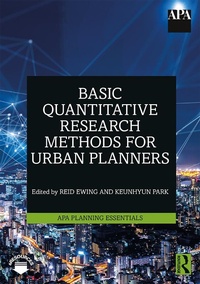
Basic Quantitative Research Methods for Urban Planners
1st Edition
Published on 24. February 2020
342 pages
978-1-000-76923-4 (ISBN)
Description

In most planning practice and research, planners work with quantitative data. By summarizing, analyzing, and presenting data, planners create stories and narratives that explain various planning issues. Particularly, in the era of big data and data mining, there is a stronger demand in planning practice and research to increase capacity for data-driven storytelling.
Basic Quantitative Research Methods for Urban Planners provides readers with comprehensive knowledge and hands-on techniques for a variety of quantitative research studies, from descriptive statistics to commonly used inferential statistics. It covers statistical methods from chi-square through logistic regression and also quasi-experimental studies. At the same time, the book provides fundamental knowledge about research in general, such as planning data sources and uses, conceptual frameworks, and technical writing. The book presents relatively complex material in the simplest and clearest way possible, and through the use of real world planning examples, makes the theoretical and abstract content of each chapter as tangible as possible.
It will be invaluable to students and novice researchers from planning programs, intermediate researchers who want to branch out methodologically, practicing planners who need to conduct basic analyses with planning data, and anyone who consumes the research of others and needs to judge its validity and reliability.
Basic Quantitative Research Methods for Urban Planners provides readers with comprehensive knowledge and hands-on techniques for a variety of quantitative research studies, from descriptive statistics to commonly used inferential statistics. It covers statistical methods from chi-square through logistic regression and also quasi-experimental studies. At the same time, the book provides fundamental knowledge about research in general, such as planning data sources and uses, conceptual frameworks, and technical writing. The book presents relatively complex material in the simplest and clearest way possible, and through the use of real world planning examples, makes the theoretical and abstract content of each chapter as tangible as possible.
It will be invaluable to students and novice researchers from planning programs, intermediate researchers who want to branch out methodologically, practicing planners who need to conduct basic analyses with planning data, and anyone who consumes the research of others and needs to judge its validity and reliability.
Reviews / Votes
These textbooks will likely prove useful for students in masters or doctoral programs alike for some time to come. For the practice-oriented student, the "basic" text will provide a well-documented reference that explores general statistical methods with various useful examples and interpretations for urban planning applications. These students will likely find this textbook to be both informative for learning applications of general statistics in planning contexts, as well as a useful reference as they move into practice and industry. For research-oriented students, the "basic" and "advanced" texts together extend the practical benefits of planning-oriented statistical applications into a complete reference that supports a foundation in quantitative research methods and statistics. Even for students interested in practice, the combination of these textbooks provide guidance for performing and interpreting the most commonly used quantitative research methods in research today.-Kristina M. Currans, Assistant Professor, University of Arizona
This textbook series fills the void in basic and advanced methods of planning analysis. Reid Ewing and Keunhyun Park have compiled a well-organized set of essays that artfully explain and develop a range of methodological topics with specific application to planning practice. Techniques are developed from their historical beginnings and the authors walk through step-by-step procedures using SPSS, R, and other coding software. While the Basic text will see widespread use in graduate professional degrees at the Master of Science level, the Advanced text will resonate with instructors seeking a textbook appropriate for doctoral planning students.
-Dave Marcouiller, University of Wisconsin - Madison
This book is essential to read for both beginners and experts in the Planning field because they contain such comprehensive quantitative research methods with clear and easy introduction of various basic concepts. The neat chapter structure also very valuable for the first steppers to the planning field. Especially, actual planning examples taken from various planning-related peer-reviewed journal articles are providing how planning practitioners and scholars can apply a particular method to resolve their real planning issues that are not easy to find in a planning method book.
-JiYoung Park, University at Buffalo and Seoul National University
Basic and Advanced Quantitative Research Methods for Urban Planners provide a comprehensive guide to collective, analyzing, visualizing, and writing about planning related-dated. The planning-related data sets and example analyses provide a rich set of cases to articulate core concepts and implement them in SPSS, HLM, and R. A terrific resource for planners and educators interested in using and presenting quantitative data in academic and professional settings.
-Erick Guerra, University of Pennsylvania
More details
Series
Edition
1. Auflage
Language
English
Place of publication
London
United Kingdom
Publishing group
Taylor & Francis Ltd
Target group
College/higher education
Professional and scholarly
Illustrations
38 Tables, black and white; 117 Line drawings, black and white; 77 Halftones, black and white; 194 Illustrations, black and white
ISBN-13
978-1-000-76923-4 (9781000769234)
Copyright in bibliographic data and cover images is held by Nielsen Book Services Limited or by the publishers or by their respective licensors: all rights reserved.
Schweitzer Classification
Other editions
Additional editions
Reid Ewing | Keunhyun Park
Basic Quantitative Research Methods for Urban Planners
Book
03/2020
1st Edition
Routledge
€58.90
Shipment within 15-20 days
Reid Ewing | Keunhyun Park
Basic Quantitative Research Methods for Urban Planners
Book
03/2020
1st Edition
Routledge
€207.10
Shipment within 15-20 days
Persons
Reid Ewing, Ph.D., is Distinguished Professor of City and Metropolitan Planning at the University of Utah, associate editor of the Journal of the American Planning Association and Cities, and columnist for Planning magazine, writing the column Research You Can Use. He directs the Metropolitan Research Center at the University of Utah. He holds master's degrees in Engineering and City Planning from Harvard University and a Ph.D. in Urban Planning and Transportation Systems from the Massachusetts Institute of Technology. A recent citation analysis found that Ewing, with 24,000 citations, is the 6th most highly cited among 1,100 planning academic planners in North America.
Keunhyun Park, Ph.D., is an Assistant Professor in the Department of Landscape Architecture and Environmental Planning at Utah State University. He holds master's degrees in Landscape Architecture from Seoul National University and a Ph.D. in Metropolitan Planning, Policy, Design from the University of Utah. His research interests include technology-driven behavioral research (e.g., drone, VR/AR, sensor, etc.), behavioral outcomes of smart growth, and active living.
Keunhyun Park, Ph.D., is an Assistant Professor in the Department of Landscape Architecture and Environmental Planning at Utah State University. He holds master's degrees in Landscape Architecture from Seoul National University and a Ph.D. in Metropolitan Planning, Policy, Design from the University of Utah. His research interests include technology-driven behavioral research (e.g., drone, VR/AR, sensor, etc.), behavioral outcomes of smart growth, and active living.
Content
1. Introduction 2. Technical Writing 3. Types of Research 4. Planning Data and Analysis 5. Conceptual Frameworks 6. Validity and Reliability 7. Descriptive Statistics and Visualizing Data 8. Chi-Square 9. Correlation 10. Difference of Means Tests (T-Tests) 11. Analysis of Variance (ANOVA) 12. Linear Regression 13. Logistic Regression 14. Quasi-Experimental Research
