

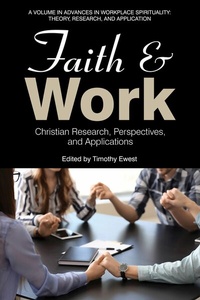
Faith and Work
Christian Research, Perspectives, and Applications
1st Edition
Published on 1. January 2023
295 pages
978-1-64802-882-3 (ISBN)
Description

The continued presence and growth of religion within the global community, resists the notion that religion is to be usurped by the secular or disenfranchised through secularism. Instead, contemporary scholarship emerging from an array of academic disciplines, continues to support religions' presence and impact on individuals, organizations and society. For example, the last two centuries offer an array of scholarship which understands religion to be formative for personal identity, instrumental in coping with suffering, an iterative force in social construction, dynamic in its historical perception and having an ever present role in culture, politics and society.However, the role of religion in the workplace is still resisted by some scholars of note in the Academy of Management. Yet, scholarship regarding the impacts of religion on societal, organizational and individual life continues to grow, carrying on the long standing research tradition of Weber. Scholarship has explored connections and manifestations of the world's religions within the workplace. Within Christianity, examples of research considerations within Catholic traditions, beliefs and practices which undergird workplace practices have been given ample consideration and alternatively examples of Protestant beliefs and practices within the workplace continues to grow. This second volume continues the work of the first volume of Faith and Work, Christian Perspectives, published in 2018. As with the first volume, this second volume considers Christian perspectives, research and insights into the faith and work movement, delimitating research into one of three areas: Individual, organizational and societal dimensions.Again, this volume, like the first contains scholarship from nationally and internationally recognized scholars whose research understands and demonstrates the importance of the connections between the Christian faith and the workplace. The scholarship presented in this volume is considered cross disciplinary, as was the first volume which was presented at the Cultural Study Association (CSA) Conference held at Carnegie Mellon University, the Society for the Scientific Study of Religion (SSSR) conference held in St. Louis, Missouri and also at the 2019 Academy of Management, Boston, MA. The first book has also enjoyed use in masters and doctoral programs as a supplemental reader.
More details
Other editions
Additional editions
Book
10/2022
Information Age Publishing
€70.70
Shipment within 3-4 weeks
Content
- Front Cover
- Faith and Work
- Christian Research, Perspectives, and Applications
- A Volume in Advances in Workplace Spirituality: Theory, Research, and Application
- Series Editor:
- Louis W. (Jody) Fry, Texas A&M University
- CONTENTS
- 1. On Earth as it Is in Heaven
- PART I: Individual
- 2. Reframing Work as Worship and Witness: A Biblical Perspective
- 3. The Mindset of Christ and Modern Mindfulness Theory and Practice
- 4. Small Deeds Make all the Difference: Christians as Tempered Radicals in Organizations
- PART II: Organization
- 5. The Purpose of Business From a Catholic Social Teaching Perspective
- 6. Faith and Work Integration Within For-Profit, Nonprofit, and Public Sector Organizations
- 7. Examining Faith and Work Integration Within Small, Entrepreneurial, Family-Owned and Faith-Based Businesses
- 8. The S.T.A.Y. Culture: Why Teachers in Faith-Based Schools Stay
- 9. Impact of Spiritual Leadership on Catholic Organizational Identity
- 10. A Defense of Kierkegaardian Arguments for Divine Authority
- PART III: Society
- 11. Corporate Social Responsibility and the Old Testament Prophets
- 12. Christianity and Good Governance: An Empirical Investigation
- 13. Christianity and the Economy: An Empirical Investigation
- PART IV: Conclusion
- 14. Heaven as it Is on Earth
- Advances in Workplace Spirituality: Theory, Research, and Application
- Faith and Work
- Christian Research, Perspectives, and Applications
- Edited by
- Timothy Ewest Houston Baptist University
- Information Age Publishing, Inc. Charlotte, North Carolina www.infoagepub.com
- Book Series Introduction
- Louis W. (Jody) Fry
- Series Editor
- Foreword
- Ben C. Blackwell
- Director, Houston Theological Seminary
- CHAPTER 1
- On Earth as it Is in Heaven
- Timothy Ewest
- Houston Baptist University
- Part I
- Part II
- PART III
- FRAMING THOUGHTS
- References
- PART I
- INDIVIDUAL
- CHAPTER 2
- Reframing Work as Worship and Witness
- A Biblical Perspective
- J. Lee Whittington
- Satish and Yasmin Gupta College of Business
- IN THE BEGINNING, THERE WAS WORK
- Distorted Views of Work
- Distortion Number 1: Work as a Curse
- Distortion Number 2: A Secular View of Work
- Distortion Number 3: The Two-Story View
- Distortion Number 4: Work as a Strategic Platform for Evangelism
- THE INSTRUMENTAL VALUE OF WORK
- How Then Shall We Work?
- References
- CHAPTER 3
- The Mindset of Christ and Modern Mindfulness Theory and Practice
- Timothy Ewest and Ben Blackwell
- Houston Baptist University
- WHAT IS MINDFULNESS?
- 1. Attention or awareness to the present moment.
- 2. The mind must provide meaning, but awareness and meaning making are intertwined.
- 3. Suspension of evaluation and discrimination.
- Paul on the Mind in Romans
- The Corrupted Mind (Romans 1:18-32)
- The Mind of Faith (Romans 6:1-11)
- The Mind of the Flesh (Romans 7:22-25
- 8:3-7)
- The Mind of the Spirit (Romans 8:5-7)
- A Renewed Mind (Romans 12:1-3)
- Comparative Analysis
- Conclusion
- notes
- References
- CHAPTER 4
- Small Deeds Make All the Difference
- Christians as Tempered Radicals in Organizations
- Peter McGhee
- Auckland University of Technology
- Patricia Grant
- Kenvale College of Hospitality & Events
- Introduction
- Spirituality and Ethics at Work
- TEMPERED RADICALS
- Strategy One: Resisting Quietly and Staying True to One's Self
- Strategy Two: Turning Personal Threats Into Opportunities
- Strategy Three: Broadening the Impact Through Negotiation
- Strategy Four: Leveraging Small Wins
- Strategy Five: Organizing Collective Action
- Implications for Organizations
- Conclusion
- NOTES
- REFERENCES
- PART II
- ORGANIZATION
- CHAPTER 5
- The Purpose of Business From a Catholic Social Teaching Perspective
- Domènec Melé
- IESE Business School-Spain North Campus
- CURRENT VIEWS OF THE PURPOSE OF THE FIRM
- BACKGROUND OF THE PURPOSE OF BUSINESS IN SOCIETY IN CST
- The Common Good, The Cornerstone of Social Life
- Purpose of the Firm
- CONTRASTING THE CST VIEW ON THE PURPOSE OF THE FIRM WITH OTHER APPROACHES
- Conclusion
- References
- CHAPTER 6
- Faith and Work Integration Within For-Profit, Nonprofit, and Public Sector Organizations
- Sharlene Buszka
- Daemen College
- The Integration Profile
- ORGANIZATIONAL ENTITY TYPE
- Entity Type, Purpose/Vision
- Entity Type, Purpose, and FWI
- Entity Type, Performance, Accountability, and Discretion
- The Triple Bottom Line
- THE BENEFIT CORPORATION AND CERTIFIED B CORPORATION
- Nonprofit Businesses
- PUBLIC SECTOR ORGANIZATIONS
- CONCLUSION
- ACKNOWLEDGMENTS
- References
- CHAPTER 7
- Examining Faith and Work Integration Within Small, Entrepreneurial, Family- Owned and Faith-Based Businesses
- Sharlene Buszka
- Daemen College
- The Integration Profile
- Small and Entrepreneurial Businesses
- SOCIAL ENTREPRENEURSHIP
- Family-Owned Businesses
- FAITH-BASED BUSINESSES
- Faith-Based Nonprofits
- RELIGIOUS ORGANIZATIONS AND RELIGIOUS EDUCATIONAL INSTITUTIONS
- FOR-PROFIT BUSINESSES RUN ACCORDING TO RELIGIOUS PRINCIPLES
- CONCLUSION
- References
- CHAPTER 8
- The S.T.A.Y. Culture
- Why Teachers in Faith-Based Schools Stay
- Melissa M. Meyer and Kathleen T. Campbell
- Southeastern Louisiana University
- PURPOSE OF THE STUDY
- OVERVIEW
- Alignment With Organizational Vision and Mission
- Effective School Leadership
- Job Satisfaction-Why Teachers S.T.A.Y.
- STUDY
- FINDINGS
- Overarching Question
- SUGGESTIONS
- REFERENCES
- CHAPTER 9
- Impact of Spiritual Leadership on Catholic Organizational Identity
- Linda T. Dayler
- Catholic Women's Leadership Foundation
- Louis W. Fry
- Texas A&M University Central Texas
- Introduction
- Identity Theory
- Catholic Organizational Identity
- Catholic Leadership
- WORKPLACE SPIRITUALITY AND SPIRITUAL LEADERSHIP
- Workplace Spirituality
- Spiritual Leadership
- Hypotheses
- Inner Life
- SPIRITUAL LEADERSHIP THROUGH HOPE/FAITH, VISION, AND ALTRUISTIC LOVE
- 1. Creating a vision wherein leaders and followers experience a sense of calling so that their lives have meaning and make a difference, and
- 2. Establishing a social/organizational culture based on the values of altruistic love whereby leaders and followers have a sense of membership, feel understood and appreciated, and have genuine care, concern, and appreciation for both self and others.
- Spiritual Well-Being
- The Mediating Role of Spiritual Well-Being
- METHODS
- Sample and Procedure
- MEASURES
- RESULTS
- Correlation Matrix
- 2. SL
- 3. Meaning
- 4. Membership
- 5. Satisfaction
- 6. Organization commitment
- 7. Productivity
- 8. Social responsibility
- 9. Catholicism
- Test of the Spiritual Leadership Model
- Comparison of SEM Models
- DISCUSSION
- Implications for Theory, Research, and Practice
- Suggestions for Future Research
- CONCLUSION
- REFERENCES
- CHAPTER 10
- A Defense of Kierkegaardian Arguments for Divine Authority
- Timothy Ewest
- Houston Baptist University
- Nicholas Hadsell
- Graduate Student, Baylor University
- CLASSICAL PHILOSOPHICAL THEORIES
- THE NATURE OF RELIGIOUS ETHICS
- RELIGIOUS MORAL AUTHORITY-CASE EXAMPLE
- PRELIMINARIES ABOUT AUTHORITY
- KIERKEGAARDIAN DEBT OF GRATITUDE
- IMPLICATIONS FOR WORKPLACE BEHAVIOR
- References
- PART III
- SOCIETY
- CHAPTER 11
- Corporate Social Responsibly and the Old Testament Prophets
- Timothy Ewest
- Houston Baptist University
- Brett Dutton
- Magnolia Creek Baptist Church
- CHRISTIANS AND THE ENVIRONMENT
- THE MODERN MOVEMENT OF CSR
- COVENANT
- SOCIAL JUSTICE IN THE COVENANT
- Confluences of the Servant of Yahweh, and Coregency
- References
- CHAPTER 12
- Christianity and Good Governance
- An Empirical Investigation
- Tamrat Gashaw
- Columbia University
- Data and Method
- 1. Voice and accountability expresses perceptions of the extent to which citizens are able to participate in selecting their government, as well as freedom of speech, freedom of association and a free media.
- 2. Political stability and absence of violence/terrorism expresses perceptions of the likelihood that the government will be destabilized or overthrown by unlawful or violent means, including politically motivated violence and terrorism.
- 3. Government effectiveness expresses perceptions of the quality of public services, the quality of the civil service and the degree of its independence from political pressures, the quality of policy design and implementation, and the credibility of...
- 4. Regulatory quality expresses perceptions of the ability of the government to formulate and impose sound policies and regulations that permit and promote private sector development.
- 5. Rule of law expresses perceptions of the extent to which agents have confidence in and comply with the rules of society, and in particular the quality of contract enforcement, property rights, the police, and the courts, as well as the likelihood ...
- 6. Control of corruption expresses perceptions of the extent to which public power is exercised for private gain, including both petty and grand forms of corruption, as well as misappropriation of the state by elites and private interests.
- EMPIRICAL METHODOLOGY
- EMPIRICAL RESULTS AND DISCUSSION
- Descriptive Statistics
- Regression Results
- Conclusion
- References
- CHAPTER 13
- Christianity and the Economy
- Empirical Investigation
- Tamrat Gashaw
- Columbia University
- Introduction
- Data and Method
- EMPIRICAL RESULTS AND DISCUSSION
- Descriptive Statistics
- Regression Analysis
- Conclusion
- References
- PART IV
- conclusion
- CHAPTER 14
- Heaven as it Is on Earth
- Timothy Ewest
- Houston Baptist University
- Confessional or Naturalist
- Worldview and Conceptual Frame
- Psychological Worldview-Naturalism
- Humanities Worldview-Naturalism
- SOCIOLOGICAL WORLDVIEW-NATURALISM
- 1. Networks of informal interactions between a plurality of individuals, groups and/or organizations without a central organizing or controlling entity
- 2. Responding to an important social need that is not being satisfactorily addressed by the relevant civil society institutional power structure (e.g. church, state, judicial, economy)
- 3. Have a shared organizing principle or collective identity
- BIBLICAL WORLDVIEW-CONFESSIONAL
- THEOLOGICAL WORLDVIEW-CONFESSIONAL
- SPIRITUAL WORLDVIEW-CONFESSIONAL
- SALIENT WORLDVIEWS
- CONCLUSION
- References
- About the Contributors
- About the Contributors
- Back Cover
