

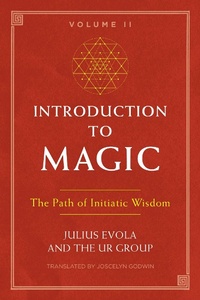
Introduction to Magic, Volume II
The Path of Initiatic Wisdom
Published on 12. March 2019
448 pages
978-1-62055-718-1 (ISBN)
Description

Authentic initiatic practices, rituals, and wisdom collected by the UR Group
• Shares a rigorous selection of initiatory exercises, including instructions for creating the diaphanous body of the Opus magicum, establishing initiatic consciousness after death, and the construction of magical chains (the enchained awareness of initiates)
• Offers studies of mystery traditions throughout history, presenting not only the principles themselves but also witnesses to them and their continual validity today
The ?Gruppo di UR? was a group of Italian esotericists who collaborated from 1927 to 1929. The purpose of this group was to study and practice ancient rituals gleaned from the mystery traditions of the world, both East and West, in order to attain a state of superhuman consciousness and power to allow them to act magically on the world. They produced a monthly journal containing techniques for spiritual realization, accounts of personal experiences, translations of ancient texts, and original essays on esoteric topics. The group included a distinguished line-up of occultists, neo-pagans, freemasons, Anthroposophists, orientalists, poets, and members of high society. The prime movers of the group were Arturo Reghini (1878-1946), a Pythagorean mathematician and reviver of a spiritual Freemasonry, and Julius Evola (1898-1974), then a young philosopher with a precocious mastery of the esoteric doctrines of East and West. Many years later, in 1971, Evola gathered these essays into three volumes. Inner Traditions published Volume I in 2001, under the title Introduction to Magic: Rituals and Practical Techniques for the Magus.
This volume, the second in the series, complements the first one, yet they are not strictly sequential, and their contents can be read in any order. Volume II shares authentic initiatic wisdom and a rigorous selection of initiatory exercises, including instructions for creating the diaphanous body of the Opus magicum, establishing initiatic consciousness after death, and the construction of magical chains (the enchained awareness of initiates). It offers studies of mystery traditions throughout history, presenting not only the principles themselves but also witnesses to them and their continual validity today.
This series shows that the ?Magic? of the UR Group meant an active and affirmative attitude toward individual development, handed down from a ?primordial tradition? and discernable in alchemy, Hermetism, esoteric religious doctrines, indigenous practices, Tantra, Taoism, Buddhism, Vedanta, and the pagan mysteries of the West. Although some of the practical experiments demanded extraordinary efforts, both individual and collective, there is incalculable value here even for the less heroic, for merely reading these essays leaves a permanent mark on the reader.
• Shares a rigorous selection of initiatory exercises, including instructions for creating the diaphanous body of the Opus magicum, establishing initiatic consciousness after death, and the construction of magical chains (the enchained awareness of initiates)
• Offers studies of mystery traditions throughout history, presenting not only the principles themselves but also witnesses to them and their continual validity today
The ?Gruppo di UR? was a group of Italian esotericists who collaborated from 1927 to 1929. The purpose of this group was to study and practice ancient rituals gleaned from the mystery traditions of the world, both East and West, in order to attain a state of superhuman consciousness and power to allow them to act magically on the world. They produced a monthly journal containing techniques for spiritual realization, accounts of personal experiences, translations of ancient texts, and original essays on esoteric topics. The group included a distinguished line-up of occultists, neo-pagans, freemasons, Anthroposophists, orientalists, poets, and members of high society. The prime movers of the group were Arturo Reghini (1878-1946), a Pythagorean mathematician and reviver of a spiritual Freemasonry, and Julius Evola (1898-1974), then a young philosopher with a precocious mastery of the esoteric doctrines of East and West. Many years later, in 1971, Evola gathered these essays into three volumes. Inner Traditions published Volume I in 2001, under the title Introduction to Magic: Rituals and Practical Techniques for the Magus.
This volume, the second in the series, complements the first one, yet they are not strictly sequential, and their contents can be read in any order. Volume II shares authentic initiatic wisdom and a rigorous selection of initiatory exercises, including instructions for creating the diaphanous body of the Opus magicum, establishing initiatic consciousness after death, and the construction of magical chains (the enchained awareness of initiates). It offers studies of mystery traditions throughout history, presenting not only the principles themselves but also witnesses to them and their continual validity today.
This series shows that the ?Magic? of the UR Group meant an active and affirmative attitude toward individual development, handed down from a ?primordial tradition? and discernable in alchemy, Hermetism, esoteric religious doctrines, indigenous practices, Tantra, Taoism, Buddhism, Vedanta, and the pagan mysteries of the West. Although some of the practical experiments demanded extraordinary efforts, both individual and collective, there is incalculable value here even for the less heroic, for merely reading these essays leaves a permanent mark on the reader.
More details
Other editions
Additional editions
Book
04/2019
Inner Traditions Bear and Company
€28.50
Article not available at the moment
Persons
A controversial philosopher and critic of modern Western civilization, Julius Evola (1898-1974) is considered one of the foremost authorities on the world's esoteric traditions. He wrote widely on Eastern religions, alchemy, sexuality, politics, and mythology and published many books, including Revolt Against the Modern World.
Content
Foreword: The ?Magical? Gruppo di UR in Its Historical and Esoteric Context by Hans Thomas Hakl
Introduction to the Second Volume
PART 1
I.1 PYTHAGORAS • The Golden Verses
I.2 ARVO AND EA • The Esoteric Doctrine of the ?Centers? in a Christian Mystic
1 I.3 ABRAXA • Ritual Magic
PART II
II.1 Instructions for Magical Chains Individual Instructions for Preparation First Instructions for the Chain Instructions for a Later Phase
II.2 IAGLA • Subterranean Logic
II.3 PIETRO NEGRI • On the Western Tradition
1. Devaluation of the Pagan Tradition
2. East, West, and Christianity
3. The Initiatic Tradition in the West
4. The Roman Tradition
5. Roman Initiatic Wisdom
6. The Legend of Saturnus
7. Etymology of Saturn
8. Addenda
9. Agricultural Symbolism in Rome
PART III
III.1 HAVISMAT • Tradition and Realization
III.2 OSO • A Solar Will
III.3 PIETRO NEGRI • The Secret Language of the Fedeli d'Amore
III.4 ABRAXA • Solutions of Rhythm and Liberation
III.5 LUCE • Opus Magicum: The Diaphanous Body
PART IV
IV.1 ARVO • Vitalizing the ?Signs? and ?Grips?
IV.2 EA • Initiatic Consciousness beyond the Grave
IV.3 Various Commentaries
The Magic, The Master, The Song
PART V
V.1 IAGLA • On the ?Corrosive Waters?
V.2 ARVO • Ethnology and the ?Perils of the Soul?
V.3 On the Art of the Hermetic Philosophers
V.4 Various Commentaries
Desire in Magic -- Meaning of the Ritual -- Feeling and Realization -- Anticipations of Physical Alchemy -- On Shamanic Initiation
PART VI
VI.1 Experiences: The ?Double? and Solar Consciousness
VI.2 EA • On the Metaphysics of Pain and Illness
VI.3 LEO • Notes for the Animation of the ?Centers?
VI.4 ARVO • Kirillov and Initiation
PART VII VII.1 HAVISMAT • Notes on Ascesis and on Anti-Europe
VII.2 MILAREPA • Excerpts from the Life of Milarepa
The Demon of the Snows -- The Song of Joy -- The Song of the Essence of Things
VII.3 ARVO • The Magic of Effigies
PART VIII
VIII.1 EA • Esotericism and Morality
VIII.2 NILIUS • Medicine and Poison
VIII.3 Turba Philosophorum: The Assembly of the Wise
VIII.4 Various Commentaries
Corporealizing Consciousness -- On ?Mortification? -- On Power
PART IX
IX.1 ABRAXA • The Magic of Creation
IX.2 PIETRO NEGRI • On the Opposition Contingent on Spiritual Development IX.3 Some Effects of Magical Discipline: The ?Dissociation of the Mixed?
PART X
X.1 The Contrast between Positive Science and Magic: Positions and Solutions
X.2 ABRAXA • The Magic of Conjunctions
X.3 OTAKAR BŘEZINA • Perspectives X.4 Various Commentaries Prodigies and Former Times -- Sexual Magic
PART XI
XI.1 BRENO • Notes on Occult Morphology and Spiritual Corporeality
XI.2 ZAM • A Pagan Magical Spell
XI.3 ARVO • On the Hyperborean Tradition
XI.4 The Golden Flower of the Great One
XI.5 Various Commentaries Woman and Initiation -- Ex Oriente lux
Index
Introduction to the Second Volume
PART 1
I.1 PYTHAGORAS • The Golden Verses
I.2 ARVO AND EA • The Esoteric Doctrine of the ?Centers? in a Christian Mystic
1 I.3 ABRAXA • Ritual Magic
PART II
II.1 Instructions for Magical Chains Individual Instructions for Preparation First Instructions for the Chain Instructions for a Later Phase
II.2 IAGLA • Subterranean Logic
II.3 PIETRO NEGRI • On the Western Tradition
1. Devaluation of the Pagan Tradition
2. East, West, and Christianity
3. The Initiatic Tradition in the West
4. The Roman Tradition
5. Roman Initiatic Wisdom
6. The Legend of Saturnus
7. Etymology of Saturn
8. Addenda
9. Agricultural Symbolism in Rome
PART III
III.1 HAVISMAT • Tradition and Realization
III.2 OSO • A Solar Will
III.3 PIETRO NEGRI • The Secret Language of the Fedeli d'Amore
III.4 ABRAXA • Solutions of Rhythm and Liberation
III.5 LUCE • Opus Magicum: The Diaphanous Body
PART IV
IV.1 ARVO • Vitalizing the ?Signs? and ?Grips?
IV.2 EA • Initiatic Consciousness beyond the Grave
IV.3 Various Commentaries
The Magic, The Master, The Song
PART V
V.1 IAGLA • On the ?Corrosive Waters?
V.2 ARVO • Ethnology and the ?Perils of the Soul?
V.3 On the Art of the Hermetic Philosophers
V.4 Various Commentaries
Desire in Magic -- Meaning of the Ritual -- Feeling and Realization -- Anticipations of Physical Alchemy -- On Shamanic Initiation
PART VI
VI.1 Experiences: The ?Double? and Solar Consciousness
VI.2 EA • On the Metaphysics of Pain and Illness
VI.3 LEO • Notes for the Animation of the ?Centers?
VI.4 ARVO • Kirillov and Initiation
PART VII VII.1 HAVISMAT • Notes on Ascesis and on Anti-Europe
VII.2 MILAREPA • Excerpts from the Life of Milarepa
The Demon of the Snows -- The Song of Joy -- The Song of the Essence of Things
VII.3 ARVO • The Magic of Effigies
PART VIII
VIII.1 EA • Esotericism and Morality
VIII.2 NILIUS • Medicine and Poison
VIII.3 Turba Philosophorum: The Assembly of the Wise
VIII.4 Various Commentaries
Corporealizing Consciousness -- On ?Mortification? -- On Power
PART IX
IX.1 ABRAXA • The Magic of Creation
IX.2 PIETRO NEGRI • On the Opposition Contingent on Spiritual Development IX.3 Some Effects of Magical Discipline: The ?Dissociation of the Mixed?
PART X
X.1 The Contrast between Positive Science and Magic: Positions and Solutions
X.2 ABRAXA • The Magic of Conjunctions
X.3 OTAKAR BŘEZINA • Perspectives X.4 Various Commentaries Prodigies and Former Times -- Sexual Magic
PART XI
XI.1 BRENO • Notes on Occult Morphology and Spiritual Corporeality
XI.2 ZAM • A Pagan Magical Spell
XI.3 ARVO • On the Hyperborean Tradition
XI.4 The Golden Flower of the Great One
XI.5 Various Commentaries Woman and Initiation -- Ex Oriente lux
Index
