

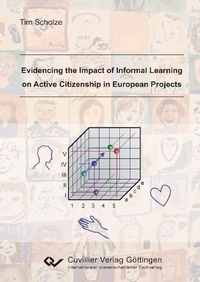
Evidencing the Impact of Informal Learning on Active Citizenship in European Projects
Cuvillier Verlag eBooks
Published on 19. November 2009
216 pages
978-3-7369-3156-5 (ISBN)
Description

This survey describes and analyses an innovative approach to evaluate the impact of informal learning in
European countries on different, mainly citizenship related, competence.
It was developed in the framework of the project ACT funded by the European Commission from 2005 to 2008.
A comprehensive evaluation system was developed especially taking into account the demands of
grass-root organisations that deliver citizenship competence to non-mainstreaming societal target
groups. The developed approach is treading new trails since it rather relates to the required citizenship
competence of the beneficiaries in their living context than to politically determined learning
objectives concerning Active Citizenship.
On the basis of a comprehensive European stock-taking with regard to European citizenship education,
an explanatory model was developed to visualise Active Citizenship competence (the so
called ACT-Cube).
This model has been the foundation of a complete evaluation procedure that is on the one hand
standardised, and on the other hand enables grass-root projects to establish an individualised
reference system for assessing and evidencing1 relevant competence of their beneficiaries in a
process-orientated way. The function of the system allows users to evidence the impact of their
work according to a standardised procedure while, at the same time, keeping up their individuality
as informal learning projects in their specific contexts.
In the past, these opposing goals, i.e. standardisation vs. individuality, were the major obstacles
with regard to a validation of informal learning: when evaluating competences in not-formalised
learning contexts, the uncountable variety of learning offers, contents and very often a lack of
specified learning objectives are limiting a traceable and transferable evaluation and validation.
In an intensive two year development process, an interdisciplinary team of experts from 9 countries
developed a perfected evaluation procedure, which was successfully tested and applied in 23
grass-root projects throughout Europe.
On the basis of the model and the evaluation procedure, an interactive evaluation and evidencing
software was programmed - the so-called ACT Impact Assessment System (IAS). With the help of
the IAS, grass-root projects can self-evaluate and evidence the impact of their learning offers.
In addition to the analysis and interpretation of the development of the approach and the products
the dissertation on hand describes and evaluates the project’s collaborative transnational research
and development activities (action research, visualisation and network theory).
More details
Other editions
Additional editions

Book
11/2009
1st Edition
Cuvillier Verlag
€29.00
Article exhausted; check different version
