

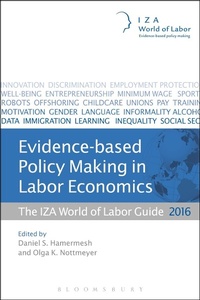
Evidence-based Policy Making in Labor Economics
The Iza World of Labor Guide 2016
Bloomsbury Information (Publisher)
1st Edition
Published on 21. April 2016
280 pages
978-1-4729-3264-8 (ISBN)
Description

IZA World of Labor distils and condenses the best thinking and research on labor economic issues to enable decision-makers make better informed policy decisions. Written by well-known labor economists worldwide, the findings on each topic are presented in a compact and readable format, as distillations of comprehensive evidence-based research. The IZA World of Labor Policy Handbook brings together summaries of over one hundred research articles to give busy policy-makers and advisors worldwide instant access to reliable, and up-to-date guidance on key policy topics including: migration and immigration; the minimum wage; supporting an aging workforce; the gender pay gap; microfinance in developing countries.
More details
Edition
1. Auflage
Language
English
Place of publication
London
United Kingdom
Target group
Professional and scholarly
ISBN-13
978-1-4729-3264-8 (9781472932648)
Copyright in bibliographic data and cover images is held by Nielsen Book Services Limited or by the publishers or by their respective licensors: all rights reserved.
Schweitzer Classification
Other editions
Additional editions
Evidence-based Policy Making in Labor Economics
The IZA World of Labor Guide 2016
Book
04/2016
Bloomsbury Information
€44.76
Article exhausted; check different version
Persons
Klaus Zimmermann is Professor of Economics at the University of Bonnat DIW Berlin, University of Potsdam, and Director of the IZA, Germany
Alexander Kritikos is Professor of Economics at the DIW Berlin, University of Potsdam, and IZA, Germany Olga Nottmeyer is Editor of the IZA World of Labor Project
Alexander Kritikos is Professor of Economics at the DIW Berlin, University of Potsdam, and IZA, Germany Olga Nottmeyer is Editor of the IZA World of Labor Project
Content
- cover
- Contents
- Acknowledgments
- Competing interests
- About IZA
- Editorial board
- INTRODUCTION
- SECTION I: Program evaluation
- The effects of wage subsidies for older workers
- Wage subsidies to encourage employers to hire older workers are often ineffective
- Bernhard Boockmann
- Can hiring subsidies benefit the unemployed?
- Hiring subsidies can be a very cost-effective way of helping the unemployed, but only when they are carefully targeted
- Alessio J. G. Brown
- Is unconditional basic income a viable alternative to other social welfare measures?
- Countries give basic education and health care to everyone, and for good reasons-why not basic income?
- Ugo Colombino
- Who benefits from firm-sponsored training?
- Firm-sponsored training benefits both workers and firms through higher wages, increased productivity, and innovation
- Benoit Dostie
- Does vocational training help young people find a (good) job?
- Systems combining structured learning on the job with classroom training can ease youth unemployment
- Werner Eichhorst
- Should unemployment insurance cover partial unemployment?
- Time-limited benefits may yield significant welfare gains and help underemployed part-time workers move to full-time employment
- Susanne Ek Spector
- Should severance pay be consistent for all workers?
- Single, open-ended contracts with severance pay smoothly rising with seniority can decrease both unemployment and job losses
- J. Ignacio García Pérez
- Is training effective for older workers?
- Training programs that meet the learning needs of older workers can improve their employability
- Matteo Picchio
- Active labor market policies and crime
- Unemployment increases crime among youth, while active labor market policies can mitigate the problem
- Torben Tranaes
- SECTION II: Behavioral and personnel economics
- High involvement management and employee well-being
- Giving employees more discretion at work can boost their satisfaction and well-being
- Petri Böckerman
- What makes a good job? Job quality and job satisfaction
- Job satisfaction is important to well-being, but intervention may be needed only if markets are impeded from improving job quality
- Andrew E. Clark
- Market competition and executive pay
- Increased competition affects the pay incentives firms provide to their managers and may also affect overall pay structures
- Priscila Ferreira
- Goal setting and worker motivation
- Individual work goals can increase a worker's performance, but they need to be chosen wisely
- Sebastian J. Goerg
- Performance-related pay and labor productivity
- Do pay incentives and financial participation schemes have an effect on a firm's performance?
- Claudio Lucifora
- Happiness as a guide to labor market policy
- Happiness is key to a productive economy, and a job is key to individual happiness
- Jo Ritzen
- Are workers motivated by the greater good?
- Workers care about employers' social causes, but the public sector does not attract particularly motivated employees
- Mirco Tonin
- SECTION III: Migration
- Language and culture as drivers of migration
- Linguistic and cultural barriers affect international migration flows
- Alícia Adserà
- Can immigrants ever earn as much as native workers?
- Immigrants initially earn less than natives
- the wage gap falls over time, but for many immigrant groups it never closes
- Kathryn H. Anderson
- Consequences of the obesity epidemic for immigrants
- When migrants move to countries with high obesity rates, does assimilation lead to labor market penalties and higher health care costs?
- Laura Argys
- Does return migration influence fertility at home?
- Migrants encounter different fertility norms while abroad, which they can bring back upon returning home
- Simone Bertoli
- Income of immigrants and their return
- Both low- and high-income immigrants stay for a relatively short time
- Govert E. Bijwaard
- Ethnic minority self-employment
- Poor paid employment prospects push minority workers into working for themselves, often in low-reward work
- Ken Clark
- Smart policy toward high-skill emigrants
- Many proposed policies on skilled migration do little to improve skill stocks or development outcomes, but promising options exist
- Michael A. Clemens
- Migration and families left behind
- Families that stay behind when a member migrates do not clearly benefit
- Sylvie Démurger
- Does emigration increase the wages of non-emigrants in sending countries?
- Emigration can increase the wages of non-emigrants, but may eventually lead to lower productivity and wage losses
- Benjamin Elsner
- Migrants and educational achievement gaps
- Avoiding segregation and compensating for parental disadvantage can reduce migrants' educational achievement gaps
- Horst Entorf
- Are married immigrant women secondary workers?
- Patterns of labor market assimilation for married immigrant women are similar to those for men
- Ana Ferrer
- Immigrant labor and work-family decisions of native-born women
- As immigration lowers childcare and housework costs, native-born women alter their work and fertility decisions
- Delia Furtado
- Naturalization and citizenship: Who benefits?
- Liberalizing access to citizenship has labor market benefits for immigrants and can improve their assimilation
- Christina Gathmann
- Do minimum wages induce immigration?
- The minimum wage affects international migration flows and the internal relocation of immigrants
- Corrado Giulietti
- The value of language skills
- A common language facilitates communication and economic efficiency, but linguistic diversity has economic and cultural value too
- Gilles Grenier
- Setting policy on asylum: Has the EU got it right?
- Harmonizing asylum policies, a noble goal, does not produce the best outcomes for refugees or host country populations
- Tim Hatton
- What drives the language proficiency of immigrants?
- Immigrants differ in their language proficiency along a range of characteristics
- Ingo E. Isphording
- Impact of remittances on fertility
- Remittances are closely linked to household fertility choices with consequences at the community and country level
- George S. Naufal
- Intermarriage and the economic success of immigrants
- Who is the driving factor-the native spouses or the immigrants themselves?
- Olga K. Nottmeyer
- Occupational choice of return migrants
- Migrant-sending countries can significantly benefit from the type of occupation chosen by return migrants
- Matloob Piracha
- Cross-border migration and travel: A virtuous relationship
- International migration boosts travel and vice versa, bringing economic benefits but challenging public policy
- Jacques Poot
- Does corruption promote emigration?
- Corruption is a driving force of emigration, especially for high-skilled workers, but also for other workers
- Friedrich Schneider
- Retiree migration and intergenerational conflict
- Retiree migration can have economic benefits but can also lead to intergenerational conflict in education spending
- Mehmet S. Tosun
- Who benefits from return migration to developing countries?
- Despite returnees being a potential resource, not all developing countries benefit from their return
- Jackline Wahba
- Should countries auction immigrant visas?
- Selling the right to immigrate to the highest bidders would allocate visas efficiently but might raise ethical concerns
- Madeline Zavodny
- SECTION IV: Institutions
- A flexicurity labor market during recession
- Long-term unemployment did not rise under the flexicurity model during the great recession, despite the large drop in GDP
- Torben M. Andersen
- Knowledge spillovers and future jobs
- In the future, jobs will be created by those bold enough to transform new ideas and knowledge into innovations
- David B. Audretsch
- Perverse effects of two-tier wage bargaining structures
- Two-tier wage bargaining fails to link wages more closely to productivity and increases allocative inefficiencies
- Tito Boeri
- The minimum wage versus the earned income tax credit for reducing poverty
- Enhancing the earned income tax credit would do more to reduce poverty, at less cost, than increasing the minimum wage
- Richard V. Burkhauser
- How are minimum wages set?
- Countries set minimum wages in different ways, and some countries set different wages for different groups of workers
- Richard Dickens
- The shadow economy in industrial countries
- Reducing the size of the shadow economy requires reducing its attractiveness while improving official institutions
- Dominik H. Enste
- Who owns the robots rules the world
- Workers can benefit from technology that substitutes robots or other machines for their work by owning part of the capital that replaces them
- Richard Freeman
- Should the earned income tax credit rise for childless adults?
- The earned income tax credit raises income and work incentives among low-income parents but little goes to adults without children
- Harry J. Holzer
- Do works councils raise or lower firm productivity?
- Works councils can have a positive impact on firm productivity, but only when specific conditions are in place
- Olaf Hübler
- The decline in job-to-job flows
- An aging workforce and declining entrepreneurship explain the decline in job-to-job flows only partially
- Henry R. Hyatt
- Wage compression and the gender pay gap
- Wage-setting institutions narrow the gender pay gap but may reduce employment for some women
- Lawrence M. Kahn
- Offshoring and the migration of jobs
- Offshoring has little net effect on domestic employment, while pushing domestic workers toward more complex jobs
- Gianmarco Ottaviano
- Does it pay to be a public-sector employee?
- Contrary to common belief, the long-term public-private pay gap is negligible in many countries
- Fabien Postel-Vinay
- Do minimum wages stimulate productivity and growth?
- Minimum wage increases fail to stimulate growth and can have a negative impact on vulnerable workers during recessions
- Joseph J. Sabia
- Employment effects of longer working hours
- Extending work hours may reduce employment in the short term but may increase it in the long term if hourly pay remains constant
- Thorsten Schank
- Institutional long-term care and government regulation
- Focus on family and portable allowances to lower the costs of institutional long-term care while monitoring its quality
- Elena Stancanelli
- Unions and investment in intangible capital
- When workers and firms cannot commit to long-term contracts and capital investments are sunk, union power can reduce investment
- Giovanni Sulis
- Employment and wage effects of extending collective bargaining agreements
- Extending provisions of collective contracts to all workers in an industry or region may lead to employment losses
- Ernesto Villanueva
- Innovation and employment
- Technological unemployment is not inevitable-some innovation creates jobs, and some job destruction can be avoided
- Marco Vivarelli
- SECTION V: Transition and emerging economies
- Latent entrepreneurship in transition economies
- Some entrepreneurs and would-be entrepreneurs face financial and bureaucratic barriers to starting a business
- Hilal Atasoy
- New firms entry, labor reallocation, and institutions in transition economies
- In transition economies, better property rights protection and rule of law enforcement can boost job creation and growth
- Randolph L. Bruno
- Skill mismatch and overeducation in transition economies
- Substantial skill shortages coexist with overeducation, affecting both young and old workers
- Olga Kupets
- Migrant well-being after leaving transition economies
- Evidence is mixed on whether quality of life improves for migrants from post-socialist economies
- Milena Nikolova
- Alcoholism and mortality in Eastern Europe
- Excessive drinking is the main cause of high male mortality rates, but the problem can be addressed
- Evgeny Yakovlev
- SECTION VI: Development
- Entrepreneurship for the poor in developing countries
- Well-designed entrepreneurship programs show promise for improving earnings and livelihoods of poor workers
- Yoonyoung Cho
- Trade, foreign investment, and wage inequality in developing countries
- Exposure to foreign trade raises the skill premium in countries with a large stock of educated workers and reduces it in others
- Alessandro Cigno
- The welfare impact of rising food prices
- The welfare impact of rising food prices differs for net food consumers and net producers
- Ralitza Dimova
- Are social security programs progressive?
- Whether social security programs reduce inequality is not related to the amount they redistribute
- Alvaro Forteza
- Policies to support women's paid work
- Policies in developing countries to improve women's access to paid work should also consider child welfare
- Gianna Claudia Giannelli
- Collective bargaining in developing countries
- Negotiating work rules at the firm level instead of the industry level could lead to productivity gains
- Carlos Lamarche
- Pensions, informality, and the emerging middle class
- Getting the incentives right for firms and workers should be the priority in the labor formalization agenda
- Angel Melguizo
- SECTION VII: Environment
- Environmental regulations and business decisions
- Environmental regulations impose costs on firms, affecting productivity and location but providing significant health benefits
- Wayne B. Gray
- SECTION VIII: Education and human capital
- Slavery, racial inequality, and education
- Historical slavery may be a driver of human capital and its unequal racial distribution, with implications for education and income inequalities
- Graziella Bertocchi
- The promises and pitfalls of universal early education
- Universal early education can be beneficial, and more so for the poor, but quality matters
- Elizabeth U. Cascio
- Impact of bilingual education on student achievement
- Language development programs should focus on quality rather than the language in which instruction is provided
- Aimee Chin
- Early-life medical care and human capital accumulation
- Medical care and public health interventions in early childhood may improve human capital accumulation as well as child health
- N. Meltem Daysal
- The importance of informal learning at work
- On-the-job learning is more important for workers' human capital development than formal training
- Andries de Grip
- How effective are financial incentives for teachers?
- Linking teacher pay to student performance has become popular, but evidence on its effectiveness is mixed
- Scott A. Imberman
- Immigrants in the classroom and effects on native children
- Having immigrant children in the classroom may sometimes, but not always, harm educational outcomes of native children
- Peter Jensen
- Class size: Does it matter for student achievement?
- Smaller classes are often associated with increased achievement, but the evidence is far from universal
- Christopher Jepsen
- Sports, exercise, and labor market outcomes
- Increasing participation in sports and exercise can boost productivity and earnings
- Michael Lechner
- Youth sports and the accumulation of human capital
- Positive contributions to cognitive and non-cognitive skills justify public support of youth sports
- Michael A. Leeds
- University dropouts and labor market success
- Dropping out of university can be more advantageous than not having enrolled in university at all
- Sylke V. Schnepf
- The educational effects of school start times
- Delaying secondary school start times can be a cost-effective policy to improve students' grades and test scores
- Teny Maghakian Shapiro
- The impacts of shortening secondary school duration
- Shortening secondary school duration may increase the skilled workforce in aging societies
- Stephan L. Thomsen
- The role of preschool in reducing inequality
- Preschool improves child outcomes, especially for disadvantaged children
- Jane Waldfogel
- Do higher levels of education and skills in an area benefit wider society?
- Education benefits individuals, but the societal benefits are likely even greater
- John V. Winters
- The boom in university graduates and the risk of underemployment
- Better information on university quality may reduce underemployment and overeducation in developing countries
- Gustavo A. Yamada
- SECTION IX: Demography, family, and gender
- Intergenerational income persistence
- Measures of intergenerational persistence can be indicative of equality of opportunity, but the relationship is not clear cut
- Jo Blanden
- Fertility postponement and labor market outcomes
- Postponed childbearing increases women's labor market attachment but may reduce overall fertility
- Massimiliano Bratti
- Relative deprivation and individual well-being
- Low status and a feeling of relative deprivation are detrimental to health and happiness
- Xi Chen
- Childcare choices and child development
- Generous parental leave and affordable, high-quality childcare can foster children's abilities
- Daniela Del Boca
- Health effects of job insecurity
- Job insecurity adversely affects health, but fair workplace practices and employee participation can mitigate the effects
- Francis Green
- Do joint custody laws improve family well-being?
- Joint child custody laws affect not only divorced families but intact families as well
- Martin Halla
- Sexual harassment in the workplace
- Despite being illegal, costly, and an affront to dignity, sexual harassment is pervasive and challenging to eliminate
- Joni Hersch
- Pension reform and couples' joint retirement decisions
- The success of policies raising the retirement age depends on people's responsiveness to changes in pension eligibility
- Laura Hospido
- Beauty pays but does investment in beauty?
- Despite the large returns from an attractive appearance, the cost-effectiveness of investment in beauty is ambiguous
- Soohyung Lee
- The quantity-quality fertility-education trade-off
- Policies to reduce fertility in developing countries generally boost education levels, but only slightly
- Haoming Liu
- Trade liberalization and gender inequality
- Can free-trade policies help to reduce gender inequalities in employment and wages?
- Janneke Pieters
- Does it pay to be beautiful?
- Physically attractive people can earn more, particularly in customer-facing jobs, and the rewards for men are higher than for women
- Eva Sierminska
- The determinants of housework time
- Boosting the efficiency of household production could have large economic effects
- Leslie S. Stratton
- SECTION X: Data and methods
- Google search activity data and breaking trends
- Google search activity data are an unconventional survey full of unbiased, revealed answers in need of the right question
- Nikolaos Askitas
- Matching as a regression estimator
- Matching avoids making assumptions about the functional form of the regression equation, making analysis more reliable
- Dan A. Black
- Measuring the cost of children
- Knowing the real cost of children is important for crafting better economic policy
- Olivier Donni
- Evaluating the efficiency of public services
- Differences in efficiency in public services can offer clues about good practice
- Geraint Johnes
- The challenges of linking survey and administrative data
- Combining survey and administrative data is growing in popularity, even though data access is still highly restricted
- Steffen Künn
- The use of natural experiments in migration research
- Data on rapid, unexpected refugee flows can credibly identify the impact of migration on native workers' labor market outcomes
- Semih Tumen
- Measuring disincentives to formal work
- Does formal work pay? Synthetic measurements of taxes and benefits can help identify incentives and disincentives to formal work
- Michael Weber
- Counting on count data models
- Quantitative policy evaluation can benefit from a rich set of econometric methods for analyzing count data
- Rainer Winkelmann
- AUTHOR INDEX
- SUBJECT INDEX
