

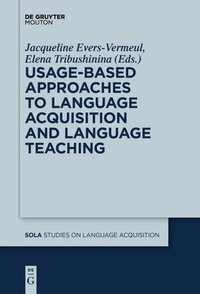
Usage-Based Approaches to Language Acquisition and Language Teaching
1st Edition
Published on 6. March 2017
X, 307 pages
978-1-5015-0549-2 (ISBN)
Description

No detailed description available for "Usage-Based Approaches to Language Acquisition and Language Teaching".
More details
Other editions
Additional editions

Jacqueline Evers-Vermeul | Elena Tribushinina
Usage-Based Approaches to Language Acquisition and Language Teaching
Book
11/2018
1st Edition
De Gruyter Mouton
€34.95
Shipment within 3-4 weeks
Jacqueline Evers-Vermeul | Elena Tribushinina
Usage-Based Approaches to Language Acquisition and Language Teaching
E-Book
03/2017
1st Edition
De Gruyter Mouton
€149.95
Available for download
Jacqueline Evers-Vermeul | Elena Tribushinina
Usage-Based Approaches to Language Acquisition and Language Teaching
Book
03/2017
1st Edition
De Gruyter Mouton
€149.95
Article not available at the moment
Persons
Jacqueline Evers-Vermeul and Elena Tribushinina, Utrecht University, The Netherlands
Content
- Intro
- Acknowledgments
- Table of contents
- List of contributors
- Language acquisition and language teaching in the usage-based framework
- I Theoretical and methodological foundations of language acquisition from a usage-based perspective
- 1 Advances and lacunas in usage-based studies of first language acquisition
- 2 Applied cognitive linguistics and second/foreign language varieties: Towards an explanatory account
- 3 Acquiring relational meaning from the situational context: What linguists can learn from analyzing videotaped interaction
- 4 Validity issues in longitudinal research
- II Driving forces of language development
- 5 L1 acquisition beyond input frequency
- 6 Acquiring and processing morpheme constructions: The MultiRep Model
- 7 The development of Dutch object-naming constructions in bilingual Turkish-Dutch children receiving low amounts of Dutch language input
- 8 Acquisition order of connectives in stories of Dutch L1 and L2 children from 4 to 8
- 9 Acquisition of additive connectives by Russian-German bilinguals: A usage-based approach
- III Implications for language teaching and translation
- 10 Development of chunks in Dutch L2 learners of English
- 11 Predictive power of controled productive knowledge of collocations over L2 proficiency
- 12 Comparing word sense distinctions with bilingual comparable corpora: A pilot study of adjectives in English and Spanish
- Index
