

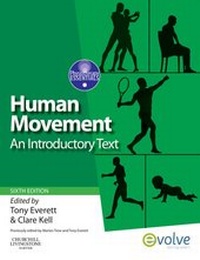
Human Movement
Description

The sixth edition of this popular text introducing human movement to a range of readers, offers the building blocks, signposts and opportunities to think about the application and integration of basic Human Movement theory. It confirms basic knowledge which is then applied to specific areas. Drawing on the expertise of a range of authors from the healthcare professions, the new edition has adopted a themed approach that links chapters in context.
The strength of this current edition is the explicit chapter integration which attempts to mimic the realities of human movement. The themed approach explores the psychosocial influences on movement. Integration is further facilitated by increased cross-referencing between the chapters and the innovative use of one themed case study throughout. Framed about a family unit, this case study enables chapter authors to explicitly apply the content of their chapters to the real world of human movement. Taken as a whole, this more integrated format will enable readers to see the reality and complexity of human movement.
All prices
More details
Other editions
Additional editions
Content
- Front Cover
- Human Movement
- Copyright Page
- Dedication
- Contents
- Contributors
- Preface
- Chapter 1: Introduction
- Working through this book
- Meet the family
- Chapter 2: Skeletal muscle, muscle work, strength, power and endurance
- Introduction
- Protein filaments
- The sarcomere
- The differences between muscle force and muscle strength
- Muscle work
- Muscle strength
- Recruitment
- Muscle fibre types
- Gradation of muscle force
- Length-tension relationship
- Active and passive tension
- Force-velocity relationship
- Angle of pull
- Stability and sequencing
- Anatomy
- Age and gender
- Psychological factors
- Muscle power
- Muscle endurance
- Fatigue
- Measuring strength and endurance
- Measuring strength
- Measuring endurance
- When things go wrong
- Increasing strength and endurance
- Muscle strength
- Physiological processes
- Increased vascularization
- Increase in size
- Increasing strength
- Increasing endurance
- Conclusion
- References
- Chapter 3: Joint mobility
- Introduction
- Range of movement
- Facilitation and restriction or limitation of movement
- Normal facilitation
- Normal limitation or restriction of an intact system
- Abnormal limitation
- Effects of decreased range of movement
- Treatment
- Types of movement of joints
- Passive movement
- Active movement
- Conclusion
- References
- Chapter 4: Motor control
- Introduction
- Information transmission
- Receptors
- Motor control
- Controlling 'simple' movements
- Postural control and balance
- Gait
- The structures of the nervous system for controlling movement
- Control processes of voluntary movement
- References
- Chapter 5: Posture and balance
- Introduction
- Human posture
- The spine and its role in the development of bipedalism
- The human foot
- Development of the S-shaped spine across the lifespan
- The 'ideal' alignment of segments
- Upright stance
- Sitting
- Lying
- Requirements for achieving the 'ideal' posture
- The reality of postural alignment
- Factors influencing segmental alignment
- Defined postural deviations from the ideal
- Maintaining a functional posture
- Introduction
- Some definitions
- How does postural control work?
- Postural control synergies used in standing
- Factors that affect postural control
- Relevance to therapeutic practice
- Symptomatic postural alignment
- Problems with postural control: balance re-education
- Conclusion
- References
- Chapter 6: Motor learning
- Introduction
- Motor learning
- Definition
- Historical perspective
- Types of movement
- Motor control
- The closed loop theory
- Dynamic systems theory
- Skill
- Definition
- Accuracy, consistency and efficiency
- Memory
- Closed and open skills
- Skill acquisition
- Variable practice
- Locus of control
- Conclusion
- References
- Chapter 7: Psychosocial influences on human movement
- Introduction
- Socialization
- The family as primary socializers
- The influence of a family's beliefs and values
- Secondary socialization
- Friends as secondary socializers in adolescence
- Friends as secondary socializers in adulthood
- The wider societal influences on socialization
- Race and ethnicity
- Celebrity role models
- Government and the media
- The impact of others on our psychological well-being
- Self-esteem and participation
- The influence of others on the choices we make
- Anxiety and its impact on participation
- The impact of support when learning motor behaviours
- Summary
- Glossary of terms (taken from Giddens 2006)
- References
- Chapter 8: The influence of the environment on human movement
- Introduction
- What is the environment?
- Why do we need to consider the environment?
- A systematic approach to considering the environmental impact on movement
- The environment's impact on systems of movement
- A balance theory model
- The task environment
- The task design
- Technology
- The organization
- The individual
- Summary
- References
- Chapter 9: Biomechanics of human movement
- Introduction
- Basic concepts
- Newton's laws of motion
- Force
- Definition of force
- Description of a force
- Equation of force
- Force systems
- Force analysis
- Types of forces
- Pressure
- Moment of force
- Levers
- Effects of force and moment of force
- Centre of gravity and base of support
- Body centre of gravity, line of gravity and centre of pressure
- Base of support
- Balance, equilibrium and stability
- Work, energy, power and momentum
- Work
- Energy
- Power
- Momentum and impulse
- Quantitative movement analysis
- Link segment model and a free body diagram
- Finding the resultant
- Steps involved in quantitative movement analysis
- Moving up the limb
- Deformation of materials
- Stress and strain
- Linear loading
- Young's modulus
- Stress-strain curves
- Mechanical principles of fluids
- Hydrostatics and hydrodynamics
- Pressure
- Density
- Relative density or specific gravity
- Buoyancy
- Stability
- Moment of buoyancy
- Types of flow
- Movement through a fluid
- References
- Further reading
- Chapter 10: Function of the upper limb
- Introduction
- Factors affecting the function of the upper limb
- The shoulder girdle
- The scapula
- Properties of muscle affecting function of the upper limb
- The elbow and forearm
- Hand
- The upper limb as part of the kinetic chain
- Proximal control
- Open chain, closed chain
- Function of the upper limb in activities of daily living
- Summary
- References
- Chapter 11: Function of the lower limb
- Introduction
- Moving from sitting to standing
- Seated phase
- Stance phase
- Forces required to rise from a chair
- Walking
- Terminology of gait
- Gait cycle
- Joint and muscle activity in the stance phase
- Joint and muscle activity in the swing phase
- Movement in the trunk, shoulder girdle and upper limbs
- Ground reaction forces in gait
- Energy expenditure and gait
- Running
- Walking backwards
- Walking up and down stairs
- Stance phase on ascent
- Swing phase on ascent
- Stance phase on descent
- Swing phase on descent
- Clinical considerations
- References
- Chapter 12: Function of the spine
- Introduction
- The spinal column: a supporting link for the head, the rib cage and the pelvis
- The spine
- The spine: providing protection of vital structures
- The spine: absorbing load and facilitating movement
- Absorbing load
- Facilitating movement
- The spine: providing stability - ligaments and the thoracic cage
- The thorax
- Pelvic girdle
- The spine: enhancing stability and making the body move - muscles of the spine
- Muscles providing dynamic stability: sitting still is a dynamic activity
- The spine: giving shape to your body posture
- The spine: the link in the kinetic chain and key to functional tasks
- Summary
- References
- Chapter 13: Human movement across the lifespan
- Introduction
- Movements before birth
- When do humans start to move?
- How does the baby's environment influence movement?
- The perinatal period
- Birth: the new environment
- Newborn
- The early years
- Motivation for movement: interaction between mother and baby
- Stages of development of human movement leading to walking
- Movement as a preteen child: progression from younger child
- Motivation for movement: to find out about myself and others
- Developing postural control
- The ongoing challenges of postural control development
- Education
- Adolescence: a period of rapid growth, social pressure and personal choices
- Intrinsic physiological and anatomical changes
- Extrinsic factors: social and environmental influences
- Adulthood
- Young adults
- Adults
- Older adulthood
- Conclusion
- References
- Further reading
- Chapter 14: Measuring and analysing human movement
- Introduction
- Analysis of movement
- Methods of analysis
- Observational analysis
- Mechanical analysis
- Measuring joint range
- Measuring the force generated by muscles
- Force and pressure measurements
- Ground reaction forces
- Pure pressure measurements
- Electromyography
- The basis of electromyography
- Types of electrode
- Electromyography processing
- Electromyography and the phasic activity of muscles
- Electromyography and force production
- Electromyography and isometric tension
- Electromyography and isotonic tension
- Energy expenditure analysis
- Conclusion
- References
- Chapter 15: Scales of measurement
- Introduction
- General principles of measurement scales
- Validity and reliability
- Methods of scoring
- Data collection methods
- Measurement scales for mobility
- Defining mobility
- Mobility scales
- Measurement scales for functional status
- Defining function
- Activities of daily living scales
- Measurement scales for quality of life
- Defining quality of life
- Quality of life measures
- Conclusion
- References
- Chapter 16: Conclusion
- Index

