

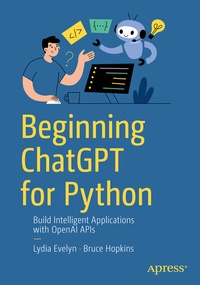
Beginning ChatGPT for Python
Description

Unlock the future of software development and empower yourself to elevate your Python applications by harnessing the power of AI as this field continues to grow and evolve. Perfect for beginner to intermediate Python programmers, this book breaks down the essentials of using ChatGPT and OpenAI APIs.
You'll start with the basics, learning to authenticate, send prompts, generate responses, test in the Playground, and handle errors with ease. Each chapter includes hands-on exercises that bring concepts to life, demonstrating different API functionalities and practical applications. You'll master models like GPT-4o, GPT-4, GPT-3.5, Whisper, and DALL-E, enabling you to enhance your applications with cutting-edge AI.
Discover how generative AI tools like ChatGPT can automate tedious tasks rather than replace jobs. Leverage ChatGPT's powerful Natural Language Processing (NLP) capabilities to handle various formats of unstructured text within your Python apps. Quickly see how easy it is to use ChatGPT as your AI-pair programmer, boosting your productivity and speed.
This step-by-step guide will have you creating intelligent chatbots that can automatically process messages from Slack or Discord. With Beginning ChatGPT for Python , you'll master the ChatGPT and OpenAI APIs, building intelligent applications that offer a personalized and engaging user experience.
What You'll Learn
- Connect with the ChatGPT and OpenAI APIs and send effective prompts.
- Harness parameters like temperature and top_p to create unique and engaging responses from ChatGPT.
- Create an intelligent assistant bot for Slack that automates tasks and enhances productivity.
- Develop a bot that can moderate conversations and manage communities on Discord.
- Add context to your prompts to get more accurate and relevant responses.
Who This Book Is For
Python developers and enthusiasts who aspire to employ OpenAI and ChatGPT in the creation of intelligent applications to enhance productivity.
More details
Other editions
Additional editions
Persons
Lydia Evelyn is a proficient technical writer and a skilled Python developer with a professional background in ChatGPT. She has effectively utilized ChatGPT, coupled with prompt engineering, in multiple client projects within the realm of technical publishing. Lydia boasts extensive programming expertise in both Python and Java.
Bruce Hopkins is an accomplished author and technical writer. Bruce's focus has been on pioneering research in natural language processing (NLP) and artificial intelligence (AI), particularly in the domain of speech and chatbot applications. He holds the distinguished title of an Intel Innovator for AI and IoT.
Content
Chapter 1: Introducing ChatGPT for Python Developers.- Chapter 2: Using ChatGPT as Your Pair-Programmer.- Chapter 3: Creating a Basic ChatGPT Client in Python.- Chapter 4: Using AI in the Enterprise! Creating a Text Summarizer for Slack Messages.- Chapter 5: Multimodal AI: Creating a Podcast Visualizer with Whisper and DALL·E 3.- Chapter 6: Creating an Automated Community Manager Bot with Discord and Python.- Chapter 7: Adding Intelligence to our Discord Bots, Part 1: Using the Chat Model for Q&A.- Chapter 8: Adding Intelligence to our Discord Bots, Part 2: Using the Chat and Moderation Models for Moderation.
