


Close Reading with Computers
Textual Scholarship, Computational Formalism, and David Mitchell's Cloud Atlas
Published on 4. June 2019
272 pages
978-1-5036-0937-2 (ISBN)
Available for download
Description

Most contemporary digital studies are interested in distant-reading paradigms for large-scale literary history. This book asks what happens when such telescopic techniques function as a microscope instead. The first monograph to bring a range of computational methods to bear on a single novel in a sustained fashion, it focuses on the award-winning and genre-bending Cloud Atlas (2004). Published in two very different versions worldwide without anyone taking much notice, David Mitchell's novel is ideal fodder for a textual-genetic publishing history, reflections on micro-tectonic shifts in language by authors who move between genres, and explorations of how we imagine people wrote in bygone eras. Though Close Reading with Computers focuses on but one novel, it has a crucial exemplary function: author Martin Paul Eve demonstrates a set of methods and provides open-source software tools that others can use in their own literary-critical practices. In this way, the project serves as a bridge between users of digital methods and those engaged in more traditional literary-critical endeavors.
Reviews / Votes
"This book is full of 'aha!' moments. The sheer number, combination, and experimentalist elan of Eve's methods set a model for how future distant and close readers might work in concert, closing the gap between the digital humanities and the larger communities of scholars of literature, book history, and textual criticism."-Alan Liu, University of California, Santa Barbara "Literary scholars intrigued by computational methods but frustrated that they only seem useful for dry factual questions or vast aerial surveys will find Close Reading with Computers a welcome surprise and an impressive achievement. Seamlessly blending idioms often cast as antagonists, Eve shows how new methods can illuminate familiar critical questions."-Ted Underwood, University of Illinois, Urbana-Champaign "This book is a field-defining intervention in an area of literary studies that is just starting to expand and find its ground. Martin Paul Eve has a rare stylistic facility: the ability to combine rhetorical accessibility with a commanding view of several related fields of literary studies and digital humanities."-Paul A. Harris, Loyola Marymount University "Close Reading with Computers will appeal to literary scholars willing to interrogate how and which digital technologies can enrich their work at the micro-scale and more generally to humanists interested in testing their information literacy.By providing and putting in practice a digital kit for the study of literature, [Eve] demonstrates the kind of analytical outcome that the digital field can afford the world of books, and endeavors to build bridges between both realms for a deeper interpretation of literary products."--Helene B. Ducros, EuropeNow "Close Reading with Computers is an astute investigation into the literary nuances of Cloud Atlas using computational tools.[It] is neither a starting point nor an end to understanding CLS. It is a snapshot, zoomed in, of one aspect of controversial but continuing CLS and the new kinds of literary criticism facilitated by computers."-Leah Hendrickson, EnglishMore details
Edition
New edition
Language
English
Place of publication
Palo Alto
United States
Target group
Professional and scholarly
Edition type
New edition
ISBN-13
978-1-5036-0937-2 (9781503609372)
Copyright in bibliographic data and cover images is held by Nielsen Book Services Limited or by the publishers or by their respective licensors: all rights reserved.
Schweitzer Classification
Other editions
Additional editions
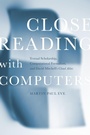
Martin Paul Eve
Close Reading with Computers
Textual Scholarship, Computational Formalism, and David Mitchell's Cloud Atlas
Book
06/2019
Stanford University Press
€121.50
Shipment within 15-20 days
Person
Martin Paul Eve is Professor of Literature, Technology, and Publishing at Birkbeck College, University of London. He is a winner of the 2019 Philip Leverhulme Prize, sponsored by The Leverhulme Trust
Content
Introduction: Close Reading, Computers, and Cloud Atlas
1. The Contemporary History of the Book
2. Reading Genre Computationally
3. Historical Fiction and Linguistic Mimesis
4. Interpretation
Conclusion
1. The Contemporary History of the Book
2. Reading Genre Computationally
3. Historical Fiction and Linguistic Mimesis
4. Interpretation
Conclusion

