

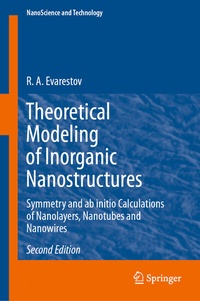
Theoretical Modeling of Inorganic Nanostructures
Description

This book summarizes the state of the art in the theoretical modeling of inorganic nanostructures. Extending the first edition, published in 2015, it presents applications to new nanostructured materials and theoretical explanations of recently discovered optical and thermodynamic properties of known nanomaterials. It discusses the developments in theoretical modeling of nanostructures, describing fundamental approaches such as symmetry analysis and applied calculation methods. The book also examines the theoretical aspects of many thermodynamic and the optical properties of nanostructures. The new edition includes additional descriptions of the theoretical modeling of nanostructures in novel materials such as the V2O5 binary oxide, ZnS, CdS, MoSSe and SnS2.
More details
Other editions
Additional editions
Person
Robert A. Evarestov graduated from St. Petersburg State University with a degree in Theoretical Physics in 1960, and received his Ph.D. in Theoretical Physics from the same university in 1964 (supervisor Prof. Marija Petrashen, coworker of Academician V.A.Fock). In 1977 he completed his postdoctoral degree with a thesis on "Molecular models in the electronic structure theory of crystals." He has worked at the Department of Quantum Chemistry of St. Petersburg State University since 1968, and became a Professor there in 1979. From 1990 to 1994, he was Director of the Chemistry Institute, and from 1994 to 1998 he was the First Vice Rector of St. Petersburg State University. Since 1999 he has been the Head of the university's Department of Quantum Chemistry.
His research interests include symmetry of crystalline solids (his monograph Site Symmetry in Crystals was published by Springer in 1993, second edition in 1997), the application of quantum chemistry methods to perfect and defective crystals (his book Quantum Chemistry of Solids was published by Springer in 2007, second edition in 2012), and symmetry and quantum chemical study of monoperiodic nanostructures (nanotubes, nanowires). The first edition of his monograph Theoretical Modeling of Inorganic Nanostructures: Symmetry and ab-initio Calculations of Nanolayers, Nanotubes and Nanowires was published by Springer in 2015.
He is a Foreign Member of the Latvian Academy of Science (from 2005), and a recipient of the Humboldt Foundation Award (1998). He has published over 300 papers indexed in WOS and has been cited more than 3500 times. His Hirsh index is 31 (Web of Science data, January 2020).Content
