

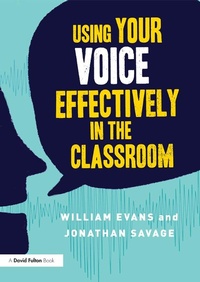
Using Your Voice Effectively in the Classroom
Published on 12. October 2017
168 pages
978-1-317-23283-4 (ISBN)
Description

As a teacher, you are required to use your voice more than any other professional! Your voice is the most important tool that you have at your disposal to inspire students and help them learn effectively. Using your voice powerfully and effectively is the key to becoming an outstanding teacher. Developing a strong vocal presence in the classroom influences everything else that you do, helping to build your confidence and positive interactions with students. If you neglect your voice as a teacher, you are more likely to end up stressed, have a shorter teaching career and suffer from vocal health issues.
This book explores how you can learn to use your voice effectively in the classroom, linking together basic theory about vocal production and teacher identity with numerous practical tips, tricks and exercises which you can apply to your own teaching. Covering all aspects of the voice and its employment both inside the classroom and its importance to daily life outside, the book tackles topics such as:
the philosophy of the voice, how it develops and its role in creating your own identity
the mechanical and mental skills required to develop a teaching voice
acquiring confidence and an exploration of body language to underpin your vocal production
the relationship between the student's voice and the teacher's voice
the importance of practice for a teacher
the practicality of caring for one's voice.
Using Your Voice Effectively in the Classroom offers a much-needed exploration and thorough examination of the voice in the classroom and will be an indispensable guide for trainee teachers, as well as valuable reading for all practising teachers.
This book explores how you can learn to use your voice effectively in the classroom, linking together basic theory about vocal production and teacher identity with numerous practical tips, tricks and exercises which you can apply to your own teaching. Covering all aspects of the voice and its employment both inside the classroom and its importance to daily life outside, the book tackles topics such as:
the philosophy of the voice, how it develops and its role in creating your own identity
the mechanical and mental skills required to develop a teaching voice
acquiring confidence and an exploration of body language to underpin your vocal production
the relationship between the student's voice and the teacher's voice
the importance of practice for a teacher
the practicality of caring for one's voice.
Using Your Voice Effectively in the Classroom offers a much-needed exploration and thorough examination of the voice in the classroom and will be an indispensable guide for trainee teachers, as well as valuable reading for all practising teachers.
Reviews / Votes
"The power of our voice - as an integral part of not just what we do, but who we are - comes across throughout this informative and thought-provoking book. Starting from an investigation of sound production and the purpose of vocal sound as a powerful tool for communication, the reader is compelled to think differently about their own voice; to become more self-aware of how it is used and how it could be developed to better effect. For a teacher, this critical self-analysis of the power of our own voice is a key to effective delivery across the multitude of situations in which our varied work takes us. Its applied approach, weaving together a strong theoretical underpinning with a series of practical exercises, will be of benefit to any teacher wanting to reflect upon and develop their work and enhance their wellbeing." - Dr Alison Daubney, Senior Teaching Fellow, University of Sussex"This is an important and wide-ranging book that covers not only the use and protection of the voice, which is important for teachers as a topic in its own right, but also the ways in which teachers use their voices as key mechanisms for pedagogy. But in addition to this it also covers important areas relating to the different ways in which teachers actually find their own teaching voices, and what sorts of voice are appropriate on various occasions. These areas alone would make this book worthwhile, but what makes this book really stand out is that it also deals with the under-researched area of beginning teachers setting out to find their own voices. This is a fascinating and worthwhile subject area, and is so important in the early professional lives of all educators. This important book has something for all those who work with children and young people, and will make an important addition to the staff library of all schools and colleges."
Martin Fautley, Professor & Director of Research in Education, Birmingham City University, UK
More details
Language
English
Place of publication
London
United Kingdom
Publishing group
Taylor & Francis Ltd
Target group
College/higher education
Professional and scholarly
File size
0,65 MB
ISBN-13
978-1-317-23283-4 (9781317232834)
Copyright in bibliographic data and cover images is held by Nielsen Book Services Limited or by the publishers or by their respective licensors: all rights reserved.
Schweitzer Classification
Other editions
Additional editions

Jonathan Savage
Using Your Voice Effectively in the Classroom
Book
04/2018
Routledge
€23.88
No shipping information available
William Evans | Jonathan Savage
Using Your Voice Effectively in the Classroom
Book
10/2017
1st Edition
Routledge
€41.50
Shipment within 10-20 days
William Evans | Jonathan Savage
Using Your Voice Effectively in the Classroom
Book
10/2017
1st Edition
Routledge
€205.90
Shipment within 10-20 days
Persons
William Evans is Senior Lecturer in Education at the Faculty of Education, Manchester Metropolitan University, UK.
Jonathan Savage is Reader in Education at the Faculty of Education, Manchester Metropolitan University, UK. He is also Managing Director of UCan Play.
Jonathan Savage is Reader in Education at the Faculty of Education, Manchester Metropolitan University, UK. He is also Managing Director of UCan Play.
Content
Introduction
1. Finding Your Voice
2. Developing Your Voice
3. Your Voice and Your Pedagogy
4. Your Voice and Your Student's Learning
5. Developing an Effective Teacher Voice
6. Effective and persuasive language
7. Your voice and your body language
8. Vocal Metaphors
9. Looking After Your Voice
1. Finding Your Voice
2. Developing Your Voice
3. Your Voice and Your Pedagogy
4. Your Voice and Your Student's Learning
5. Developing an Effective Teacher Voice
6. Effective and persuasive language
7. Your voice and your body language
8. Vocal Metaphors
9. Looking After Your Voice
