

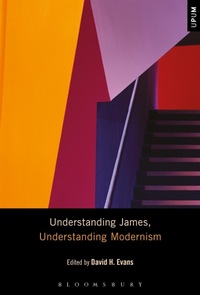
Understanding James, Understanding Modernism
1st Edition
Published on 20. April 2017
272 pages
978-1-5013-0276-3 (ISBN)
Description

Psychologist, philosopher, teacher, writer-William James stood closer than any other thinker to the center of the confluence of intellectual and artistic forces that defined the culture of modernism. The outstanding feature of this volume lies in its intent to investigate James's influence on both American and International Modernism. It provides, on the one hand, a multifaceted introduction to students of history, philosophy, and culture, and on the other, a compendium of some of the most up-to-date thinking on this central figure.
James's first book, Principles of Psychology (1890) immediately established James as the leading psychologist of his time, at a moment in history when psychology seemed to offer the promise of finding some definitive answers to eternal philosophical conundra. James's innovations would register a clear effect on much modernist art, most evidently in the stylistic prose experiments of James Joyce, Virginia Woolf, and their imitators. James's tentative skepticism concerning the concept of consciousness as such, and the post-Cartesian ego that was its foundation, also anticipates the questioning of the subject that would be the theme of much modern, and indeed postmodern thought.
The contributors to this volume explore James's most essential texts as well as his influence on contemporary writers, artists, and thinkers. The final section is a glossary of James's key terms, with entries written by leading experts.
James's first book, Principles of Psychology (1890) immediately established James as the leading psychologist of his time, at a moment in history when psychology seemed to offer the promise of finding some definitive answers to eternal philosophical conundra. James's innovations would register a clear effect on much modernist art, most evidently in the stylistic prose experiments of James Joyce, Virginia Woolf, and their imitators. James's tentative skepticism concerning the concept of consciousness as such, and the post-Cartesian ego that was its foundation, also anticipates the questioning of the subject that would be the theme of much modern, and indeed postmodern thought.
The contributors to this volume explore James's most essential texts as well as his influence on contemporary writers, artists, and thinkers. The final section is a glossary of James's key terms, with entries written by leading experts.
Reviews / Votes
Understanding James, Understanding Modernism collects into a single volume an impressive set of essays by both well-established and emerging experts guiding us through James's entire philosophy, viewed through the prism of literary and cultural modernism. Many of James's well-known ideas-including pragmatism, pluralism, philosophical temperaments, radical empiricism, stream of thought, and the will to believe-are illuminated in strikingly novel ways in this context. It turns out that modernism, emphasizing temporality, change, and the 'flux' of reality in contrast to fixity, abstraction, and unchanging essences, captures much of what is central to James's basic pragmatist, pluralist, and empiricist approach. The book offers an astonishing breadth and coverage, a plurality of perspectives on his thought that James himself would have admired. * Sami Pihlstroem, Professor of Philosophy of Religion, University of Helsinki, Finland * With impressive scholarship, these lucid and probing essays trace William James's protean work from book to book and remind us of what an original modern thinker he was. They offer a fresh and convincing account of his intersections with boldly innovative modern writers, beginning with his own brother Henry. * Morris Dickstein, Distinguished Professor Emeritus of English, CUNY Graduate Center, USA * This volume is an insightful and accessible entry into William James's thought, creating new perspectives inside a mapping of the essential ideas. It shows precisely how James translated experience into modernity, negotiating between the claims of science and opening pluralistic worlds in thought and practice. The strength of the collection is the way it addresses the entire range of James's works and offers a wealth of multiple relations between James, modernism and literature. * Jeremy Carrette, Professor of Philosophy, Religion & Culture, University of Kent, UK * Evans (English, Dalhousie Univ., Canada) has assembled an impressive collection of original essays examining the varied contributions of philosopher, psychologist, and religious thinker William James (1842-1910) to the project of modernism. James's reflections on the nature of consciousness, religious experience, time, and meaning profoundly affected a range of artists, writers, and social and philosophical theorists-including his brother Henry James, W. E. B. Du Bois, Gertrude Stein, Robert Frost, and Henri Bergson. Essays on Marcel Proust, Frost, Stein, and Wallace Stevens demonstrate how significantly James's thought shaped and unshaped modernist culture. Emphasis is on James's relation to modernist endeavors in the US, the UK, France, and Italy. Students of the history of ideas will particularly value part 3, "A Glossary," which includes essays on 14 terms and concepts key to James's thinking, including habit, morality, pluralism, pragmatism, pure experience, and stream of thought. This volume offers an accessible map of James's relation to modernist aesthetics and intellectual projects and thus provides a rich base for further inquiries into modernism, aesthetics, philosophy, and religion. Summing Up: Highly recommended. Lower-division undergraduates through faculty. * CHOICE * If the other volumes [in the series] are anywhere near as good as this one, they are a bargain ... Reading through the volume with its very high and consistent standards of cogency and clarity made me see the work as a really important-and lively-re-assessment of modernism itself, and a book I can no longer do without. Understanding James, Understanding Modernism is a robust defense of pragmatism, pluralism, and religious experience, and the entire volume is merrily complicit in what Evans calls 'the defenestration of metaphysics that would become the central philosophical project of the twentieth century.' * The New England Quarterly *More details
Series
Edition
1. Auflage
Language
English
Place of publication
New York
United States
Publishing group
Bloomsbury Publishing PLC (Digital)
Target group
Professional and scholarly
ISBN-13
978-1-5013-0276-3 (9781501302763)
Copyright in bibliographic data and cover images is held by Nielsen Book Services Limited or by the publishers or by their respective licensors: all rights reserved.
Schweitzer Classification
Other editions
Additional editions
David H. Evans
Understanding James, Understanding Modernism
Book
11/2018
Bloomsbury Academic USA
€63.39
Shipment within 15-20 days
David H. Evans
Understanding James, Understanding Modernism
Book
04/2017
Bloomsbury Academic USA
€195.30
Shipment within 15-20 days
Person
David H. Evans is Associate Professor of English at Dalhousie University, Canada. He is the author of William Faulkner, William James, and the American Pragmatic Tradition (2008) and co-editor of America and Violence, a special issue of the Canadian Review of American Studies (2008).
Content
Series Preface
List of Abbreviations
Introduction: Unstiffening All Our Theories: William James and the Culture of Modernism
David H. Evans, Dalhousie University, Canada
Part 1: Conceptualizing James
1 The Character of Consciousness
Owen Flanagan and Heather Wallace, Duke University, USA
2 Redeeming the Wild Universe: William James's Will to Believe
John J. Stuhr, Emory University, USA
3 The Psychology of Religion: William James's The Varieties of Religious Experience
Michael Bacon, Royal Holloway, University of London, UK
4 The Human Contribution: James and Modernity in Pragmatism and The Meaning of Truth
Alan Malachowski, Stellenbosch University, South Africa
5 "Ever Not Quite!": William James's A Pluralistic Universe
Barry Allen, McMaster University, Canada
6 James's Radical Empiricism
James Campbell, University of Toledo, USA
Part 2: James and Modernist Culture
7 James and Bergson: Fighting the Beast Intellectualism with Metaphors
Rosa Slegers, Babson College, USA
8 William James, Henry James and the Turn Toward Modernism
Jill Kress Karn, Villanova University, USA
9 "Never Reject Anything. Nothing Has Been Proved": William James and Gertrude Stein on Time and Language
David H. Evans, Dalhousie University, Canada
10 The Varieties of Robert Frost's Religious Experience
Mark Richardson, Doshisha University, Japan
11 Notes Toward the Specious Present: James and Stevens
Kristen Case, University of Maine at Farmington, USA
12 Modernist Figures and James's Pluralistic Universe
Patricia Rae, Queen's University, Canada
13 William James's Stream of Consciousness and the River of the Unconscious in Joyce and Proust
Gian Balsamo, Stanford University, USA
14 "That skilful but slow-moving arranger": Habit in James and Proust
Lisi Schoenbach, University of Tennessee, USA
15 William James and Italian Pragmatism
Giovanni Maddalena, University of Molise, Italy, and Michela Bella, Universita degli Studi Roma Tre, Italy
16 James's Pluralism and the Problems of Modern Political and Social Thought
Robert Danisch, University of Waterloo, Canada
Part 3: Glossary
17 James on Chance and Indeterminacy
Kyle Bromhall, University of Guelph, Canada
18 James on Habit
Lisi Schoenbach, University of Tennessee, USA
19 James on Morality
David Rondel, University of Nevada, USA
20 James on Philosophical Temperaments
Tom Donaldson
21 James on Pluralism
Susan Dieleman, University of Saskatchewan, Canada
22 James on Pragmatism
Colin Koopman, University of Oregon, USA
23 James on Psychical Phenomena
Ermine Algaier IV, Harvard University, USA
24 James on Pure Experience
Joel Krueger, University of Exeter, UK
25 James on Radical Empiricism
Loren Goldman, University of Pennslyvania, USA
26 James on the Reinstatement of the Vague
Rosa Slegers, Babson College, USA
27 James on Religious Experience
Michael Bacon, Royal Holloway, University of London, UK
28 James on the Stream of Thought
Alexis Dianda, The New School, USA
29 James on Time and the Specious Present
David H. Evans, Dalhousie University, Canada
30 James on the Will to Believe
Mark Richardson, Doshisha University, Japan
Notes on Contributors
Index
List of Abbreviations
Introduction: Unstiffening All Our Theories: William James and the Culture of Modernism
David H. Evans, Dalhousie University, Canada
Part 1: Conceptualizing James
1 The Character of Consciousness
Owen Flanagan and Heather Wallace, Duke University, USA
2 Redeeming the Wild Universe: William James's Will to Believe
John J. Stuhr, Emory University, USA
3 The Psychology of Religion: William James's The Varieties of Religious Experience
Michael Bacon, Royal Holloway, University of London, UK
4 The Human Contribution: James and Modernity in Pragmatism and The Meaning of Truth
Alan Malachowski, Stellenbosch University, South Africa
5 "Ever Not Quite!": William James's A Pluralistic Universe
Barry Allen, McMaster University, Canada
6 James's Radical Empiricism
James Campbell, University of Toledo, USA
Part 2: James and Modernist Culture
7 James and Bergson: Fighting the Beast Intellectualism with Metaphors
Rosa Slegers, Babson College, USA
8 William James, Henry James and the Turn Toward Modernism
Jill Kress Karn, Villanova University, USA
9 "Never Reject Anything. Nothing Has Been Proved": William James and Gertrude Stein on Time and Language
David H. Evans, Dalhousie University, Canada
10 The Varieties of Robert Frost's Religious Experience
Mark Richardson, Doshisha University, Japan
11 Notes Toward the Specious Present: James and Stevens
Kristen Case, University of Maine at Farmington, USA
12 Modernist Figures and James's Pluralistic Universe
Patricia Rae, Queen's University, Canada
13 William James's Stream of Consciousness and the River of the Unconscious in Joyce and Proust
Gian Balsamo, Stanford University, USA
14 "That skilful but slow-moving arranger": Habit in James and Proust
Lisi Schoenbach, University of Tennessee, USA
15 William James and Italian Pragmatism
Giovanni Maddalena, University of Molise, Italy, and Michela Bella, Universita degli Studi Roma Tre, Italy
16 James's Pluralism and the Problems of Modern Political and Social Thought
Robert Danisch, University of Waterloo, Canada
Part 3: Glossary
17 James on Chance and Indeterminacy
Kyle Bromhall, University of Guelph, Canada
18 James on Habit
Lisi Schoenbach, University of Tennessee, USA
19 James on Morality
David Rondel, University of Nevada, USA
20 James on Philosophical Temperaments
Tom Donaldson
21 James on Pluralism
Susan Dieleman, University of Saskatchewan, Canada
22 James on Pragmatism
Colin Koopman, University of Oregon, USA
23 James on Psychical Phenomena
Ermine Algaier IV, Harvard University, USA
24 James on Pure Experience
Joel Krueger, University of Exeter, UK
25 James on Radical Empiricism
Loren Goldman, University of Pennslyvania, USA
26 James on the Reinstatement of the Vague
Rosa Slegers, Babson College, USA
27 James on Religious Experience
Michael Bacon, Royal Holloway, University of London, UK
28 James on the Stream of Thought
Alexis Dianda, The New School, USA
29 James on Time and the Specious Present
David H. Evans, Dalhousie University, Canada
30 James on the Will to Believe
Mark Richardson, Doshisha University, Japan
Notes on Contributors
Index
